Spiritual & Myth

Geburah Dream Meaning

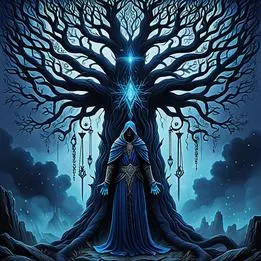
The fifth Sephirah on the Kabbalistic Tree of Life, representing divine severity, judgment, strength, and the power to limit and purify.

Common Appearances & Contexts

Context Emotion Interpretation
Facing a judge Anxious Confronting personal accountability.
Breaking an object Resolute Necessary destruction of old.
A strict teacher Intimidated Internalized need for discipline.
A cleansing fire Awed Purification through ordeal.
Setting a boundary Empowered Asserting personal strength.
A warrior figure Respectful Mobilizing inner defenses.
A crumbling wall Relieved Release of rigid constraints.
Receiving criticism Humbled Integrating harsh truth.
A sharp blade Focused Precision in cutting away.
A storm Overwhelmed Overpowering force of change.
A scale balancing Measured Weighing actions and consequences.
Pruning a tree Purposeful Strategic removal for growth.

Interpretive Themes

Cultural Lenses

Jungian Perspective

View Context →

Represents the archetype of the Warrior or the Senex (strict father), symbolizing the ego's need for structure, discipline, and the confrontation with the Shadow to achieve individuation.

Freudian Perspective

View Context →

May symbolize the superego's harsh, punishing function, internalized parental authority, or repressed aggressive drives seeking expression through dreams of conflict or destruction.

Gestalt Perspective

View Context →

The dreamer's own capacity for judgment or severity, projected onto a figure or force. Asks: 'What part of me is this strict judge or powerful destroyer?'

Cognitive Perspective

View Context →

A mental schema for processing concepts of justice, boundaries, and power. The dream rehearses or processes situations requiring decisive action, conflict resolution, or moral judgment.

Evolutionary Perspective

View Context →

May tap into ancient adaptive mechanisms for enforcing social norms (punishing cheaters), establishing dominance hierarchies, or the fight-or-flight response to threats, ensuring group cohesion and survival.

Middle Eastern Perspective

View Context →

Rooted in Kabbalah, Geburah (Din) is the left pillar of severity, balancing Chesed's mercy. Historically, it connects to divine wrath in Abrahamic faiths; modernly, it signifies ethical rigor and spiritual discipline.

European Perspective

View Context →

Historically linked to concepts of divine right, feudal justice, and the stern father-god. In modern esoteric traditions (e.g., Hermetic Qabalah), it is the sphere of Mars, representing dynamic energy and will.

Modern Western Perspective

View Context →

Often secularized as the psychological principle of 'tough love,' assertiveness training, boundary-setting, and the necessary destruction of outdated systems or beliefs for personal or societal progress.

Global/Universal Perspective

View Context →

A cross-cultural archetype of the punishing deity (e.g., Kali, Sekhmet), the just king, or the force of nature that clears the old to make way for the new, representing a universal cycle.

East Asian Perspective

View Context →

Resonates with the Confucian principle of Yi (righteousness/justice) and the Legalist philosophy of strict laws. In modern context, it aligns with disciplined self-cultivation (e.g., in martial arts) and social order.

South Asian Perspective

View Context →

Parallels Shiva as the destroyer within the Trimurti, Kali's fierce aspect, and the karmic law of cause and effect. It signifies the destruction of illusion (Maya) and the austerity of spiritual practice.

African Perspective

View Context →

Connects to orishas like Ogun (Yoruba), god of iron, war, and justice, or the concept of divine retribution. In modern context, it relates to struggles for liberation, justice, and breaking oppressive chains.

AI-Powered

Interpret Your Full Dream

Beyond this symbol, every dream carries a unique story. Share your dream for a personalized AI-powered interpretation.