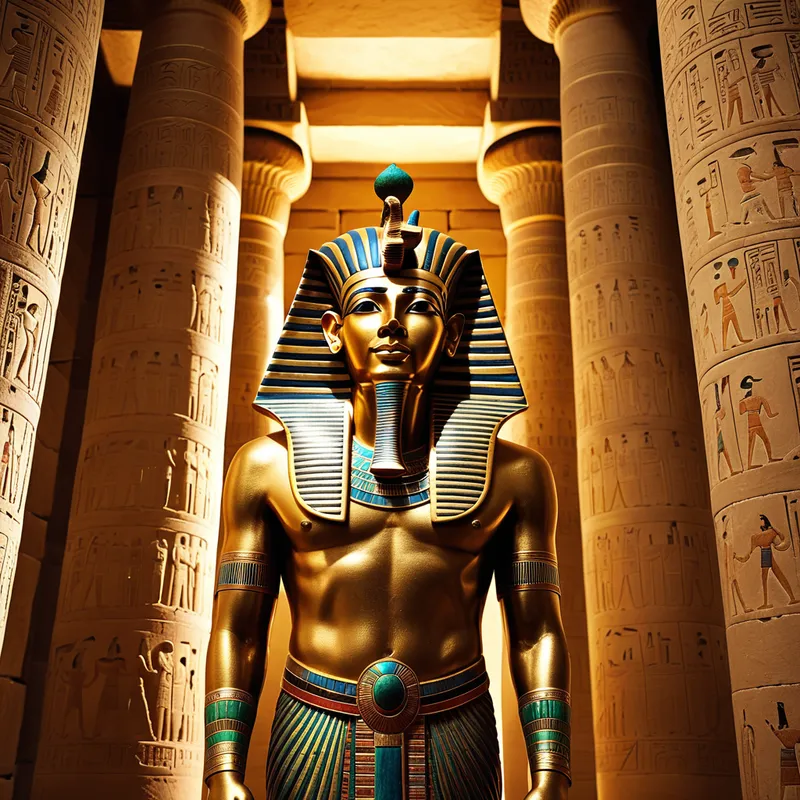
Pharaoh Myth Meaning & Symbolism
The Pharaoh is the living god-king, the human vessel for divine order, tasked with maintaining cosmic balance against the ever-present threat of primordial chaos.
The Tale of Pharaoh
Hear now the tale not of a man, but of a pillar. In the time when the black earth of Kemet was born from the waters of Nun, and the sun first climbed the ladder of the sky, the gods walked close to the world. But they were too vast, their light too pure, to dwell directly in the mud and the reed. The world needed a hinge, a living knot to bind the divine breath to the earthly clay.
And so was born the office, the terrible and glorious weight of the Per-aa. He is crowned not in a simple ceremony, but in a mystery. In the dim, incense-heavy air of the temple's inner sanctum, before the statue of Amun, the candidate is anointed. The Uraeus, the fire-spitting serpent, is fixed to his brow. The Nekhbet vulture spreads her wings upon his head. He is given the crook to shepherd his people, and the flail to chastise disorder. The priest whispers the sacred names, and in that moment, a transubstantiation occurs. The man recedes; the office floods in. He is now the Horus-on-Earth, the Son of Ra.
His daily life is the ritual. At dawn, he stands on the palace balcony as the sun breaches the horizon, and for a breath, he is Ra, his ka—his vital force—mingling with the solar barque to help repel the serpent Apep. He offers Ma’at—not just justice, but the fundamental principle of truth, order, and cosmic balance—to the gods. With each offering of incense, each libation of water, he stitches the fabric of reality a little tighter against the ever-gnawing void of Isfet.
The conflict is eternal and invisible. It is the creeping doubt in a drought, the whisper of rebellion in a distant nome, the sickness that slips through the city walls. His body, the body of the land, feels every tremor of chaos. In the Sed Festival, when his strength is tested after thirty years, he must run a ritual course, proving his vitality is undimmed, that the hinge between worlds has not rusted. He does not fight a dragon in a lair; he fights entropy in every granary, deceit in every court, and the silent, patient waiting of the desert, which is the face of Nun, longing to reclaim its own.
His resolution is not a final victory, but a sustained tension. A good Pharaoh dies having kept the balance. His final act is the greatest ritual of all: his mummification and journey through the Duat. In the tomb, he becomes Osiris, the king of the dead, while his heir becomes the new Horus. The office, the pillar, remains unbroken. The man has passed, but the function is eternal. The Two Lands breathe, held in the sacred, unceasing grip of Ma’at.
Cultural Origins & Context
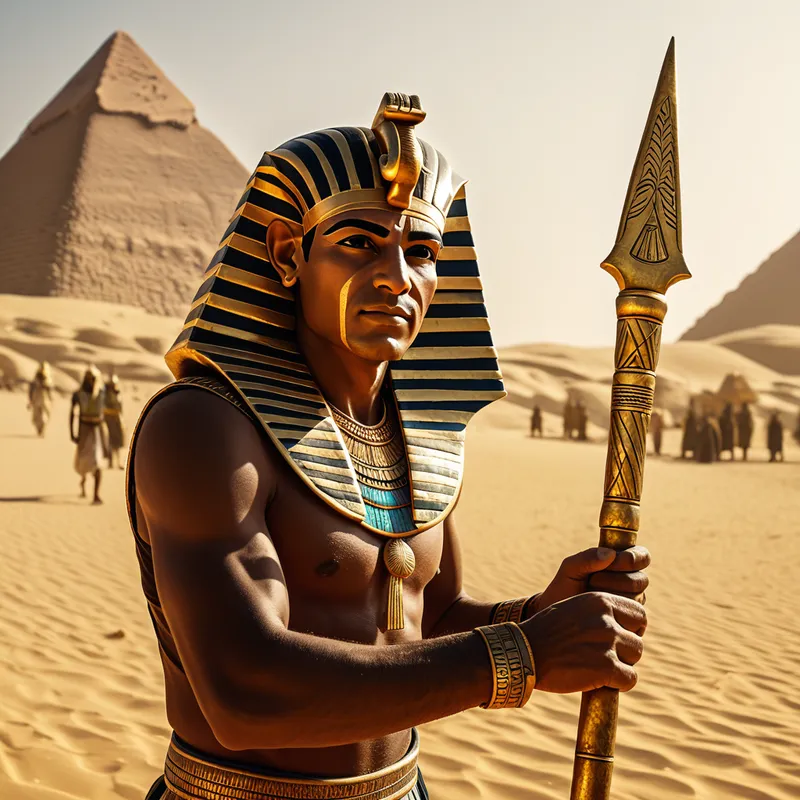
The myth of Pharaoh is not a single story with a beginning and end, but a living, breathing ideology woven into the very fabric of ancient Egyptian civilization for over three millennia. It emerged from the primal need to explain and control the environment. The Nile’s predictable, life-giving flood and the relentless, sterile desert created a worldview obsessed with the balance between fertile order and lethal chaos. Pharaoh was the human-engineered solution to this cosmic problem.
This myth was passed down not by bards around a fire, but through an immense, state-sponsored apparatus of stone and ritual. It was carved on temple walls in eternal hieroglyphs, performed daily in temple liturgies by hereditary priests, enacted in grand state festivals like Opet or Sed, and codified in the Pyramid Texts, Coffin Texts, and finally the Book of the Dead. The primary tellers were the priesthood and the royal court itself; the myth was both theology and political propaganda, justifying the absolute authority of the king as the sole guarantor of the world’s continued existence. Its societal function was total: it provided cosmological meaning, political stability, and a template for every individual’s own journey through life and into the afterlife, with Pharaoh as the ultimate successful initiate.
Symbolic Architecture
Psychologically, the Pharaoh is the ultimate symbol of the conscious ego in its most developed and burdened form. He represents the part of the psyche tasked with establishing and maintaining order, identity, and structure—the "I" that says "this is who I am, and this is how my world shall be."
The Pharaoh is not the individual self, but the Self-as-Function: the psychic organ of governance, mediating between the inner heavens of potential and the inner earth of manifestation.
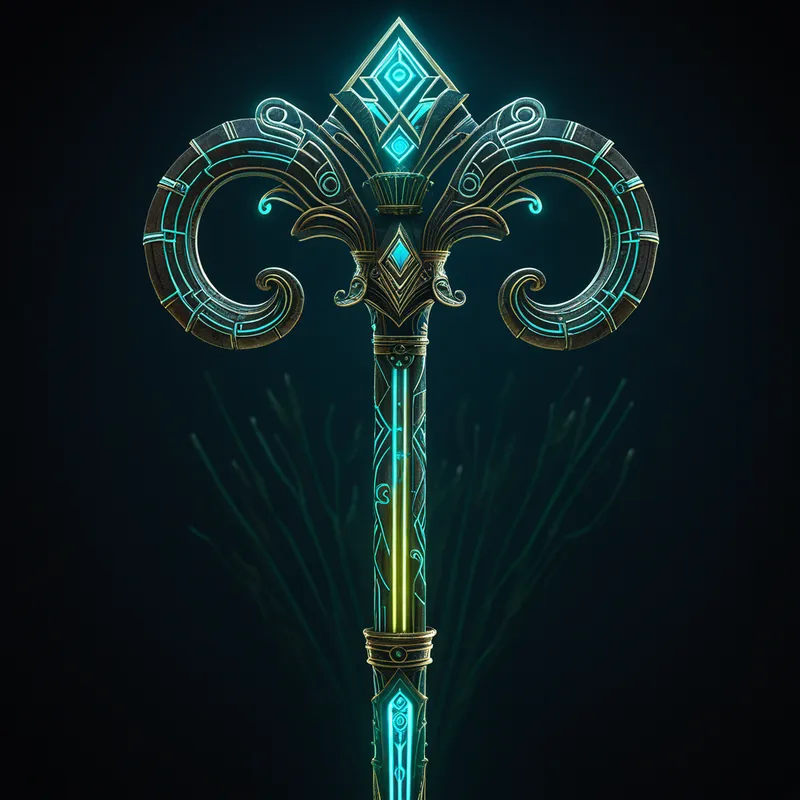
The crown is the weight of consciousness itself. The crook and flail symbolize the dual mandate of the ego: to nurture and integrate (the crook) and to discipline and reject (the flail) the contents of the unconscious. The eternal struggle against Isfet is the ego’s endless battle against the disintegrating forces of the unconscious—repressed memories, chaotic emotions, irrational impulses, and the sheer, overwhelming vastness of the unknown within. Pharaoh’s divinity signifies that a healthy, functioning ego is not a tyrant, but a servant of a higher, transpersonal order (the Self). His mortality is the humbling recognition that no conscious structure is permanent; it must eventually be surrendered and renewed.
The Dreamer's Resonance
When the archetype of the Pharaoh appears in modern dreams, it rarely manifests as a literal Egyptian king. Instead, one dreams of being in a position of immense, solitary responsibility—a CEO unable to save a failing company, a parent desperately holding a crumbling family together, or simply oneself trying to "keep it all together" under immense pressure.
The somatic feeling is one of crushing weight, rigidity in the shoulders and jaw, and a profound fatigue that is more existential than physical. Psychologically, the dreamer is experiencing what the Egyptians called the "burden of Ma’at." The conscious ego is over-identified with its ruling function. It has taken on too much responsibility, believing it alone must hold back chaos, often by sheer force of will. This can indicate a life where one is performing a role—the perfect professional, the flawless caregiver, the unshakeable leader—at the expense of the authentic, flawed, and mortal human beneath the crown. The dream is a signal that the "office" is consuming the "person," and the connection to the deeper, nourishing waters of the unconscious (the Nile) has been severed in the effort to control the desert.
Alchemical Translation
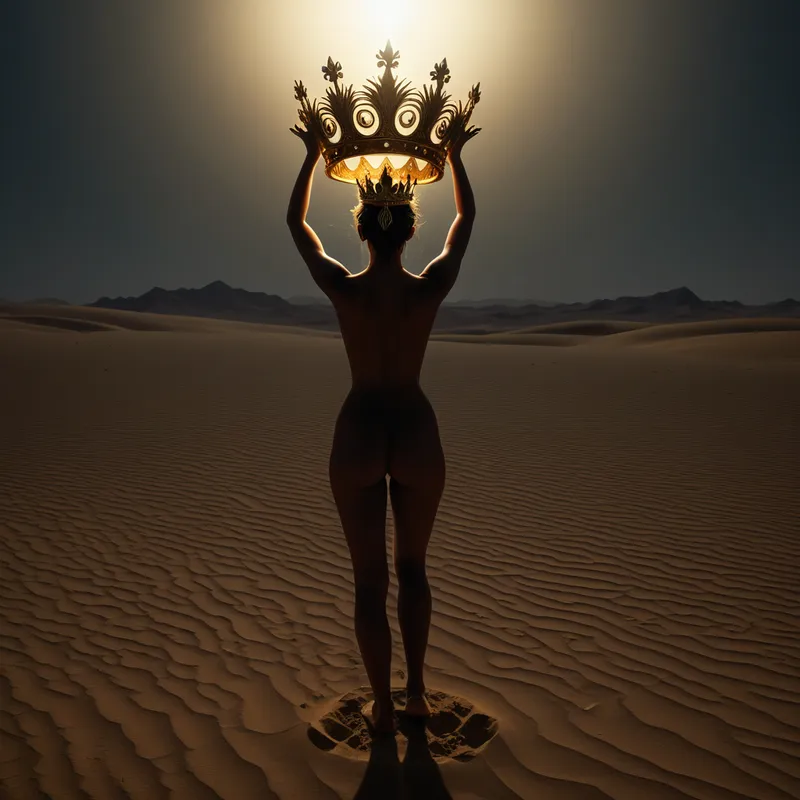
The individuation process modeled by the Pharaoh myth is not about becoming a tyrannical ruler of the psyche, but about learning the sacred art of divine kingship. It is the alchemical transmutation of the ego from a fragile, narcissistic identity into a vessel capable of channeling a greater wholeness.
The first stage is the "Coronation"—the conscious assumption of responsibility for one’s own inner kingdom. This means building a stable ego: setting boundaries (the flail), cultivating talents (the crook), and establishing a sense of self (the crown). However, the perilous, middle stage is the "Reign," where the ego, intoxicated by its own power, may mistake itself for the actual god. It tries to suppress all chaos (shadow), leading to rigidity, burnout, and a spiritual drought.
The true alchemy occurs in the "Sed Festival": the ritual humiliation and renewal of the king. For the modern individual, this is the conscious descent—allowing the worn-out, over-identified ego-structure to be challenged, to fail, to feel its mortality.
This is the encounter with the shadow (the rebellious nomes, the serpent Apep). One must "run the course" not with perfect control, but with acknowledged vulnerability, to prove the vitality comes not from the ego’s strength alone, but from its connection to the deeper Self (Ra, Amun). The final translation is the "Osirian Transformation": the death of the ego as the sole ruler and its rebirth as an integrated part of a larger psychic ecosystem. The individual no longer is the Pharaoh; they contain the Pharaoh-as-function, alongside the nourishing Osiris, the transformative Isis, the chaotic Set. They become the balanced Two Lands, where order and chaos, consciousness and unconsciousness, exist in a dynamic, sacred tension. The pillar then stands not by its own might, but because it is perfectly placed between the heaven of potential and the earth of being.
Associated Symbols
Explore related symbols from the CaleaDream lexicon: