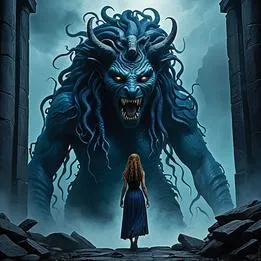
Gorgon Dream Meaning
A monstrous female figure from Greek mythology whose gaze turns onlookers to stone, representing primal terror, forbidden knowledge, and the power of the unconscious.
Common Appearances & Contexts
| Context | Emotion | Interpretation |
|---|---|---|
| Being pursued | Panic | Overwhelming threat approaches. |
| Locking eyes | Horror | Moment of fatal connection. |
| Seeing reflection | Dread | Self as monster revealed. |
| Hiding from gaze | Terror | Avoiding transformative truth. |
| Holding mirror | Awe | Power to deflect petrification. |
| Snake hair moving | Revulsion | Chaotic, living threat. |
| Stone statues around | Despair | Evidence of past victims. |
| Beheading the Gorgon | Triumph | Heroic overcoming of terror. |
| Becoming the Gorgon | Rage | Embodying monstrous power. |
| Gorgon weeping | Pity | Monster's hidden vulnerability. |
| Gorgon in modern city | Disorientation | Ancient terror intrudes present. |
| Gorgon's whisper | Fascination | Forbidden knowledge offered. |
Interpretive Themes
Cultural Lenses
Jungian Perspective
View Context →Archetype of the Terrible Mother or anima's destructive aspect. Represents the petrifying power of the unconscious when confronted directly, a shadow figure that must be integrated rather than destroyed for wholeness.
Freudian Perspective
View Context →Symbol of castration anxiety and fear of the devouring/monstrous feminine. The petrifying gaze may represent sexual terror, with snakes symbolizing phallic danger and the Medusa head representing female genitalia.
Gestalt Perspective
View Context →Projection of one's own 'stony' or petrified aspects—emotional numbness, rigidity, or inability to change. The dreamer is both the gazer and the gazed-upon, confronting self-created paralysis.
Cognitive Perspective
View Context →Mental schema for overwhelming, inescapable threat that triggers freeze response. May represent cognitive rigidity ('stuck' thinking) or a hyper-vigilant threat-detection system fixated on a terrifying stimulus.
Evolutionary Perspective
View Context →Amplified threat-detection symbol combining primal fears: snake phobia (hair), direct eye contact (confrontation), and paralysis response. Represents an ultimate survival threat triggering deep freeze instinct.
European Perspective
View Context →Rooted in Greek myth as a guardian of sacred, forbidden spaces. Medieval Christian reinterpretation as demonic feminine, Renaissance symbol of tragic beauty, Romantic emblem of sublime terror.
Modern Western Perspective
View Context →Reclaimed as feminist icon of justified rage against patriarchal violation. Symbol of trauma survival, the 'monstrous feminine' in horror media, and a metaphor for social petrification (cancel culture, stigma).
Middle Eastern Perspective
View Context →Parallels to Lamia or Lilith—child-stealing female demons. In some traditions, the 'evil eye' concept mirrors the petrifying gaze as a curse from envious or malicious looking.
South Asian Perspective
View Context →Echoes in Kali's terrifying aspect or Rakshasi demons. The gaze may align with darshan (sacred sight)—here inverted to destructive vision. Snakes connect to kundalini energy gone awry.
East Asian Perspective
View Context →Resonates with Jiangshi (hopping vampire) paralysis or Nue (chimera) terror. The petrifying gaze may reflect concept of 'killing intent' or the danger of direct confrontation with imbalanced yin (dark feminine) energy.
African Perspective
View Context →Parallels to Aje (Yoruba witch) with transformative gaze, or Mami Wata's dangerous beauty. The symbol may represent ancestral wrath or the terrifying aspect of earth goddesses when desecrated.
Global/Universal Perspective
View Context →Cross-cultural motif of the deadly gaze (basilisk, cockatrice, Evil Eye). Represents universal human fear of visual confrontation with ultimate power, taboo, or one's own mortality reflected in another's eyes.
Interpret Your Full Dream
Beyond this symbol, every dream carries a unique story. Share your dream for a personalized AI-powered interpretation.