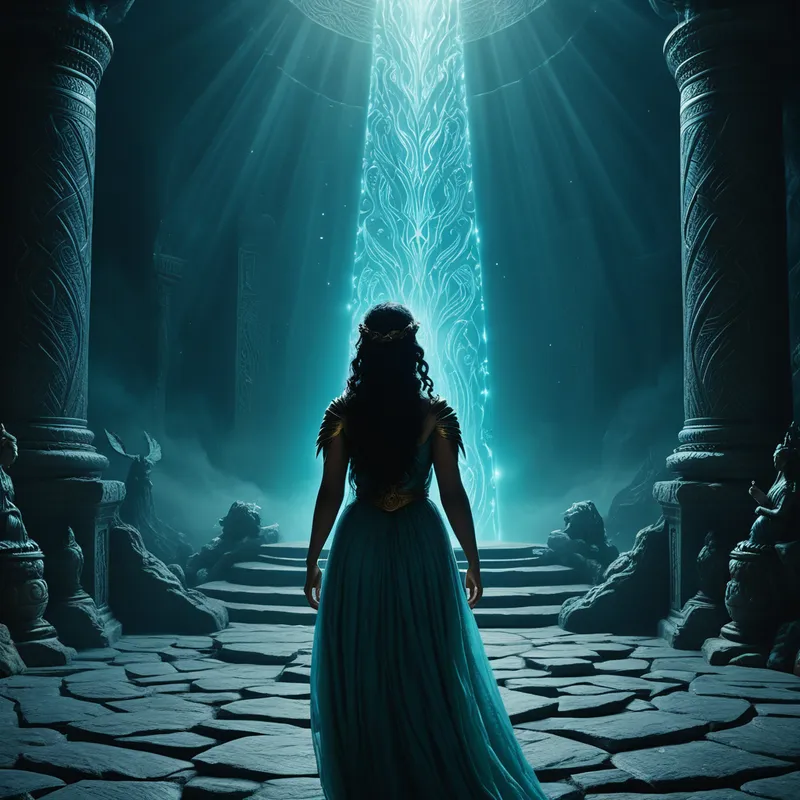
Amaterasu's Cave
The Shinto myth where the sun goddess Amaterasu retreats into a cave, casting the world into darkness until tricked out by other deities.
The Tale of Amaterasu's Cave
The world was young, and the light of the sun goddess Amaterasu was a constant, nurturing presence. Her radiance sustained the rice, warmed the waters, and brought order to the cycles of life. Yet, this celestial order was shattered by a profound transgression. Her brother, the storm god Susanoo, in a fit of chaotic rage, defiled her sacred rice fields, hurled a flayed heavenly pony into her weaving hall, and killed one of her attendants. This was not mere mischief; it was a violation of the sacred contract of care, a desecration of her divine domain and the life she fostered.
Wounded not in body, but in spirit, Amaterasu retreated. The world watched as she withdrew into the Ama-no-Iwato, sealing the entrance with a mighty stone. With her, the sun itself vanished. The universe was plunged into an unending, frigid night. The Yaoyorozu no Kami gathered outside the cave, their celestial forms dimmed. Chaos reigned; crops withered, spirits wailed, and evil ran rampant in the perpetual gloom. The darkness was not merely an absence of light, but the manifestation of a divine psyche in retreat—the world’s soul had turned inward in grief and shame.
Desperation birthed ingenuity. The deities devised a plan of sacred deception, a ritual to lure the light back out. They gathered sakaki trees, adorned them with jewels, mirrors, and cloth, creating an offering of breathtaking beauty. The goddess Ame-no-Uzume performed the pivotal role. She overturned a tub before the cave entrance, climbed upon it, and began a dance of ecstatic, uninhibited abandon. Stamping her feet, she loosened her garments, dancing with such raw, joyful fervor that the eight hundred myriad deities roared with laughter.
This cacophony of life—the shaking earth, the thunderous mirth, the rhythmic stomping—pierced the silent darkness of the cave. Curious, Amaterasu cracked open the stone door. “Why do you laugh when the world is in darkness?” she asked. Ame-no-Uzume replied, “We rejoice because there is a deity more glorious than you!” As Amaterasu peered out, puzzled, the assembled gods held up the yata no kagami, the mirror they had hung upon the sakaki tree. In its polished surface, Amaterasu saw a radiant, brilliant light. Unfamiliar with her own reflection, she leaned closer, captivated by this dazzling “other.” In that moment of divine narcissism, of encountering her own essence externalized, her isolation was broken. The god Ame-no-Tajikarao, waiting in readiness, seized the opportunity. He grasped the rock door and flung it aside. Another deity stretched a sacred rope behind her, barring her return. Light flooded the world once more. Order was restored, not by force, but through a collective ritual of allure, laughter, and reflection.
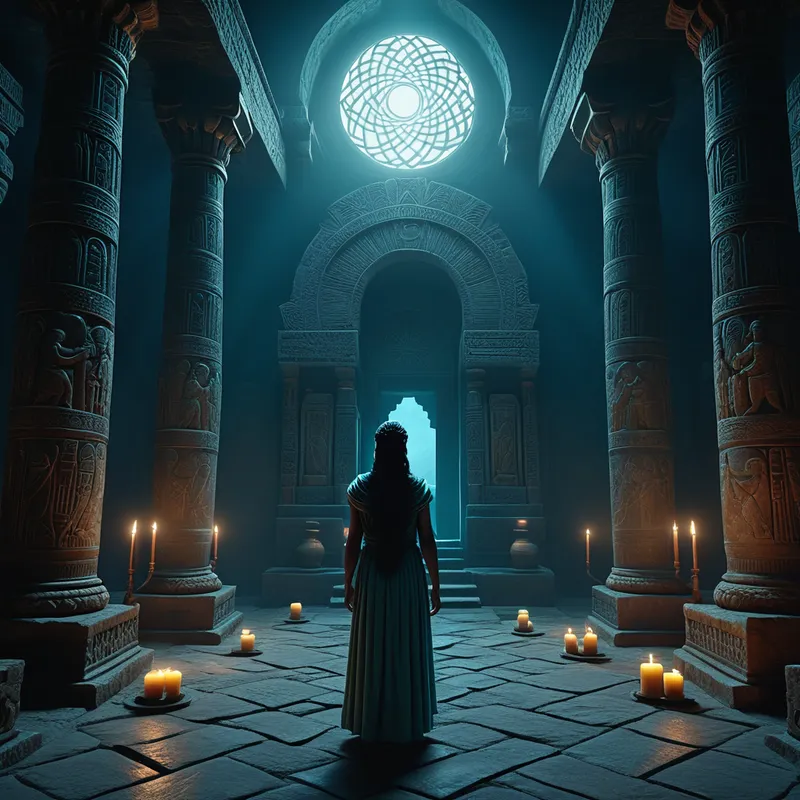
Cultural Origins & Context
This myth is central to the Kojiki (712 CE) and the Nihon Shoki (720 CE), the foundational texts of Shinto. It is not merely a story of celestial mechanics but a aetiological myth that establishes the divine origins of key elements in Japanese spiritual and imperial life. The mirror that lured Amaterasu out became one of the Three Sacred Treasures, enshrined at Ise Jingu, the most sacred Shinto site dedicated to Amaterasu. The dance of Ame-no-Uzume is considered the mythical origin of kagura, sacred dance performed to entertain and summon the kami.
The narrative underscores core Shinto values: the importance of ritual purity and the catastrophic effect of its violation (kegare), the power of communal ritual (matsuri) to restore harmony, and the interconnectedness of the natural and divine worlds. Amaterasu’s role as the ancestress of the Japanese imperial line directly links this myth to the legitimacy of the throne, grounding temporal authority in a celestial drama of darkness and restoration.
Symbolic Architecture
At its heart, the myth maps a profound psychological and cosmic process. The cave is not a prison but a sanctuary of wounded introspection. Amaterasu’s retreat represents the withdrawal of consciousness—individual or collective—when faced with unbearable violation or trauma. The world’s ensuing darkness signifies the stagnation and despair that follows when the animating, life-giving principle retreats from engagement.
The mirror held by the gods is the ultimate symbol of conscious recognition. Amaterasu does not recognize her own light until it is reflected back to her by the community. The self, in deep isolation, cannot see itself; it requires the “other” of the mirror—be it art, relationship, or ritual—to witness and call forth its own essence.
The resolution is alchemical. It does not come from an apology from Susanoo or a forceful extraction. It emerges from a collective performance so vibrant, so full of embodied life (Ame-no-Uzume’s dance) and reflected brilliance (the mirror), that it sparks curiosity and draws the hidden self back into the world. Laughter here is not mockery but the sound of life force reasserting itself, breaking the spell of solemn despair.
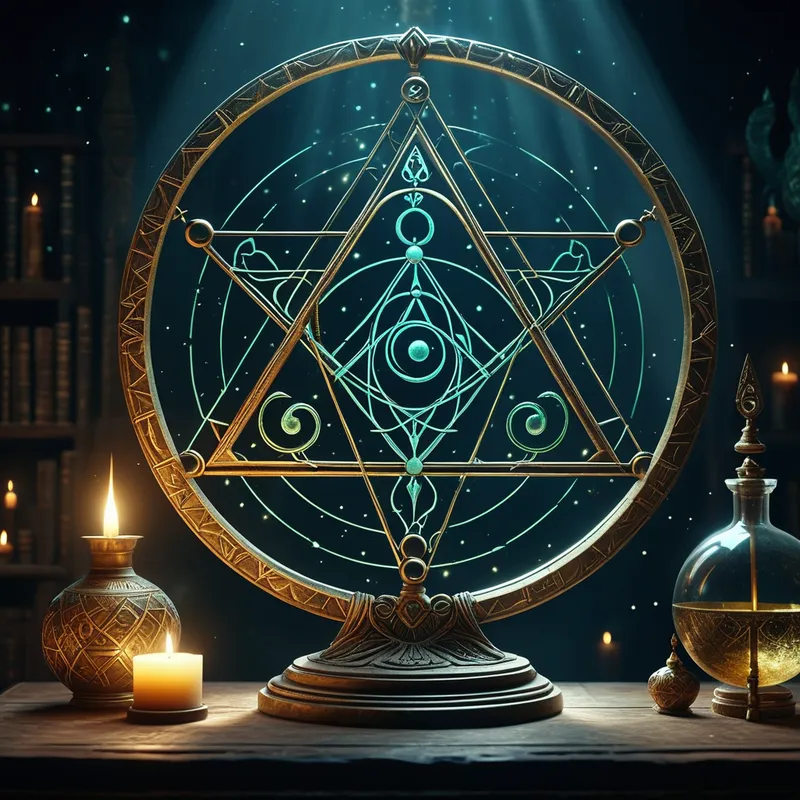
The Dreamer's Resonance
To dream of Amaterasu’s cave is to encounter a space within where one’s vital light has been sequestered. It may manifest as depression, creative blockage, or a retreat from life following a betrayal or profound disrespect (Susanoo’s transgressions). The dreamer dwells in a cold, silent interior, while their external world feels barren and hopeless.
The myth offers a blueprint for emergence. It asks the dreamer: What is the dance that must be danced? What is the mirror that must be held up? The answer lies not in brute willpower, but in allowing the neglected, ecstatic, and playful parts of the psyche (Ame-no-Uzume) to perform. It is about creating something beautiful and engaging outside the cave of the self—a project, a ritual, a connection—that is so compelling it lures the hidden light to peek out. The final barrier, the shimenawa rope, signifies the need for a conscious commitment to stay in the world once the light returns, to not retreat again at the next shadow.
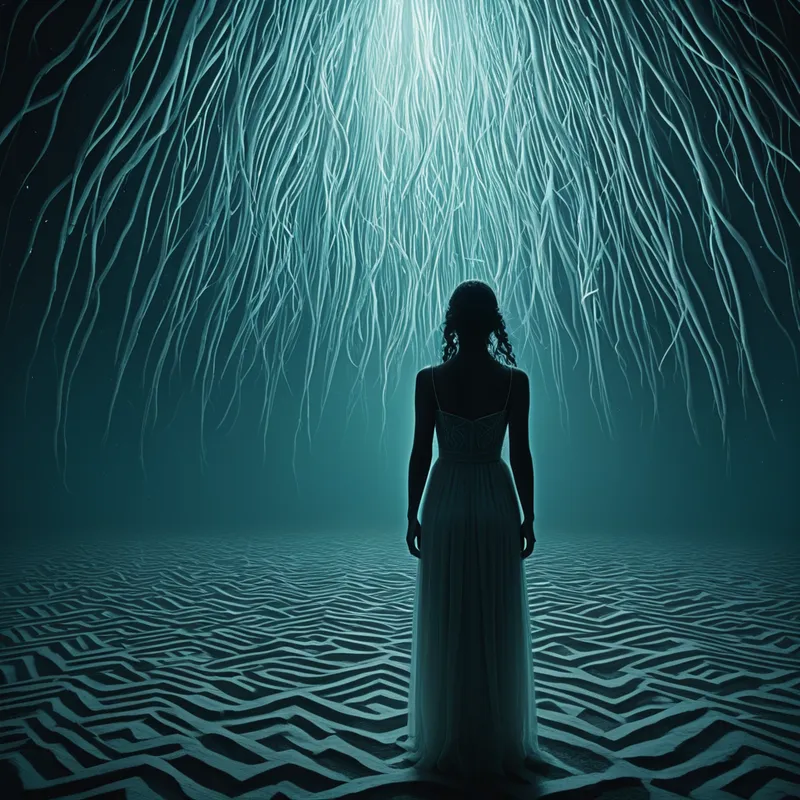
Alchemical Translation
The alchemy of this myth is the transformation of shame into radiance through sacred spectacle. The initial state is one of polluted order (Amaterasu’s defiled realm). The nigredo, or blackening, is her retreat and the world’s darkness—a necessary dissolution into formless night. The gathering of the gods represents the albedo, the whitening, where disparate elements of the psyche (deities of thought, craft, strength, mirth) are assembled.
The pivotal operation is the conjunctio, the sacred marriage, not of male and female, but of the hidden self and its reflected image. The mirror facilitates this union. Amaterasu, leaning toward her reflection, performs the ultimate act of self-encounter, which is simultaneously an act of being encountered by the world. The light rejoins its source by recognizing itself in the artifact of the community.
The laughter of the gods is the citrinitas, the yellowing, the dawning of intellectual and joyful understanding. The final flood of sunlight is the rubedo, the reddening, the return of the fully integrated, conscious life force to a world now appreciated anew. The restored sun is not the same as before; it has known the cave and chosen to return.
Associated Symbols
Explore related symbols from the CaleaDream lexicon:
- Cave — A sanctuary for wounded introspection, where the vital self retreats from a violating world, creating external darkness through internal seclusion.
- Mirror — The tool of self-recognition, held by the community to reflect a hidden essence back to itself, breaking the spell of isolation.
- Dance — Ecstatic, embodied life force performed as a sacred lure, using rhythm and abandon to call the withdrawn spirit back into the world.
- Sun — The animating, ordering principle of consciousness and life, whose absence signifies spiritual and literal stagnation.
- Goddess — The archetypal feminine as source, nurturer, and sovereign, capable of profound withdrawal and majestic return.
- Trickster — The deity (Ame-no-Uzume) who uses unconventional, playful, and embodied means to resolve a crisis of spirit that solemnity cannot fix.
- Light — Consciousness, awareness, and generative power, whose return is synonymous with healing, order, and the restoration of meaning.
- Darkness — Not evil, but the formless, fertile, and terrifying state of potential that exists when the guiding principle of consciousness is absent.
- Ritual — The structured, collective performance (the adorned tree, the dance, the mirror) designed to mediate between chaos and order, darkness and light.
- Shinto Shrine — The architectural and ritual space that re-enacts this myth, housing the mirror as a sacred object that connects the human community to the returned light.
- Rebirth — The emergence from the cave, not as a return to a naive past, but as a conscious re-engagement with the world after a transformative ordeal of darkness.
- Echoing Cavern — The psychic space where internal grief and shame resonate, amplifying isolation until broken by external sound and invitation.