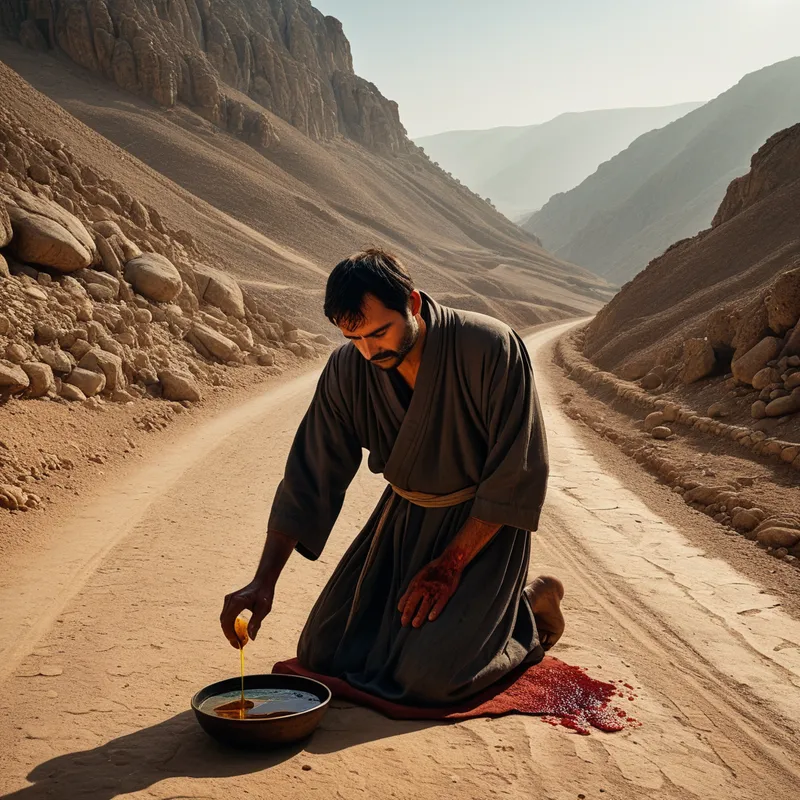
The Alchemy of Compassion: When the Dream Heart Begins to Feel
The Somatic Echo
Before it is a thought, compassion is a physical event. It begins not in the chest, but in the gut—a subtle, unsettling loosening, a quiet dissolution of a long-held internal dam. It is the visceral sensation of a boundary, once felt as necessary armor, becoming permeable. You may feel it as a warmth that spreads upward, a softening behind the sternum that makes the breath feel deeper, more vulnerable. Or it may arrive as a peculiar, resonant ache, a sympathetic vibration that hums in your own bones in response to an image of another’s suffering—or your own. This is the somatic echo: the body’s intelligence recognizing a fundamental kinship before the mind can rationalize, judge, or flee. It is the pre-verbal recognition that the pain “out there” is built from the same raw material as the pain “in here.” The echo is often accompanied by a slight tremor, a fear of this very permeability, because to feel this resonance is to admit a connection that the ego’s fortress was built to deny.
The Dreamer's Log
I stood in a vast, empty chamber with a floor of cracked obsidian. In the center lay a sphere of pure, honey-colored light, pulsating softly. A figure made of shadows and shattered glass knelt beside it, weeping. Without thought, I cupped my hands and gently lifted the light, offering it not to the figure, but to the dark, wet cracks in the floor beneath us. The chamber filled with a silent, radiant hum.
Alchemical Interpretation: The dream reveals that true compassion is not a transaction with the wounded other, but an act of healing the fractured ground of shared existence upon which you both stand.

The False Lead
Compassion in dreams is not pity, nor is it the self-congratulatory sentiment of “feeling bad for someone.” Pity maintains a hierarchy; it looks down from a presumed position of wholeness onto brokenness. The dream-image of compassion dismantles this hierarchy. It is also not mere empathy—the mirroring of another’s emotional state. Empathy can be a closed loop of shared distress. Compassion, as the dream logic reveals, is the next alchemical stage: empathy that has been metabolized, transformed into a conscious, grounded presence that can hold suffering without being consumed by it. Do not mistake the dream’s call for compassionate integration for an instruction to become a martyr or to fix what is not yours to fix. The dream points toward a transformation of your relationship to suffering itself, not an enlistment in its endless service.
Psychological Architecture
To dream of compassion is to encounter the heart of your Shadow work. The psyche, in its movement toward wholeness (Individuation), must retrieve and integrate the parts of itself it has exiled in the name of safety. We exile our own vulnerability, our helplessness, our raw need—casting them out into the “other” or burying them in somatic crypts. When these exiles appear in dreams as figures worthy of compassion—the beggar, the wounded animal, the crying child—they are not merely symbolic others. They are emissaries of your own disowned fragility. The alchemy here is brutal in its tenderness: you are asked to extend care toward the very aspects of your being you were taught to despise or fear. This is not a passive feeling. It is an active, internal restructuring. The “Internal Family System” of the psyche, with its Managers (striving for control) and Firefighters (dousing pain with distraction), must learn to yield to a new, conscious “Self” energy. This Self does not fight the exiled parts; it witnesses them with a compassionate presence, allowing the frozen grief and terror to finally complete their journey. In doing so, the boundary between “my pain” and “the world’s pain” becomes less a wall and more a membrane—a site of sacred exchange.
Mythic Resonance
This process echoes in the great myths that form our psychic firmware. Consider the Buddha under the Bodhi tree. His final temptation before enlightenment was not by demons of fear, but by the goddess Mara, who sent visions of overwhelming worldly suffering to break his resolve. The Buddha’s response was not to deflect or argue, but to reach down and touch the earth, calling it as a witness to his right to be there. This is the mythic blueprint: compassion as a grounded, unshakeable witnessing that transforms the very ground of being. In the Greek tale of Chiron, the wounded healer, we see another facet. Chiron, suffering an incurable wound from a poisoned arrow, achieves his apotheosis not through a cure for himself, but by voluntarily surrendering his immortality to free Prometheus. His ultimate healing arises from the compassionate act that accepts and transcends his own perpetual pain, transmuting it into the liberation of another. The dream of compassion places you at this crossroads: will you touch the earth, or will you flee?
Symbolic Nodes
- A Healing Touch or Embrace: Not of passion, but of pure, grounding solace.
- Offering Food or Water: Basic sustenance given freely, especially to a despised or frightening figure.
- Mending a Broken Object: Repairing a doll, a vase, a clock—restoring integrity to something shattered.
- A Shared Tear: Crying with, not for, another being.
- A Bridge or Membrane: A structure that connects separated realms, often glowing or translucent.
- A Heart of Light or Crystal: A visualized, luminous organ, sometimes seen outside the body, radiating warmth.
- Sheltering a Vulnerable Creature: Protecting a bird, an insect, or a mythical beast from a storm.
Archetypal Resonance
The energy of this theme resonates most deeply with The Caregiver Archetype. This is not its shadow expression of Martyrdom, which gives to get or to prove worth, but its mature, sovereign form. The somatic echo of softening boundaries is the Caregiver’s core energy making itself known in the body—the innate impulse to nurture, protect, and hold space. Its alchemical potential lies in its evolution from compulsive care-taking of others into a radical, compassionate stewardship of the entire internal ecosystem. This archetype, when integrated, understands that true care begins with the compassionate witnessing of the psyche’s own exiled parts. It provides the “container”—the warm, non-judgmental presence—necessary for the heat of transformation to do its work without causing further trauma. The dream calls forth the Caregiver not to send you out into the world to save it, but to invite you to become the ultimate sanctuary for your own becoming.
The Alchemical Process
The transmutation here is from isolated grief into interconnected presence. The prima materia, the base substance, is the raw, unprocessed ache of separation—your own, and that which you sense in the world. The alchemical vessel is the conscious, embodied heart-space that learns to stay open. The required heat and pressure are almost unbearable: it is the sustained willingness to feel the full resonance of pain without the anesthetic of judgment, analysis, or spiritual bypass. You must allow the grief of the exiled orphan, the rage of the betrayed innocent, and the terror of the helpless child within you to arise and be felt in your body. This is the nigredo, the blackening. The compassion is not applied to make this go away; it is the gentle, persistent flame that allows these elements to cook, to break down, to reveal their essence. As you hold this space, a separation occurs. The dross of personal identification (“this pain is who I am”) sinks. What rises is the quintessence: a purified, impersonal love that is not yours, but flows through you. This is the albedo and rubedo—the whitening and reddening. You become a conduit for a compassion that includes you in its circuit, transforming sovereignty from isolation into a deeply connected, responsible presence.

The Integration Protocol
Question 1: In the dream, who or what was the recipient of compassion? Can you feel a resonance between that figure and a disowned, vulnerable, or "unacceptable" part of your own history or personality?
Question 2: Where in your body did you feel the sensation of compassion most strongly? What happens when you bring your attention to that area now—does it want to open, contract, or speak?
Question 3: If the compassionate act in the dream was a new "protocol" for your psyche, what old, automated program of defense (e.g., judgment, withdrawal, fixing) is it asking to replace?
Action 1 (Somatic Grounding): For five minutes, place a hand over your heart center. Do not try to feel love. Simply feel the warmth of your hand, the rhythm of your breath beneath it. With each exhale, imagine that warmth softening a single, specific layer of psychic armor you can name (e.g., "the need to be right," "the fear of neediness"). Just soften it; do not remove it.
Action 2 (Creative Witness): Using any medium—doodles, clay, digital collage—create an image of the "exiled" figure from your dream or your reflection. Do not make it beautiful or whole. Render it exactly as it felt. Then, on a separate page or layer, create an abstract representation of the "honey-colored light" or compassionate presence. Finally, create a third image that shows the two in relationship. The goal is not art, but witnessed dialogue.
Action 3 (Ritual of Shared Ground): Find a natural setting—a park, your yard, a potted plant. Sit quietly and identify one personal burden you carry. Then, identify one sorrow you perceive in the wider world. In your mind, place both on the ground before you. Visualize roots growing from your being into the earth, and from the earth into you, creating a silent, stable network that holds both burdens without needing to solve either. Sit in this networked silence for as long as feels sustainable.
Final Validation
This work is not for the faint of heart. To allow the dream of compassion to rewrite your internal code is to consent to a profound vulnerability. It means feeling the tremors of a world in pain as if they were your own, because in the deepest sense, they are. It is exhausting, messy, and can feel like a cruel dismantling of the defenses that have kept you safe. Validate that exhaustion. Honor that fear. And then, remember the alchemy: this crushing pressure is the very force required to fuse your isolated heart into the greater pulse of being. You are not being asked to carry the world. You are being asked to become porous enough to let the world flow through you, and in that flow, to discover a sovereignty so connected, so resilient, and so real that it can finally, truly, begin to heal.