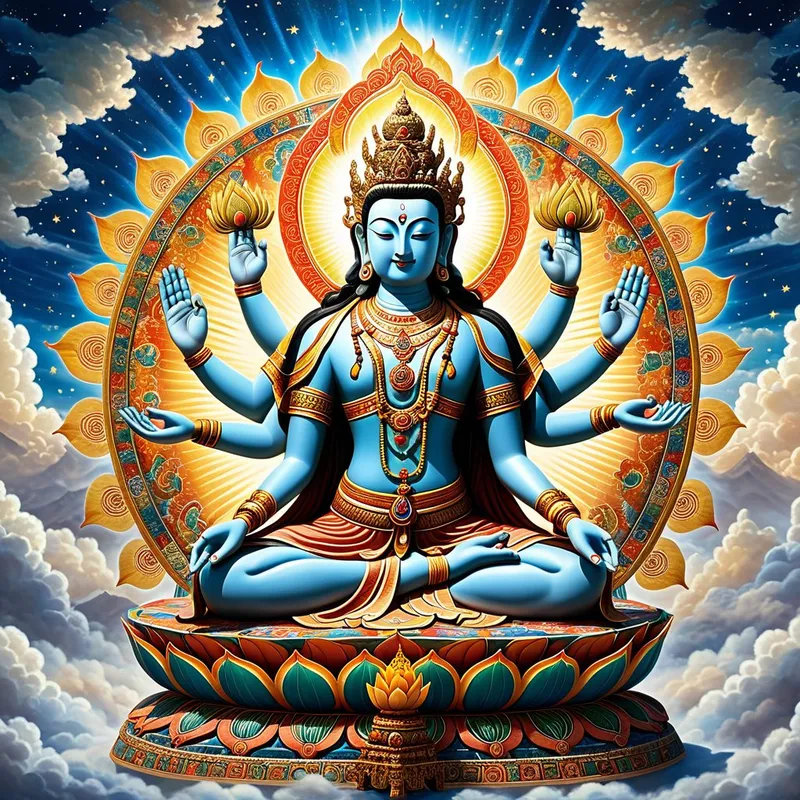
Avalokiteśvara Myth Meaning & Symbolism
The Bodhisattva who vowed to hear the world's cries, whose compassion was so vast it shattered and was remade into a thousand helping hands.
The Tale of Avalokiteśvara
In the time before time, when the fabric of reality was woven from vows, there arose a being of luminous intent. His name was Avalokiteśvara. He stood upon the jeweled slopes of Mount Potalaka, a place between worlds, where the air hummed with the silent syllables of the Great Mantra. From this vantage, he made a promise that would echo through all realms of existence: "I shall not enter final peace until every single being, from the lowest hell to the highest heaven, is freed from suffering."
And so he listened. He turned his gaze—a gaze of pure, attentive love—upon the Samsaric world. He did not see nations or stories, but the raw essence of anguish: the searing heat of hatred, the icy grip of fear, the hollow ache of loneliness, the crushing weight of despair. Each cry, each silent tear, each stifled gasp of pain flowed into him like rivers into a boundless ocean. He heard the grinding of tectonic plates as the groans of imprisoned spirits, the rustle of leaves as whispered pleas for mercy.
His compassion was not passive. It was a fierce, active force. With his thousand arms, he reached out. A hand here to pull a soul from a chasm, a hand there to offer a cup of water, another to ward off a blow, another to point the way through a dark wood. With his eleven heads, he looked in all directions, ensuring no suffering went unseen. He became the embodiment of the world’s hearing.
But the world’s suffering is infinite. The vow was absolute. The pressure of this impossible equation—finite form against infinite need—began to tell. A tremor passed through his luminous body. The sheer volume of unalleviated pain, the relentless tide of sorrow, became a weight no single being, however mighty, could structurally bear. The story says that from the intensity of his engagement, from the depth of his empathetic rupture, he shattered. His form exploded into a thousand fragments.
Yet, the vow remained. The promise was stronger than form. From the void of his fragmentation, a profound silence descended. And from that silence, a new presence coalesced. It was the Buddha Amitābha, his spiritual sire, who appeared. With a voice that was both a comfort and a command, Amitābha remade him. Not as he was, but more than he was. From the shards of shattered compassion arose not one being, but a being multiplied: eleven heads to see all paths of suffering, a thousand arms to work all means of salvation. The shattered one was made whole by becoming manifold. The compassion that broke him was the very thing that, reconstituted, made him utterly unbreakable. He was now Avalokiteśvara, the one who hears the cries of the world, whose broken-open heart became the gateway for the world’s healing.

Cultural Origins & Context
The myth of Avalokiteśvara finds its roots in the early Mahayana Buddhist sutras, composed and expanded roughly from the 1st century BCE onwards. This was not a story told around a single campfire, but one that unfolded across the Silk Road, from the monasteries of India to the caves of Dunhuang and the palaces of Tibet. It was preserved in texts like the Lotus Sutra and the Heart Sutra, where he is a central interlocutor.
The myth served a crucial societal and religious function. In a worldview where escape from the cycle of suffering (Samsara) was the ultimate goal, Avalokiteśvara provided a divine paradox: a being who had the power to leave but chose to stay. This modeled the Bodhisattva ideal for monks and laypeople alike, transforming the spiritual path from a solitary ascent to an engaged, compassionate activity. His thousand arms became a metaphor for skillful means (Upaya), teaching that compassion must be practical, adaptable, and relentless. As the myth traveled to China, becoming Guanyin, and to Japan as Kannon, it adapted to local cultures, demonstrating the myth’s core message: compassion assumes the form needed by those who suffer.
Symbolic Architecture
At its heart, the myth of Avalokiteśvara is a profound map of the psychology of empathy and the crisis of consciousness. The Bodhisattva represents the archetypal capacity of the psyche to turn outward, to attend to the "other" with total self-abandonment. His initial listening is the symbol of pure, undefended perception—a consciousness that does not filter, judge, or flee from pain.
The first step of true compassion is the shattering of the illusion of separation. To hear the world's cry is to admit it is your own.
The shattering is the critical symbolic turn. It represents the inevitable crisis of the empathetic ego. One cannot truly take on the suffering of the world without the risk of psychological dissolution. This is the "fatigue of compassion," the burnout of the caregiver, the despair of the activist. It is the point where identification with suffering threatens to destroy the identity of the one who cares. The myth does not shy away from this; it makes it the central ordeal.
His reconstitution by Amitābha is the key. Amitābha represents transcendent wisdom, the insight of Śūnyatā. The repair is not a return to the old, singular, heroic self. It is a rebirth into a decentralized, networked consciousness. The eleven heads symbolize the multi-perspectival wisdom needed to understand complex suffering. The thousand arms symbolize the embodied, practical action that arises when compassion is guided by wisdom, not merged with pain. The self is not erased but multiplied—it becomes a vehicle, an instrument, rather than a fortress.

The Dreamer's Resonance
When this mythic pattern stirs in the modern dreamer, it often manifests as dreams of overwhelming responsibility or fragmented identity. You may dream of being in a control room with a thousand blinking alarms, unable to respond to all. You may dream your body is made of glass, cracking under pressure, or that you have too many limbs, tangled and useless. These are somatic echoes of the "shattering."
Such dreams signal a psyche engaged in a profound, perhaps unsustainable, level of empathetic labor. It is the healer who cannot switch off, the parent who feels consumed, the friend who carries everyone's burdens. The dream is not a condemnation of compassion, but a warning of its unintegrated state. It points to a compassion that is still ego-bound, where the caregiver's identity is fused with the act of caregiving. The suffering of the other is felt as a personal failure, a weight to be singly borne. The dream presents the crisis so that, like Avalokiteśvara, the dreamer can move through it to a new structure of being.

Alchemical Translation
The alchemical journey modeled by Avalokiteśvara is the transmutation of raw, identificatory empathy into wise, effective compassion. The process begins with the nigredo, the blackening: the descent into the suffering of the world and of oneself without filters. This is the listening on Mount Potalaka. It is painful, dark, and feels infinite.
The shattering is the mortificatio, the death of the old form. The ego-structure that believed "I must save everything" or "I alone can bear this" is broken apart. This is a necessary, if terrifying, stage of psychic death.
The alchemy of compassion requires the death of the savior complex to give birth to the skillful servant.
The intervention of Amitābha is the arrival of the lapis philosophorum, the philosopher's stone—in psychological terms, the transcendent function. It is the insight that emerges from the ruins: "You are not the source of the power to help; you are a conduit for it." The reconstitution is the albedo and rubedo, the whitening and reddening—the rebirth. The psyche reorganizes itself not around a monolithic "I," but around a central purpose ("the vow") served by a multiplicity of internal capacities (the "thousand arms"). Individuation here is not about becoming a perfected, isolated self, but about becoming a coherent, resilient, and adaptable vessel for a transpersonal value—Compassion itself. You become a conscious participant in a network of care, able to act without being destroyed, to engage without being consumed, because your center is now the unwavering vow, not the fragile ego.
Associated Symbols
Explore related symbols from the CaleaDream lexicon: