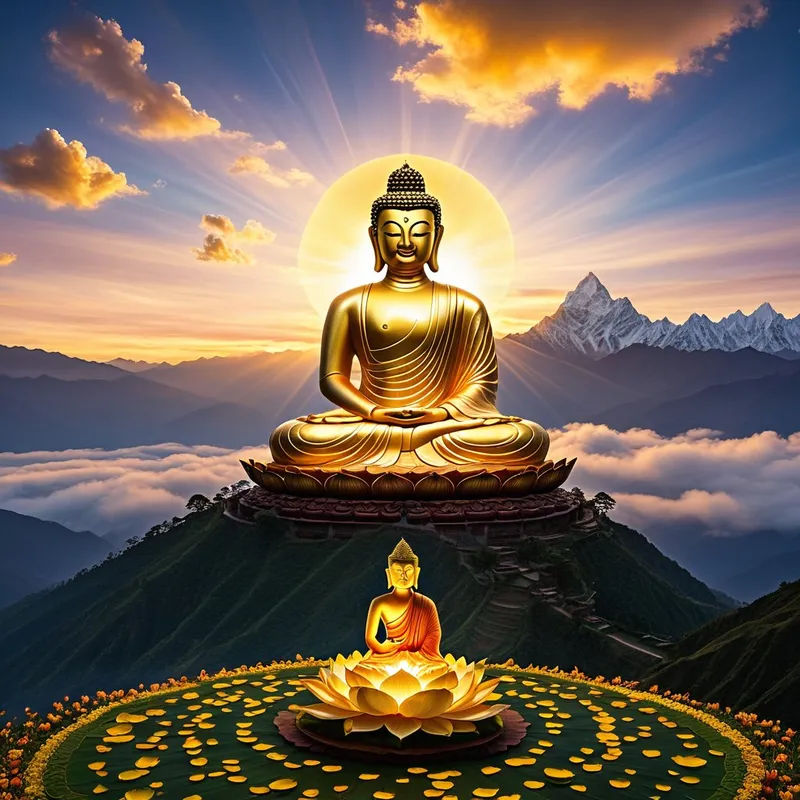
Cloud of Dharma Myth Meaning & Symbolism
A celestial cloud rains the nectar of ultimate truth upon a parched world, embodying the spontaneous, compassionate outpouring of enlightened wisdom.
The Tale of Cloud of Dharma
Listen. The world was a desert of the spirit.
For ages upon ages, the earth of the mind lay cracked and barren. Beings wandered in a great thirst, drinking from mirages—from the shallow pools of pleasure, the bitter wells of power, the stagnant waters of fixed views. Their tongues were parched for a truth that could quench, not merely moisten. The sky above was a vast, empty blue, a dome of silent, unanswered questions. It was a time of spiritual drought.
Then, from the unimaginable zenith of reality, a gathering was felt before it was seen. It was not a storm born of conflict, but a condensation of pure compassion. A luminous mass began to form, not of water vapor, but of Dharma itself. This was the Cloud of Dharma, the Dharma-megha. It did not blot out the sun; it became a sun of a different order, a soft, all-pervading radiance.
Its form was ever-shifting, mirroring the ten thousand forms of suffering it sought to soothe. At times, it resembled the gentle, billowing robes of a Bodhisattva; at others, the majestic, serene silhouette of the Tathagata seated in meditation. It moved with the gravity of inevitability, not over lands and mountains, but over the topography of the heart.
And then, the rain began.
It was a rain of nectar, amrita. But this was no ordinary shower. Each drop was a perfect, condensed teaching. Some fell as the gentle, cooling rain of loving-kindness, metta. Others fell as the steady, penetrating drizzle of compassionate action, karuna. There were drops of joyous appreciation for others' happiness, and drops of profound, unshakable equanimity.
The rain did not discriminate. It fell upon the palaces of kings and the hovels of beggars. It fell on the just and the unjust, the wise and the foolish, the ardent seeker and the contented skeptic. It soaked into the hard, packed earth of rigid dogma, softening it. It collected in the hollows of despair, filling them with a luminous, buoyant light. It dripped from the leaves of the Bodhi tree onto the heads of sleeping monks, entering their dreams as whispers of insight.
Where it fell, the desert did not merely bloom; it transformed. Lotuses of wisdom unfolded in the mud of confusion. The great thirst was quenched, not by a single draught, but by a continuous, gentle saturation that changed the very nature of the one who drank. The cloud did not depart. Having gathered, it simply was, and its raining was its eternal state—a perpetual, compassionate outpouring for a world forever learning how to open its hands and lift its face to the sky.

Cultural Origins & Context
The Cloud of Dharma, or Dharma-megha, is not a folktale with a linear plot, but a profound metaphysical and poetic image that permeates Mahayana Buddhist literature. Its most significant scriptural anchor is in the Avatamsaka Sutra (The Flower Garland Sutra), a vast, visionary text that describes the universe as an infinitely interconnected, mutually reflecting web of reality. Here, the Dharma-megha is not merely a symbol but is presented as the final, culminating "stage" or "concentration" of a Bodhisattva's path—the moment immediately preceding perfect, complete enlightenment.
This places the myth not in the realm of entertainment, but of direct contemplative mapping. It was a tool for advanced practitioners and philosophers. Monastic scholars like those of the Yogacara tradition would meditate upon its meaning. It was passed down through intricate commentaries, philosophical treatises, and the oral instructions of masters to disciples. Its function was dual: to describe the sublime, ineffable quality of a Buddha's activity in the world (spontaneous, all-pervasive, nourishing), and to provide an aspirational icon for the practitioner—to become, oneself, a cloud that rains truth for the benefit of all beings.
Symbolic Architecture
The Cloud’s symbolism is an elegant architecture of paradox. It represents the form of the formless, the activity of perfect stillness.
The Cloud does not hold the Dharma; it is the Dharma becoming rain. It is teaching not as speech, but as being.
The Sky represents the ultimate, empty, luminous nature of reality (sunyata). The Cloud is the compassionate manifestation (nirmanakaya) that spontaneously arises from that emptiness, responsive to the needs of the world. It has no solid core, no permanent self, yet it performs a vital, life-giving function.
The Rain is the teaching (Dharma) itself, adapting to the vessel that receives it. To a philosopher, it falls as logic; to a artist, as beauty; to a caregiver, as compassion. It is non-coercive. One can hide from the rain, or one can open to it. The Parched Earth is the conditioned mind, thirsty with craving (tanha) and rigid with fixed views, utterly dependent on a nourishment it cannot provide itself.
Psychologically, the Cloud represents the integrated Self in its aspect of generative, compassionate outpouring. It is the psyche that has reconciled its own depths (the sky) with its need to engage in the world (the rain). The conflict is the drought—the state of alienation where the inner wisdom is disconnected from outer expression. The resolution is not a battle won, but a condensation, a natural overflowing from a state of profound inner fullness.
The Dreamer's Resonance
When this myth stirs in the modern dreamer, it often manifests not as a literal cloud, but as a sense of benevolent, impersonal nourishment. One might dream of a gentle, warm light that permeates a room, of finding an unexpected spring in a desert, or of a wise figure who speaks not in words, but in a silent understanding that floods the dreamer with clarity.
Somatically, this can correlate with a release of chronic tension—a softening in the chest or jaw, a deep, sighing breath. Psychologically, it signals a process of receiving. The ego, often in a state of striving and "doing," is being invited into a state of "being done unto." It is the psyche's intuition that a deeper, more integrative wisdom is available, if it can cease its frantic searching and simply allow itself to be saturated. The dream is an experience of grace from the deeper Self, suggesting that the conscious mind has been laboring under a self-imposed drought, and that the waters of meaning and connection are, and have always been, available.
Alchemical Translation
The individuation process mirrored here is the alchemy of turning personal insight into transpersonal nourishment. We begin as parched earth, identified solely with our ego's struggles and thirsts. Our early spiritual or psychological work is often a desperate digging for water—seeking answers, techniques, and fixes.
The great work is not to find the cloud, but to become the sky from which it condenses.
The first alchemical stage is Contemplation (gazing at the empty sky). This is the difficult work of samadhi and self-inquiry, learning to rest in awareness itself, behind content. It feels like a drought because we are withdrawing projection from outer sources.
The second stage is Condensation. From this spacious, empty awareness, genuine compassion and insight naturally begin to gather. This is not a constructed personality trait, but an emergent property of clarity. It is the forming of the Cloud.
The final, ongoing stage is Precipitation. This is the life lived from that integration. Insight becomes art, compassion becomes action, understanding becomes a presence that nourishes others without calculation. The individual becomes a conduit. Their very being—their calm, their listening, their creative work—becomes a gentle rain that falls on the psychic ecology around them. They achieve sovereignty (the ruler) not by control, but by becoming a source of life-giving order (the sage). The struggle triumph is the end of the struggle: the realization that one's deepest purpose is to be a faithful weather system of the soul, raining truth wherever one goes, simply because the sky of one's nature is full.
Associated Symbols
Explore related symbols from the CaleaDream lexicon: