The Umbrella in 'The White Snake' Myth Meaning & Symbolism
A magical umbrella becomes the fragile vessel for a forbidden love between a snake spirit and a mortal man, testing the boundaries of nature and human law.
The Tale of The Umbrella in 'The White Snake'
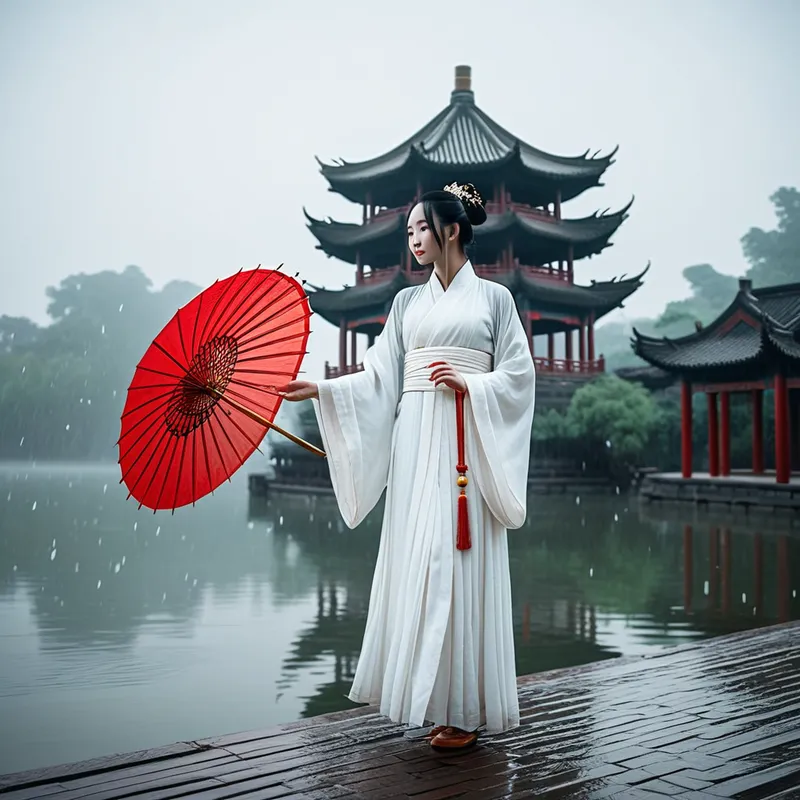
Listen, and let the mists of West Lake gather around you. It is a day when heaven weeps a gentle rain, blurring the line between lake and sky. Upon the Broken Bridge, a young scholar named Xu Xian seeks shelter, his robes damp, his heart adrift. From the opposite direction comes a vision: two peerless maidens, their beauty untouched by the drizzle. The elder, named Bai Suzhen, moves with a grace that stills the very rain. Her companion, Xiao Qing, watches with sharp eyes.
Their gazes meet—the mortal man and the ancient spirit. A recognition, deep and wordless, passes between them. Bai Suzhen, in her infinite compassion and cunning, sees his plight. With a gesture as natural as a willow bending in the wind, she offers him the shelter of her red oil-paper umbrella. It is no ordinary object; it is spun from courtesy and woven with intention. Xu Xian accepts, his fingers brushing hers on the bamboo handle—a spark in the damp gloom.
The shared space beneath that crimson canopy becomes a world entire. The drumming of the rain on the taut paper is the only sound as they walk, their steps slow, their conversation a delicate dance. The umbrella is a floating pavilion, a mobile temple where a forbidden contract is silently sealed. When they part, she lends him the umbrella, a promise of a future meeting, a tangible thread to pull their fates back together.
And so it begins. The umbrella is returned, and with it, their bond is cemented. It is the instrument of their courtship, the silent chaperone to their growing love. Bai Suzhen uses her vast magic not for dominion, but for domestic bliss, building a pharmacy to heal the sick, becoming a wife. The umbrella rests in a corner, a humble relic of their first meeting. But heaven’s laws, enforced by the stern monk Fahai, decree that spirit and mortal shall not unite. Fahai sees not love, but a monstrous deception. He reveals Bai Suzhen’s true nature to the terrified Xu Xian.
Betrayal, fear, and separation follow. Xu Xian is imprisoned in the Jinshan Temple. Bai Suzhen, in a fury of love and desperation, summons the waters of West Lake to flood the temple, an act of catastrophic devotion. Yet, in the end, it is not brute force but the enduring, fragile memory of that first act of kindness—the offering of shelter—that ultimately weaves the possibility of redemption. After great trials, after Bai Suzhen’s imprisonment beneath the Leifeng Pagoda, their son’s filial piety cracks the stone. The family is reunited, a testament that the bond forged under a simple umbrella could withstand even the wrath of heaven.

Cultural Origins & Context
The legend of the White Snake is one of China’s Four Great Folktales, with origins tracing back to Tang dynasty oral traditions and crystallizing in the Ming dynasty collections like Jingshi Tongyan. It was never a static myth, but a living story shaped by countless storytellers in tea houses, adapted into local operas, and later, films. Its primary function was entertainment, but it also served as a profound cultural negotiation. It lived in the space between the orthodox Confucian and Buddhist worldview—which viewed spirits as potentially dangerous distractions from the human realm—and the deep, popular folk belief in a world alive with sentient, complex beings. The story asked its audience: What is the true nature of virtue? Is it blind obedience to celestial law, or is it the compassion and loyalty shown between beings, regardless of their origin? The umbrella scene became the iconic heart of this dilemma, a moment of pure, human-scale connection that challenges grand cosmic decrees.
Symbolic Architecture
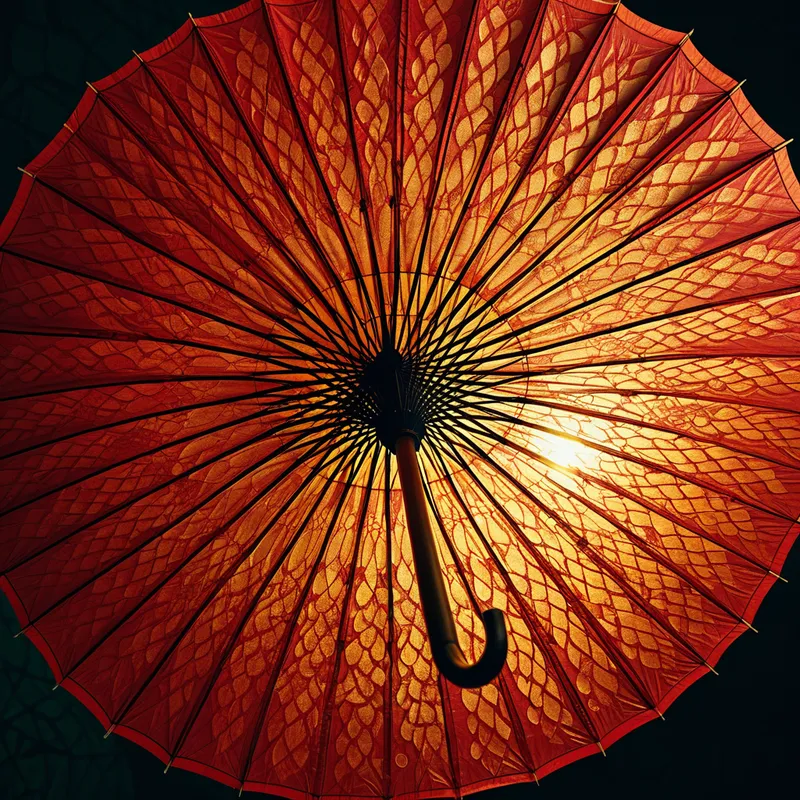
The umbrella is the myth’s central symbolic organ. It is not a weapon or a crown, but a tool of connection and containment.
The umbrella creates a sacred, temporary world where two different orders of being can meet. It is the temenos, the protected circle where the impossible becomes possible.
For Bai Suzhen, the umbrella is an act of conscious embodiment. As a snake spirit, a creature of earth and water, she uses a human artifact to initiate a human relationship. It is her first and most elegant spell—a spell of civility and vulnerability. She does not command the rain to stop; she creates a shared space within it. For Xu Xian, the umbrella is an acceptance of grace, a moment of trust in a stranger’s kindness that opens the door to a love beyond his understanding.
Psychologically, the umbrella represents the persona—the adaptive mask or tool we use to navigate the social world. Bai Suzhen’s skillful use of it is not deception, but a necessary translation of her deep, instinctual self (the snake) into a form that can relate to the conscious ego (the mortal man). The conflict with Fahai represents the crushing power of the hyper-moralistic superego, which seeks to violently separate the ego from the enriching but terrifying depths of the anima/instinctual life.
The Dreamer's Resonance
When this myth pattern arises in modern dreams, it often signals a profound encounter with the Other—the unfamiliar aspect of one’s own psyche or an external relationship that feels fated or transgressive. Dreaming of a significant umbrella, especially one offered or shared in the rain, points to the creation of a necessary psychological container.
The somatic feeling is one of sheltered exposure. One is both protected and intensely vulnerable within this temporary space. The dreamer may be in a process of bridging a deep inner divide—perhaps between a wild, intuitive, instinctual part of themselves (the snake) and their structured, daily identity (the scholar). The anxiety in the dream often mirrors Xu Xian’s terror upon discovery: the fear that this beautiful connection is actually monstrous, that integrating this “other” will destroy one’s known world. The dream calls for holding the tension of that shelter, to not flee from the connection even when the wider “world” (internalized critics, societal norms) condemns it.

Alchemical Translation
The myth’s alchemical process is the transmutation of instinct into conscious relationship. Bai Suzhen begins as prima materia—a raw, powerful, natural spirit. Her love for Xu Xian is the rubedo, the reddening, the passionate fire that drives the entire work. The umbrella is the vas, the alchemical vessel.
The work of individuation is not the eradication of the instinctual serpent, but the careful, loving construction of a vessel—a conscious attitude—in which its power can be contained, related to, and integrated.
The initial union under the umbrella is the conjunctio, the sacred marriage of opposites (spirit/human, unconscious/conscious). Fahai’s intervention and the subsequent flood represent the nigredo, the blackening, the despair and chaos that inevitably follows when the ego is overwhelmed by the contents it has invited in. This is a necessary death of the old, naive perspective.
The final resolution—not a defeat of Fahai, but a transcendence through the love of the next generation (their son)—models the ultimate alchemical goal. The gold produced is not a static “happily ever after,” but a resilient, redeemed consciousness. The instinct (the snake) is not banished or fully tamed, but its energy is now in service to a more complex, compassionate, and whole human existence. The individual learns that the most profound shelters are not walls that keep things out, but the fragile, beautiful vessels we build to hold what we most fear and most love.
Associated Symbols
Explore related symbols from the CaleaDream lexicon: