The Glass Coffin Myth Meaning & Symbolism
A tale of a soul frozen in a glass coffin, awaiting the courageous act of recognition and release to return to the world of the living.
The Tale of The Glass Coffin
Listen, and let the old words settle in your bones. This is not a story of a time that was, but a story of a truth that is.
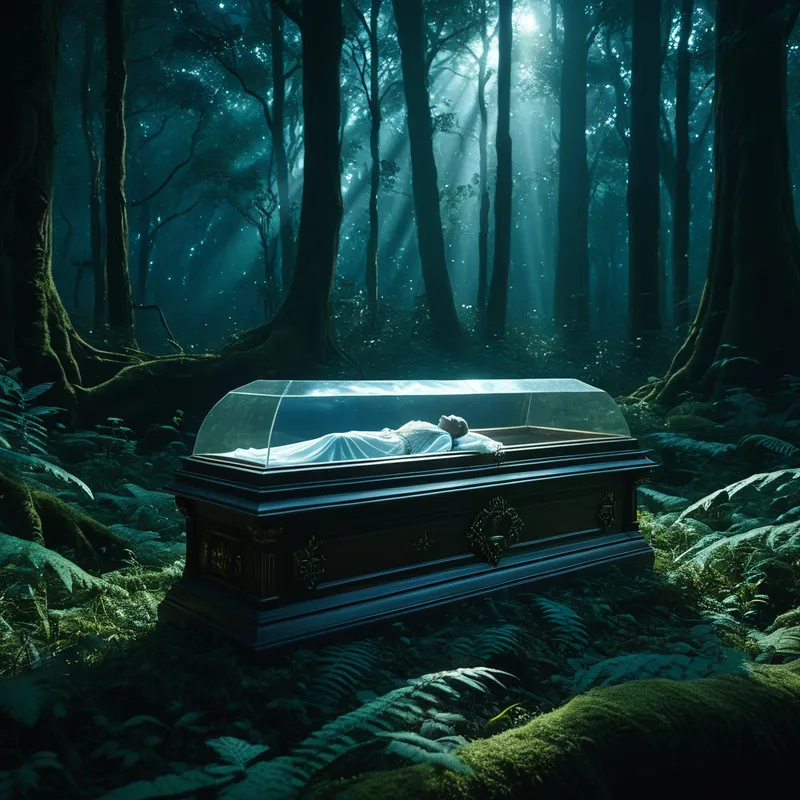
Deep in the heart of the Black Forest, where sunlight fell in shattered coins upon the moss, there was a place the deer did not tread and the birds did not sing. In that silent clearing lay a sight to still the boldest heart: a coffin of purest glass. It was not a grim thing, but a vessel of impossible craftsmanship, seamless and clear as a frozen breath. And within it slept a maiden, or perhaps a queen—her title lost to time. Her hair was spun gold upon a pillow of velvet, her face was pale as winter moon, and her hands were folded over a heart that did not beat. She was not dead, the air whispered, but held. Frozen in a sleep as deep as the roots of the mountains.
For years untold, she lay there, a secret jewel in the forest’s crown. Hunters would stumble upon the glade, see the spectacle, and flee, their minds branding it witchcraft. Others would come to gawk, to try and break the glass with axe or stone, but the material was harder than diamond, singing a high, cold note at every strike. The coffin was a perfect prison, and the sleeper its perfect captive.
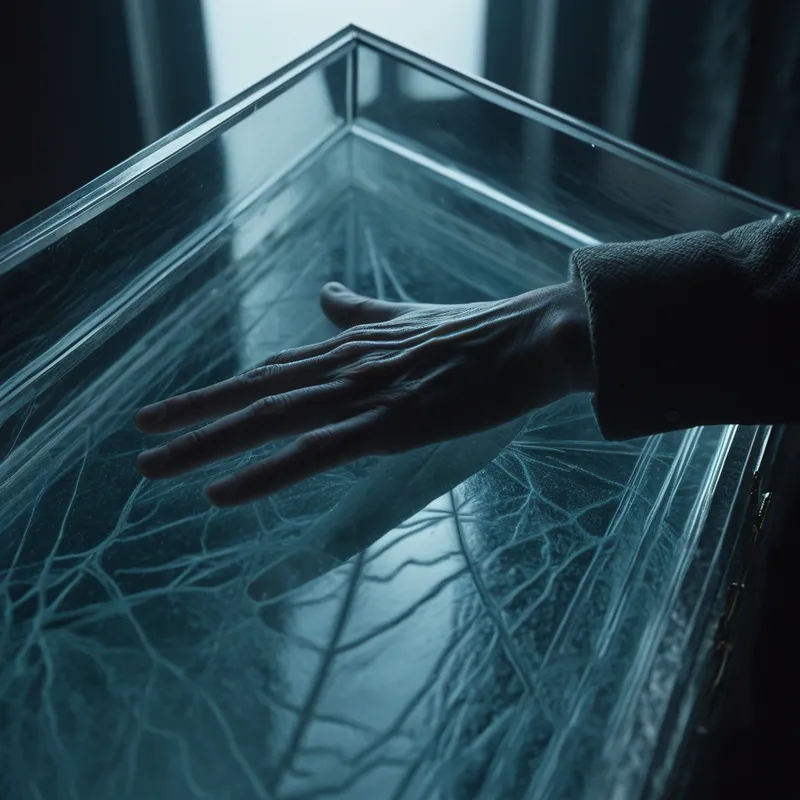
Then came the one who did not look to break, but to see. A wanderer, with eyes worn soft by hardship and kindness. He did not see a spectacle, but a person. He did not see a prison of value, but a soul in stasis. Kneeling in the damp moss, he looked past his own weary reflection in the glass and truly saw her—the subtle arch of an eyebrow, the delicate weave of her gown, the profound quiet of her captivity. A sorrow welled in him, not of pity, but of kinship. He felt the immense loneliness of that perfect, transparent tomb.
Without thinking of reward, acting from a heart-compelled impulse, he did the only thing left to do. He leaned forward and placed a gentle kiss upon the cold, smooth glass above her brow.
The sound was not a shatter, but a sigh—a great exhalation of held breath. The lid of the coffin, without hinge or seam, simply dissolved into morning mist. Color rushed into the sleeper’s cheeks like wine into crystal. Her chest rose with a first, ragged breath. Her eyelids, heavy with centuries, fluttered open, and her eyes, clear and deep as the forest pool, met his. The sleep was broken. The spell was undone. Not by force, but by an act of witnessing so complete it became a key. She sat up, the world rushing in, and her first sight was the face of the one who had truly seen her. The forest, holding its breath for an age, finally sang.
Cultural Origins & Context
The tale of The Glass Coffin finds its roots in the rich oral traditions of Central and Eastern Europe, particularly within the Germanic storytelling canon collected by the likes of the Brothers Grimm. It belongs to a family of "rescue" or "disenchantment" fairy tales, where a passive figure (often female) is trapped in an unnatural sleep or form, awaiting an active agent (often male) to perform a specific, non-violent act to break the curse.
These stories were not mere children's entertainment; they were the psychological and social textbooks of pre-literate communities, told by firelight by spinners and grandmothers. The function of such a tale was multifaceted. On one level, it modeled idealized behavior: compassion triumphs over greed, gentle recognition over violent conquest. On another, it explained the unexplainable—the strange, still beauty found in deep nature (a crystal-clear spring, a fossil in stone) might be spoken of as another sleeping entity under a spell. The tale served as a narrative container for the culture’s anxieties about stagnation, the fear of being trapped in a role or a fate, and the profound hope for an awakening brought about by an external, destined connection.
Symbolic Architecture
The myth’s power lies in its stark, perfect symbols. The Glass Coffin is the central enigma. It represents a state of perfect preservation but also perfect isolation. The soul, the psyche, or a vital aspect of the self is kept safe from the ravages of time and the dangers of the world, but at the catastrophic cost of life itself. It is not a tomb of stone, hidden away; it is a display case. The trapped one is on view, yet utterly unreachable. This speaks to the condition of potential that has been frozen—a talent unused, a love unexpressed, a trauma so perfectly encapsulated that the person lives around it but not through it.
The most perfect prison is one you can see all the way through, for it convinces you that freedom is an illusion just beyond an invisible wall.
The sleeper represents this dormant complex or the anima in stasis. She is not dead, meaning the potential is not extinct; it awaits the correct conditions for revival. The wanderer is the active consciousness, the ego that has wandered through the forest of life’s experiences and arrived at a point of readiness. His weapon is not strength, but perception. His kiss is not a romantic cliché, but the symbolic act of connection and value-bestowal. By seeing her as a subject worthy of address, rather than an object of curiosity or conquest, he performs the psychic alchemy that dissolves the barrier. The glass does not break; it transforms. The barrier between self and other, between conscious and unconscious, between frozen potential and lived life, evaporates.

The Dreamer's Resonance
When this myth stirs in the modern dreamscape, it rarely appears as a literal fairy tale. Instead, one might dream of being trapped in a transparent elevator that won't move, of trying to scream behind soundproof glass, or of a loved one frozen in a block of ice. The somatic experience is one of profound frustration and eerie calm—a paradox of being both vividly present and utterly powerless.
Such dreams signal a critical psychological process: the confrontation with a part of the self that has been "put on ice." This could be a creative impulse sacrificed for stability, a vulnerability sealed off after heartbreak, or an aspect of one's identity that was deemed too dangerous or fragile to live out. The dream is the psyche highlighting the coffin. The feeling of pressing against the invisible wall is the somatic truth of that internal division. The dreamer is both the sleeper (feeling the stasis) and the wanderer (becoming aware of the stasis). The process underway is the slow, often painful, gathering of the courage to truly look at what has been frozen, and to discover what act of genuine acknowledgment—what "kiss"—might be required to begin the thaw.

Alchemical Translation
In the individuation journey, the myth of The Glass Coffin models the phase of releasing the frozen value. Our psyches, to survive, often encapsulate our most potent energies—our deepest loves, our rawest talents, our most profound wounds—in crystalline structures of memory, defense, or inhibition. We can see them, we know they are there, defining our inner landscape, but we cannot access their living energy. They are artifacts, not resources.
The alchemical work is not to shatter the glass with willful force (which often leads to psychic fragmentation and trauma re-enactment), but to change its state through the application of a specific quality of consciousness. This is the opus of the wanderer: to bring the warmth of conscious attention to the frozen form. It is a work of meticulous observation ("I see this pattern in me"), compassionate curiosity ("I wonder why it formed"), and ultimately, heartfelt acknowledgment ("This, too, belongs to me").
The transmutation occurs not when we escape our condition, but when we turn and breathe upon it with the full heat of our attention, melting the separation between the observer and the observed.
The "kiss" is the moment of integration. When the conscious ego stops trying to own, fix, or break the encapsulated complex and instead meets it with an attitude of saving connection, the hermetic seal dissolves. The energy trapped in timeless repetition is freed into the flow of time, becoming available for life. The sleeper awakens and joins the wanderer, symbolizing the enlivening of a new, more complete personality. The forest, the greater psyche, sings because a fundamental blockage in the flow of life has been removed. The myth, therefore, is a profound map for moving from a state of preserved potential to one of embodied, awakened being.
Associated Symbols
Explore related symbols from the CaleaDream lexicon: