
The Levite and the Priest in the Parable of the Good Samaritan Myth Meaning & Symbolism
A tale of two holy men who pass by a broken stranger, revealing the shadow of piety and the alchemy of true compassion.
The Tale of The Levite and the Priest in the Parable of the Good Samaritan
The road from Jerusalem down to Jericho is a serpent of dust and stone, coiling through a wilderness of thirst and shadow. It is a place where the sun is a hammer and the rocks hold the memory of violence. On such a road, a man—nameless, everyman—fell among thieves. They stripped him, beat him, and left him half-dead, a broken vessel spilled beside the way, his breath a ragged whisper in the dust.
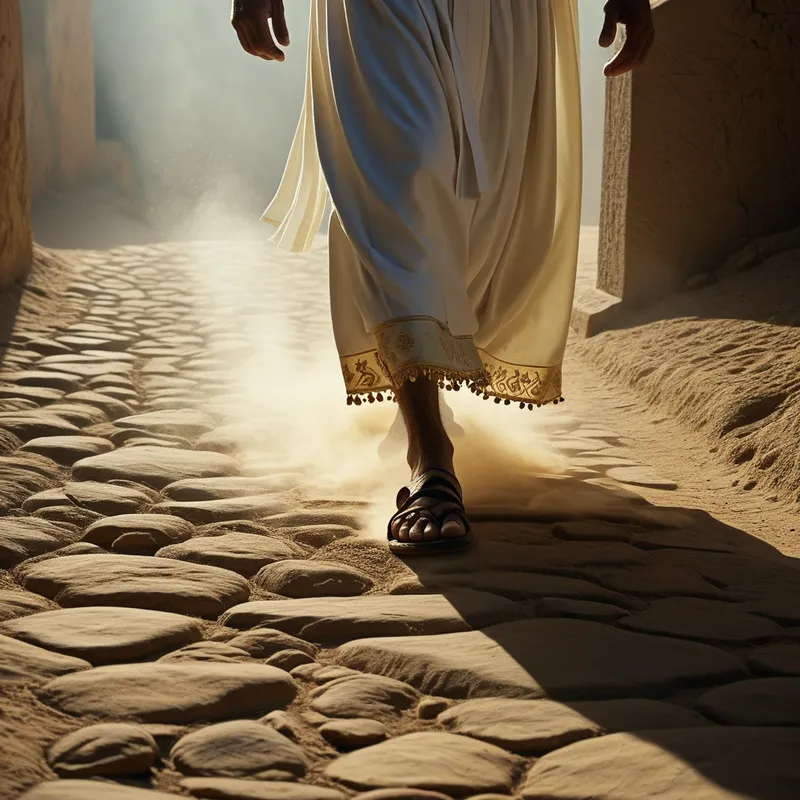
Now, by chance, there came down that road a Priest. He was a man of the sacred heights, his garments fine, his mind likely filled with the weight of ritual purity and the approaching service in the holy place. He saw the form in the ditch. The scene entered his eyes: the blood darkening the dust, the torn cloak, the terrible stillness punctuated by a faint groan. A calculation, swift and cold as a mountain stream, flowed through him. To touch blood, to touch death, or one near death, was to become ritually unclean. To be unclean was to be barred from service, from purpose, from identity. His duty was to God, not to this ruined piece of the world. And so, he passed by on the other side. He stepped wide, his eyes averted, the holiness he carried held aloof from the suffering at his feet.
Later, a Levite came to the place. He, too, served the sacred order. He, too, knew the laws of contamination. He approached the scene, perhaps closer than the Priest. He paused. He looked. He saw the same terrible equation: humanity versus purity, compassion versus law. The risk was too great, the cost too high. The system within which he found his worth demanded distance from such profane brokenness. With a heart perhaps heavy, perhaps hardened, he also passed by on the other side, leaving the silence to deepen around the dying man.
Then came a traveler from Samaria. A man of a hated race, a heretic in the eyes of those who walked this road to worship. He had no sacred duty to protect, no ritual purity to lose in the eyes of a Temple that would spurn him. He saw, and his seeing was different. It bypassed the ledger of law and entered the realm of visceral response. "He had compassion." The Greek word speaks of a movement in the bowels, a gut-wrenching identification. He went to him. He bound his wounds, pouring on oil and wine—agents of healing and cleansing. He lifted him onto his own beast, brought him to an inn, and cared for him. With a promise of more, he entrusted the broken man to another’s care, his compassion made practical, costly, and complete.
Cultural Origins & Context
This story is not an ancient, polytheistic myth but a parable delivered by Jesus of Nazareth, as recorded in the Gospel of Luke (10:25-37). Its context is a lawyer’s testing question: "Who is my neighbor?" The answer, woven into this narrative, was a radical subversion of 1st-century Jewish social and religious boundaries.
The audience would have instinctively expected the Priest or Levite—pillars of religious society—to be the heroes. The Samaritan was the ultimate "other," a figure of contempt. By making the Samaritan the exemplar of neighborly love, Jesus directly challenged the taxonomy of holiness that elevated ritual and ethnic purity over ethical action. The parable was an oral teaching, a story weapon designed to dismantle prejudice and redefine sacred duty. Its societal function was to expose the shadow of institutional religion and locate true divinity in transgressive, practical mercy.
Symbolic Architecture
The Priest and the Levite are not villains in a simplistic sense. They represent the persona—the adapted, socially acceptable self—in its most fortified state: the religious persona. Their symbols are vestments, law, and ritual. They are the ego identified entirely with a system of rules and roles, a system that promises order and meaning.
The shadow of sacred law is not sin, but the sanctioned blindness that allows suffering to continue in the name of purity.
The wounded man is the shadow itself, cast out and left for dead. He is everything the ordered self fears: vulnerability, chaos, neediness, and the mess of embodied life. The road is the conscious path of life, where we are perpetually confronted by the aspects of reality—and of ourselves—that we have been trained to ignore.
The Samaritan symbolizes the transcendent function, the psychic force that can bridge irreconcilable opposites. He is the "holy heretic." He carries the oil of soothing (acceptance) and the wine of antiseptic sting (truth-telling). His beast is the burden of conscious integration—the hard work of carrying what we would rather leave behind. The inn is the safe container of the psyche where healing can occur, and the promised return is the ongoing commitment to the work of integration.

The Dreamer's Resonance
When this mythic pattern stirs in the modern dreamscape, it signals a critical confrontation with the inner Priest and Levite. You may dream of walking past someone in need—a homeless person, a crying child, an injured animal—with a cold, detached certainty. Or you may be the figure passed by, ignored in an office, a family gathering, or your own home.
Somatically, this manifests as a tightening in the chest, a visceral clenching against a perceived contaminant—often a rising emotion like grief, rage, or need that your inner "law" deems unacceptable. Psychologically, you are at a crossroads where your adapted self—your professional identity, your role as a responsible parent, your spiritual self-image—is being challenged by a raw, unintegrated part of your soul crying out for attention. The dream is showing you the cost of your purity. The ignored figure is your own vitality, left to die on the side of the road of your ambitions and obligations.

Alchemical Translation
The alchemy here is the transmutation of law into love, and duty into desire. The prima materia is the wounded shadow, the rejected part of the self. The Priest and Levite represent the initial stage of neglectio, the refusal to engage, which is a necessary, if painful, part of the process—we must first see our own avoidance.
The Samaritan’s movement is the stage of coniunctio oppositorum—the conjunction of opposites. He, the despised, tends to the despised. The conscious ego (the traveler) must make alliance with the inner heretic—that part of you that rejects rigid identification with any single role or rule. This is the birth of conscious compassion, which is not sentimental feeling, but the willful act of attending to what the system within you has declared unclean or unworthy.
Individuation demands we become the Samaritan to our own inner Levite, showing mercy to the part of us that once knew only how to pass by.
The final stage is not perfection, but sustainable care—the innkeeper and the two denarii. It is the establishment of an inner structure (routines, therapy, creative practice, self-compassion) that can hold the integrated shadow. You pay the price of ongoing attention. The promise to "return" is the individuated individual’s commitment to a lifelong process of seeing, stopping, and binding up the wounds that inevitably appear on the long road of becoming whole. The myth teaches that our neighbor, our deepest responsibility, is the broken stranger we meet in the ditch of our own soul.
Associated Symbols
Explore related symbols from the CaleaDream lexicon: