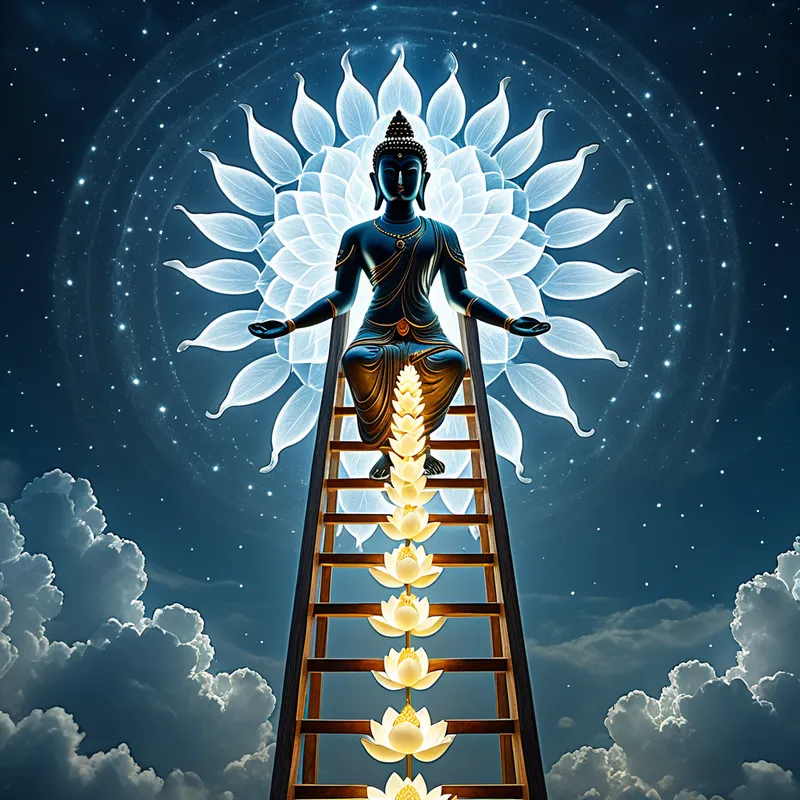
The Ladder of the Ten Bhumis Myth Meaning & Symbolism
A celestial journey of the Bodhisattva ascending ten stages of perfect wisdom, transforming the self to embrace the suffering of all worlds.
The Tale of The Ladder of the Ten Bhumis
Hear now the tale not carved in stone, but etched upon the heart of the cosmos. It begins not with a roar, but with a vow—a whisper so profound it shook the foundations of Samsara. In the realm where time spirals like a nautilus shell, a being of luminous intent stood at the precipice of final peace. This was a Bodhisattva, one who had glimpsed the shore of Nirvana across the dark, churning ocean of existence.
Yet, turning from that blissful silence, the Bodhisattva looked back. What was seen? Not a world, but worlds within worlds, a fractal cascade of suffering: the cry of the newborn, the anguish of the dying, the silent despair of the forgotten. The peace of the far shore became a prison of solitude. From the depths of that compassionate gaze, a resolve was forged—harder than diamond, more flexible than river reed. "I shall not cross alone."
And so, from the very ground of that vow, it began to grow. Not a path, but a ladder. Its base was rooted in the mire of the world, in the mud of ignorance and fear. Its first rung shimmered into being, not of wood or iron, but of Dana-Paramita, the perfection of giving. To ascend it, the Bodhisattva had to give away not just possessions, but the very idea of a "self" to give them.
The climb was the alchemy. Each rung was a world, a stage, a Bhumi. The second rung, of Sila, demanded a purity of action that reflected like a flawless mirror. The third, of Kshanti, required standing unmoved as the storms of malice and delay raged. With each step, the Bodhisattva transformed, and the ladder stretched further into a sky now thick with constellations of wisdom.
The middle rungs were a forge. On the sixth, the Prajna-Paramita blazed like a sun, incinerating all illusions. What remained was not ash, but luminous, empty clarity. Now the climb became not an effort, but a graceful unfolding. The higher rungs—skillful means, profound resolve, unwavering power—were no longer achievements, but natural emanations of a heart grown vast as space.
At the tenth and final Bhumi, the Dharmamegha, the Bodhisattva did not find a throne, but became a raincloud. The ladder had dissolved. The climber and the climb were one. From this height, a nectar of compassion fell as a gentle, inexorable rain upon all parched realms, preparing the earth for the final, supreme awakening. The journey was complete, yet the vow was just beginning its eternal work.

Cultural Origins & Context
The mythos of the Ten Bhumis is not a folktale but a sophisticated map of the mind, emerging from the Mahayana Buddhist tradition between the 1st century BCE and the 4th century CE. It is systematically elaborated in seminal texts like the Avatamsaka Sutra and the Bodhisattvabhumi. This was not a story told around a fire for entertainment, but a curriculum transmitted from master to disciple within monastic universities like Nalanda.
Its primary function was initiatory and pedagogical. It provided a graduated, psychological framework for practitioners who had taken the Bodhisattva vow, transforming the abstract ideal of enlightenment into a structured, attainable journey. Each Bhumi was described with precise signs, attainments, and the specific obscurations to be purified. It served as a societal anchor for the Mahayana worldview, elevating the ideal of the compassionate sage who postpones their own final rest for the welfare of the world, over the earlier Theravada ideal of the Arhat who achieves liberation for oneself.
Symbolic Architecture
The Ladder is the ultimate symbol of structured transformation. It represents the paradox of the spiritual path: a linear progression through stages that ultimately reveals the nonlinear, immanent nature of awakening.
The ladder is not climbed to reach a higher place, but to dismantle the very idea of height and depth, until only the climbing—the compassionate activity itself—remains.
Each Bhumi is an archetypal layer of the psyche being integrated. The early Bhumis (1-3) deal with the foundational virtues of the developed personality: generosity, ethics, patience. The middle Bhumis (4-6) represent the heroic struggle with the core of the ego: effort, meditation, and the piercing wisdom that sees through its illusion. The final Bhumis (7-10) symbolize the flowering of a transpersonal consciousness: effortless skill, unwavering intention, spiritual power, and the consummation of wisdom as a nourishing, universal force (the Cloud of Dharma).
The ascent is not an escape from the world, but a deeper immersion into its true nature. The base in the "mud" is critical; enlightenment is not a rejection of the somatic, earthly experience, but its ultimate purification and fulfillment.

The Dreamer's Resonance
When this myth stirs in the modern dreamer, it often manifests not as a literal ladder, but as a profound, somatic experience of ascent through ordeal. One may dream of climbing an endless staircase in a familiar yet alien building, each floor presenting a different emotional challenge—a room of grief on the fourth floor, a hall of mirrors (self-reflection) on the sixth. The dreamer feels a solemn responsibility to keep climbing, even as the body grows weary.
This dream pattern signals a psyche engaged in a profound process of integration and vertical transformation. It is the soul's recognition that personal growth has become a structured, inevitable journey. The somatic feeling of strain in the climb reflects the real psychological work of digesting life experiences—failures, insights, traumas—and alchemizing them into wisdom. To dream of reaching a landing or a vast, open space at the top indicates a moment of synthesis, where a major life stage has been integrated, offering a new, broader perspective. Conversely, dreaming of a broken or missing rung often points to a perceived blockage in developing a specific "virtue" or capacity, such as patience (Kshanti) or disciplined meditation (Dhyana).

Alchemical Translation
For the modern individual navigating the path of individuation, the Ladder of the Ten Bhumis is a master blueprint for psychic transmutation. It models the move from ego-centricity to world-centric consciousness.
The initial vow—the turning back from private peace—is the critical first step in depth psychology: the commitment to the totality of the Self, which includes embracing the shadow and the suffering of the inner and outer world. Each Bhumi then becomes a stage of opus, the alchemical work.
The alchemy occurs in the tension between the steps: we solidify a virtue (Sila) only to have it shattered by the demand for transcendent patience (Kshanti), forcing a deeper, less rigid integration.
The early stages involve building a competent, ethical ego (the persona refined into genuine character). The pivotal sixth Bhumi, Prajna-Paramita, is the confrontation with the unconscious, the "nigredo" where the illusion of a separate, solid self is dissolved by the fire of insight. What emerges is not annihilation, but the birth of the authentic subject, the "I" that is paradoxically connected to all things.
The final stages represent the full embodiment of this realization. The individual no longer "has" wisdom but is a channel for it. Their actions (Upaya, Skillful Means) become spontaneously appropriate, their will (Pranidhana, Resolve) aligns with the deeper currents of life, and their very presence (Bala, Power) becomes a healing, stabilizing force. They become, in psychological terms, a vessel for the Self, where personal identity has been transfigured into a purposeful, compassionate function within the greater human community. The ladder, having served its purpose, disappears, leaving only the lived reality of a heart that holds the universe.
Associated Symbols
Explore related symbols from the CaleaDream lexicon: