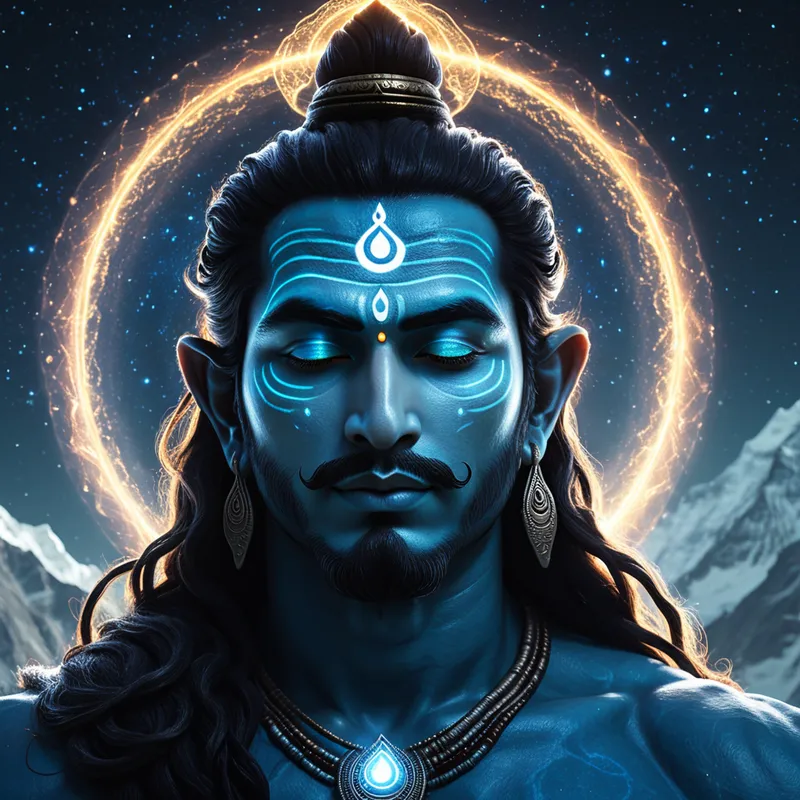
Rudraksha Mala Myth Meaning & Symbolism
The story of how the fierce god Shiva's tear of compassion for all life fell to earth and crystallized into the sacred seed of awakening.
The Tale of Rudraksha Mala
In the time before time, when the cosmos was a raw, churning ocean of potential, the great ascetic, the destroyer and renewer, Shiva, sat in unwavering samadhi. His abode was the silent, snow-laden crown of the world, Mount Kailash. For millennia uncounted, he remained, a still point in the turning wheel of creation and destruction, his consciousness merged with the absolute. The dance of the universe played out before his closed eyes—galaxies being born in fiery nebulae, civilizations rising and falling like waves, the endless cycle of life, death, and rebirth in every blade of grass and every beating heart.
But a tremor passed through that perfect stillness. Not a tremor of the earth, but of the soul. From the depths of his transcendent meditation, a profound vision arose. He saw not the grand cosmic play, but the intimate, agonizing drama of the individual soul—the jiva. He saw the ceaseless wandering, the clinging, the fear, the crushing weight of ignorance (avidya), and the desperate, often futile, search for liberation (moksha). He witnessed the suffering inherent in the very fabric of manifested existence.
A great compassion (karuna) welled up within him, a tidal wave of empathy for all trapped in the net of maya. This compassion was so vast, so intense, that it could not be contained within the formless state of pure consciousness. It demanded expression. It pressed against the inner eye of his supreme awareness.
And then, he opened his eyes.
Not the two eyes that see the world of form, but the third eye, the ajna chakra, the seat of intuitive wisdom and fiery discernment. As that eye opened, a single tear formed. It was not a tear of sorrow, nor of joy, but of pure, distilled compassion—a liquid embodiment of his desire to alleviate the suffering of all beings. This tear was luminous, holding within it the blue of the infinite sky and the fierce heat of transformative knowledge.
The tear grew heavy with its purpose, detached, and fell. It did not fall onto the stone of Kailash, but descended through the realms, a falling star of divine intent. It journeyed from the realm of pure consciousness, through the subtle planes, and into the dense, material world. As it touched the earth, in the lands that would become the Himalayas, it did not splash and vanish. It crystallized. It hardened into a seed, dark blue like a stormy night, its surface etched with deep, natural lines (mukhis). It was the seed of Shiva's compassionate gaze, a physical anchor of his protective, awakening energy. From this first seed, a great tree grew, and from its fruit came countless more. These were the Rudraksha, and when strung together, they became the mala—a circle of tears turned into a tool for drying the tears of the world.

Cultural Origins & Context
The myth of the Rudraksha is woven into the fabric of Puranic literature, particularly the Shiva Purana and the Rudraksha Jabala Upanishad. It was not a tale confined to temples alone but was carried by sadhus, gurus, and storytellers into villages and royal courts alike. Its transmission was oral, somatic, and practical. The story explained the origin of a sacred object that many could hold, wear, and use.
Societally, the myth served multiple functions. It sanctified a natural object, elevating it from a mere seed to a divine relic, making the sacred accessible. It reinforced the core theological principle of Shiva as both the terrifying Rudra and the compassionate Mahadeva. Most importantly, it provided a mythic blueprint for spiritual practice. The mala was not just jewelry; it was a technology for consciousness, a tactile link between the devotee's rhythmic prayer (japa) and the primordial moment of divine compassion that birthed it. The myth gave every practitioner a personal connection to the origin of their practice.
Symbolic Architecture
The Rudraksha Mala is a dense, multi-layered symbol. At its core, it represents the materialization of transcendent compassion. Shiva's tear is the point where infinite, formless empathy condenses into finite, usable form. It is the archetypal pattern of spirit becoming matter for the sake of guiding matter back to spirit.
The tear is the bridge between the agony of the human condition and the equanimity of the divine; it is empathy crystallized into a tool for transcendence.
The seed itself is a microcosm. Its hard, dark exterior symbolizes the challenges and obscurities of earthly life (samsara). The intricate lines or mukhis (often ranging from 1 to 21) represent the various facets of cosmic law, divine energies, and pathways of consciousness. The central, natural hole signifies the channel through which spiritual aspiration must pass—a reminder of the need for piercing through illusion. Strung together, the seeds form a circle, the mandala of practice, with the larger meru bead representing the mountain of enlightenment one circumambulates but does not claim.
Psychologically, the myth maps the process of internalizing the compassionate witness. The suffering Shiva sees is the collective human shadow—our fears, attachments, and ignorances. His tear is the birth of a conscious, caring awareness within the individual psyche that can look upon its own suffering without being destroyed by it. The mala becomes a symbolic container for this inner witness, a circlet of self-compassion worn against the heart.
The Dreamer's Resonance
When the motif of the Rudraksha Mala appears in modern dreams, it often signals a profound somatic and psychological process: the crystallization of insight from emotional intensity. The dreamer may be in a period of deep empathy fatigue, spiritual longing, or processing collective or personal suffering.
To dream of finding or receiving a Rudraksha seed suggests a nascent, hard-won insight is forming from a place of deep feeling—a "tear" of personal experience is being transformed into a durable truth. To dream of a broken mala indicates a fragmentation of one's spiritual practice or core values under pressure, a felt disconnect between compassion and daily action. Dreaming of wearing a mala that feels electrifying or heavy can mirror the somatic sensation of taking on a new level of conscious responsibility—the weight and the charge of awakening.
The dream is the psyche's way of performing the myth: showing the individual that their pain, their empathetic overwhelm, their "tears," are not wastes of energy. They are the very substance from which a protective, guiding, and transformative structure of consciousness can be formed. It is an invitation to string together disparate experiences of suffering and insight into a coherent practice of self-observation.

Alchemical Translation
The alchemical journey modeled by the Rudraksha myth is not one of conquering a beast or finding a treasure, but of transmuting raw, watery emotion into a solid, structured tool for inner work. The prima materia is not lead, but the salt of our own tears—the pain of awareness, the suffering of empathy, the grief of the world felt personally.
Individuation requires that we do not shy away from the tears evoked by life; we must catch them, honor them, and allow them to crystallize into the seeds of our own wisdom.
The first stage, nigredo, is represented by Shiva's vision of universal suffering—the confrontation with the shadow, both personal and collective. The albedo, the whitening, is the moment of compassionate recognition, the pure tear itself—emotion clarified into its essence. The rubedo, the reddening or crystallization, is the fall to earth and the formation of the seed—the integration of that clarified emotion into a functional part of the personality, a "psychic organ" for meditation and grounding.
For the modern individual, this translates to a practice of alchemical journaling or reflective meditation. When overwhelmed by empathetic distress or personal sorrow, the task is not to dismiss it or wallow, but to sit with it as Shiva sat in meditation. Then, to consciously "extract the seed"—to write down the core insight, to formulate a prayer or intention, to create a simple ritual act that embodies the lesson learned. This transforms passive suffering into an active component of one's spiritual-psychological toolkit. The "mala" one builds is not of physical seeds, but of these crystallized insights—a string of hard-won truths that one can hold onto, count upon, and use to navigate the darker passages of the soul's journey, turning the circuit of suffering into a mandala of meaning.
Associated Symbols
Explore related symbols from the CaleaDream lexicon: