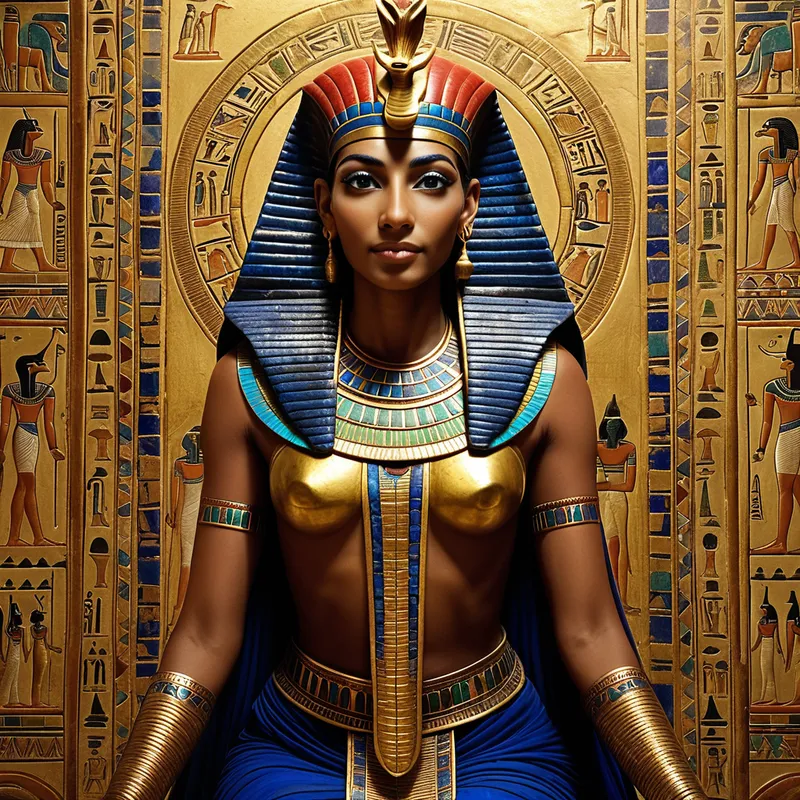
Wadjet Myth Meaning & Symbolism
The story of the fiery cobra goddess who protected the pharaoh, guarded the threshold, and embodied the primal, transformative power of the earth.
The Tale of Wadjet
Before the first stone of Memphis was laid, when the world was still damp from the breath of Nun, the Delta whispered. In the thick, green heart of the papyrus marshes, where the sun fractured into a thousand emerald shards on the water, a presence stirred. She was not born as mortals are born; she coalesced—from the heat of the black earth, from the venom that gives life through death, from the primal instinct to guard what is sacred.
She was Wadjet, the Green One, the She Who is Papyrus-Colored. Her body was the river’s deepest current, her scales the polished flint of the desert night. When she reared, her hood was a blazing sun-disc, a warning and a crown. Her domain was the fertile, chaotic, life-giving North—Lower Egypt—a land of reeds and secrets.
Hear now of her great vigil. A rightful king, an infant, was hidden in the reeds, his life threatened by usurpers. The marsh closed around him like a mother’s arms. And there, silent as a root, coiled as the very knot of existence, was Wadjet. No beast of the swamp dared approach the papyrus thicket where she lay. Her breath was not air, but a barrier; her gaze was not sight, but a shield. She did not fight with tooth and claw in open battle. She was the territory. She was the unblinking eye in the green gloom, the latent fire in the damp coolness. She guarded until the child was safe, until the crown was placed upon a worthy brow, and in that act, the wild, protective fury of the earth itself was wedded to the order of the throne.
From that day, she was bound to the forehead of the pharaoh. As the Uraeus, she sat above the ruler’s eyes, a living diadem of flame. She spat her fire against the enemies of Maat. She was the first to strike, the divine spark of sovereignty and the terrifying promise that to harm the sacred center was to invoke the wrath of the coiled earth.

Cultural Origins & Context
Wadjet’s origins are immemorial, rooted in the pre-dynastic tribal cults of the Nile Delta city of Buto. She was a local goddess of the land itself before she became a national symbol. Her myth was not a single, codified epic recited in temples, but a living truth enacted in ritual and worn on the body of the king. It was passed down through the iconography of crowns, the liturgy of coronations, and the omnipresent gaze of the Uraeus on every statue and relief.
Her primary societal function was dual: she was the protector of the physical kingdom of Lower Egypt and the metaphysical protector of the kingship principle. The pharaoh was not truly pharaoh without Wadjet’s fire upon his brow. She represented the legitimizing power of the land, the ancient, chthonic authority that sanctioned royal rule. In a culture obsessed with order against chaos, she was the necessary, fearsome edge of that order—the controlled burn that prevents the wildfire.
Symbolic Architecture
Wadjet is not a goddess of gentle nurture, but of fierce, uncompromising guardianship. She symbolizes the instinct to preserve the core. Psychologically, she represents the Self’s innate protective mechanisms.
The true guardian does not announce itself in peace; it is the latent, coiled potential for righteous fury that makes peace possible.
Her form, the cobra, is rich in paradox. It is of the earth, yet it rears upward. It is often still, yet possesses blinding speed. Its venom can kill, yet in the right context (and in later medical symbolism), it can heal. This embodies the dual nature of protective power: it is dormant until activated, and its activation is both destructive to the threat and preservative of the protected. The Uraeus on the brow is a sublime symbol of this psychology—the protective instinct elevated to the seat of consciousness and identity. It says, "I am defined, and I will defend my definition."
Furthermore, her association with the papyrus marsh—the fertile, tangled, unpredictable Delta—links her to the protective forces that arise from the unconscious itself. She is the guardian that emerges from the psychic swamp to protect the nascent, vulnerable Self (the divine child) from being overwhelmed by internal or external chaos.

The Dreamer's Resonance
When the energy of Wadjet stirs in modern dreams, it rarely appears as a literal Egyptian goddess. Instead, one might dream of a powerful, watchful snake in the basement of a childhood home, coiled calmly in the corner of a new office, or encircling the dreamer’s waist as a living belt. The somatic feeling is one of intense, focused alertness—a heat at the forehead or the base of the spine. There is no fear of the snake, but a profound respect for its presence.
These dreams often surface during life transitions where a new, fragile aspect of identity is forming—starting a creative project, entering a new relationship, or setting a vital personal boundary. The "Wadjet dream" signals the activation of deep, autonomous psychic defenses. The psyche is announcing, "This new growth, this vulnerable truth, is now under protection." The process is one of establishing psychic sovereignty. The dreamer is not necessarily becoming aggressive, but they are integrating the capacity for self-preservation at an archetypal level, learning to wear their own Uraeus.

Alchemical Translation
The alchemical journey modeled by Wadjet is the transmutation of raw, instinctual defense into conscious, sacred guardianship of the Self. It begins in the massa confusa of the Delta—the confused, emotional, and potentially chaotic realm of one’s personal history and unconscious patterns.
The first operation is coagulatio: the coalescing of a protective intent from this soup of experience. This is the formation of the "coiled" stance—a gathering of one’s resources, boundaries, and resolve. The second is sublimatio: the elevation of this instinct to the brow, to the seat of consciousness. This is the moment one consciously decides, "I will protect my inner truth, my creative spirit, my right to exist as I am." The instinct is no longer a blind reaction; it becomes a chosen principle, a part of one’s sovereign identity.
Individuation requires not just exploration but fortification. To become who you are, you must first defend the space in which that self can be born.
The final, ongoing operation is the maintenance of the Uraeus. Its fire must be disciplined—not unleashed in petty rage, but held in reserve as a defining, purifying force. To integrate Wadjet is to achieve a fearsome calm. You carry the latent, transformative fire. You become the guarded sanctuary and the guardian simultaneously, able to say with the quiet authority of the earth itself: "This is my territory. This is my truth. It is under protection."
Associated Symbols
Explore related symbols from the CaleaDream lexicon: