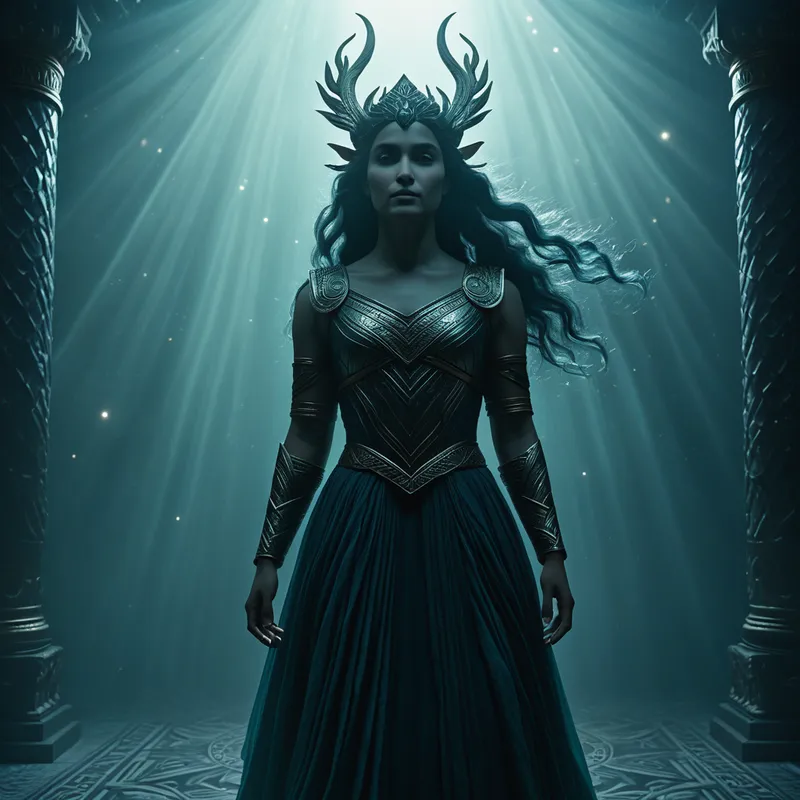
The Seraphim and Cherubim
Celestial beings of Hebrew tradition, the Seraphim and Cherubim serve as divine guardians and messengers, embodying purity and power.
The Tale of The Seraphim and Cherubim
The vision begins not in a place, but in a presence. It is the year King Uzziah dies, and the prophet Isaiah stands in the temple, the air thick with incense and the weight of a nation’s uncertainty. Then, the veil tears not in cloth, but in perception. Above the very throne of the Eternal, he sees them: the Seraphim. They are not gentle figures, but towering conflagrations of being. Each has six wings: with two they cover their faces, unable to bear the direct gaze of the Holy; with two they cover their feet, a gesture of ultimate humility and mystery; and with two they fly. Their cry to one another shakes the foundations of the temple: “Holy, holy, holy is the Lord of Hosts; the whole earth is full of His glory!” The sound is like a river of fire. One seraph flies to the prophet, holding a glowing coal taken from the altar with tongs. It touches Isaiah’s lips, searing away his impurity, forging his tongue for prophecy. Here, the Seraphim are agents of terrifying purification, the fire that both annihilates and consecrates.
Elsewhere, in the primal memory of Eden, another presence guards. After the man and the woman are sent forth, their home sealed, Cherubim are placed at the east of the garden. They hold a flaming sword that turns every way, guarding the way to the Tree of Life. They are motion and vigilance incarnate, a revolving barrier of divine fire and sharp edge. They do not speak; their presence is their proclamation. They mark a boundary that cannot be crossed, protecting a holiness that has become inaccessible, ensuring that immortality is not seized in a state of rupture.
Ezekiel, by the river Kebar, sees them in the heart of the storm-wind. Four living creatures, later named Cherubim, each with four faces—of a man, a lion, an ox, and an eagle—and four wings. Their movement is a perfect, synchronized thunder: “Wherever the spirit would go, they went, without turning as they went.” Their forms are integrated with wheels within wheels, full of eyes, a vision of omniscient, omnidirectional motion. They are the chassis of the divine chariot, the very embodiment of God’s mobile sovereignty. They are not merely beside the throne; they are the dynamic foundation of its movement through the cosmos.
Cultural Origins & Context
These beings emerge from the core tensions of ancient Hebrew theology: the overwhelming transcendence of a God who cannot be seen or represented, and the profound need to articulate the experience of His proximate, active presence. The Seraphim and Cherubim are theological instruments, poetic solutions to an impossible equation. They are the “noble court” of the Divine King, serving to magnify His holiness and execute His will while preserving His fundamental otherness.
The Cherubim have deep archaeological roots, their iconography borrowed and radically transformed from the colossal winged guardians (lamassu, sphinxes) of Mesopotamian and Egyptian palaces and temples. In Israel’s context, they are “demythologized” and subsumed into Yahweh’s service. They are not independent deities but functionaries. Their images adorn the Tabernacle and Solomon’s Temple, woven into the inner curtain and fashioned in olive wood overlaid with gold for the Ark of the Covenant’s cover—the Mercy Seat. Here, they gaze upon the space where God’s presence meets humanity, a silent witness to the covenant.
The Seraphim appear explicitly only in Isaiah’s vision, yet their conceptual fire burns throughout the prophetic tradition. They represent the aspect of God that is mysterium tremendum et fascinans—the terrifying and fascinating mystery. They belong to the realm of the temple’s inner court, the altar of sacrifice, the consuming fire that is both judgment and the source of prophetic authority.
Symbolic Architecture
The architecture of these beings is a precise geometry of relationship. Their forms are not arbitrary but are symbolic blueprints of consciousness in relation to the Absolute.
The Seraphim, with covered face and feet, enact the ultimate posture of the soul before the Divine: a simultaneous recognition of glory and unworthiness. Their six wings symbolize a triune movement—reverence, humility, and service. They are pure adoration made manifest, the fire of love that refines by its very proximity.
The Cherubim are symbols of synthesized cosmic power and vigilant guardianship. Their four faces—man, lion, ox, eagle—have been read as the pinnacle of creation (humanity, wild beasts, domestic animals, and birds) or as the attributes of divine sovereignty: intelligence, strength, service, and transcendence. Their eyes-covered wheels speak of all-seeing knowledge and the complex, often inscrutable, machinery of divine providence. They guard thresholds: of Eden, of the Holy of Holies, of the path between heaven and earth in Ezekiel’s vision.
The flaming sword of the Cherubim is not merely a weapon but a symbol of the irreversible nature of certain spiritual transitions. It guards not just a place, but a state of being. It represents the divine “No” that is itself a form of protection, preventing a return to innocence that is no longer possible, forcing the journey forward into time and history.
The Dreamer's Resonance
To encounter a Seraph or Cherub in the inner landscape of dream or vision is to meet an aspect of the psyche that is numinous, authoritative, and utterly non-personal. They do not represent the individual’s ego, but the ego’s confrontation with something vastly greater that structures its world.
A Seraphim encounter speaks of a moment of searing clarity or purgation. It is the coal to the lips: a painful, necessary burning away of an old way of speaking, seeing, or being that blocks authenticity. It is the call to a vocation that feels both terrifying and electrifying. Psychologically, it is the Self (in the Jungian sense) intervening with transformative fire, demanding integration at a higher, more demanding level of truth.
A Cherubim encounter is a confrontation with guardianship and boundary. It may appear as an immovable guardian at a threshold in one’s life, a revolving sword of consequences, or the feeling of being “seen” by an all-knowing presence. It represents the internalized structures of law, morality, and cosmic order. To be stopped by a Cherub is to be forced to consider whether one is attempting to re-enter a “Eden” of childish innocence or dependency, or to seize a “fruit” of knowledge or power for which one is not yet prepared. It is the psyche’s own custodian of deep, archetypal law.
Alchemical Translation
In the alchemy of the soul, these angels represent different stages of the opus. The Seraphim govern the stage of calcinatio—burning by divine fire. This is the destruction of the ego’s impurities, its pretensions and defenses, in the heat of a profound encounter with meaning. It is a spiritual incineration that leaves only essential ash, from which a new consciousness can arise. Their work is violent grace.
The Cherubim preside over the stage of separatio and coagulatio—the guarding of boundaries that allow for the separation of elements and their eventual recombination at a higher level. They are the vigilant force that ensures the sacred vessel is not breached, that the process is not contaminated or prematurely ended. Their flaming sword is the discriminating fire that separates spirit from literal-mindedness, eternity from temporal grasping.
Together, they orchestrate a sacred hierarchy within the psyche. The Seraphim pull the soul upward toward union through fiery love; the Cherubim maintain the necessary structure and order that makes such an ascent possible, preventing a dissolution into chaos. They are the two hands of the archetypal Caregiver: one that purifies and heals with fierce love, the other that protects and sets limits with unwavering firmness.
Associated Symbols
Explore related symbols from the CaleaDream lexicon:
- Fire — The essential element of the Seraphim, representing divine presence, purification, judgment, and the transformative energy that consumes impurity to reveal essence.
- Guardian — The primary function of the Cherubim, embodying the archetype of the protector of sacred thresholds, divine law, and the boundary between the profane and the holy.
- The Hierarchy — The explicit celestial order these beings inhabit, symbolizing the structured, layered nature of reality, consciousness, and the descent of divine influence into the world.
- Sword — Specifically the flaming sword of the Cherubim, a symbol of discriminating judgment, the cutting truth that separates, defends, and enforces spiritual boundaries.
- Wheel — Evoking the Ophanim associated with the Cherubim in Ezekiel’s vision, representing cosmic order, divine omnipresence, and the complex, cyclical machinery of fate and providence.
- Throne — The ultimate context for both beings; the Seraphim attend it, the Cherubim form its foundation, symbolizing divine authority, sovereignty, and the stable center of all creation.
- Altar — The source of the Seraph’s coal, the place of sacrifice and sacred exchange where the human and divine meet, paralleling the function of these beings as mediators.
- Face — The covered faces of the Seraphim and the multiple faces of the Cherubim speak to the mystery of divine identity, the multifaceted nature of God’s manifestations, and the human inability to behold the Fullness directly.
- Door — The threshold guarded by the Cherubim in Eden, representing any point of irreversible transition, initiation, or passage between states of being, consciousness, or realms.
- Lightning — The sudden, terrifying, and illuminating manifestation of divine power and presence, akin to the abrupt appearance and awe-inspiring movement of these celestial beings in prophetic visions.