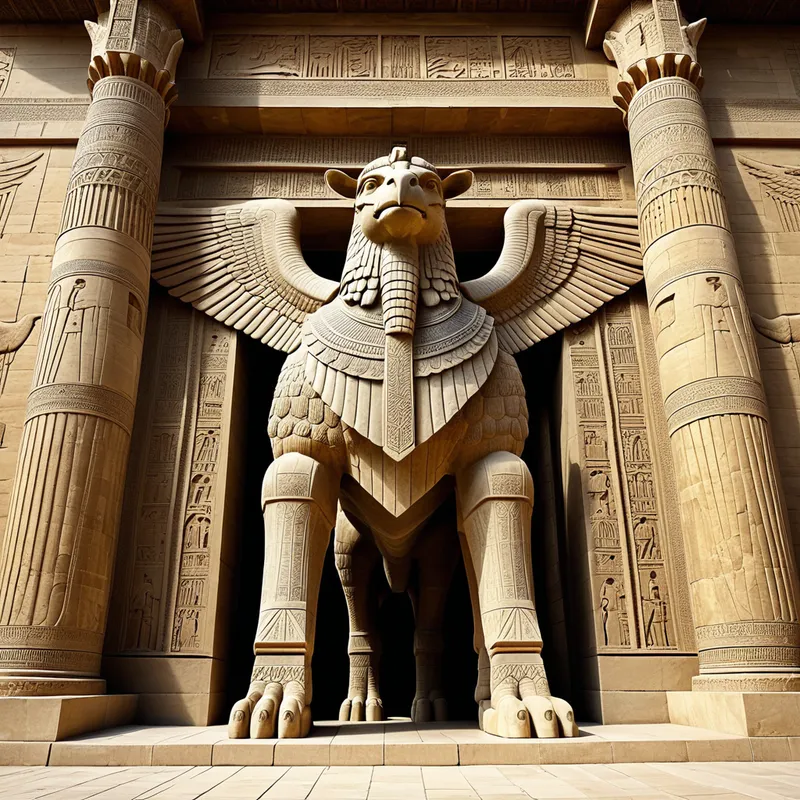
Lamassu Myth Meaning & Symbolism
A colossal guardian spirit of stone, with the head of a human, the body of a bull, and the wings of an eagle, standing watch at the gates of kings and gods.
The Tale of Lamassu
Before the world was divided into day and night, before the first brick of Babylon was laid, the air between heaven and earth was a realm of pure intention. It was here, in the breath of Anu, that the Lamassu was conceived. Not born of clay or womb, but summoned from the very substance of sovereignty and fear.
Listen. Can you hear the groan of stone awakening?
It begins with a king’s terror. He dreams of chaos slithering under his city gates, of whispers in the dark that unravel the order of his kingdom. He climbs the ziggurat, the stairway to heaven, his robes heavy with the scent of cedar and desperation. He pours libations of honeyed wine onto the altar of Ashur and makes his plea not with words, but with the silent, trembling weight of his duty.
And the gods, in their council of stars, heed it. From the forge of divine will, they sculpt a sentinel. They take the knowing brow of a human sage, so it may comprehend law and lament. They harness the mountainous strength of the wild bull, so it may stand unyielding against any storm. They grant it the vast, soaring wings of the eagle, so its vision may pierce the veil between worlds. This is no mere statue. This is a thought of the gods made manifest—a šēdu and lamassu combined.
The air shimmers at the palace threshold. The scent of ozone and crushed limestone fills the courtyard. With a sound like a mountain settling, it appears. Its five legs are an architect’s riddle and a priest’s wisdom: standing firm from the front, striding eternally from the side. It does not breathe, yet its presence is a wind that pushes back the formless dark. It does not speak, yet its gaze—inlaid with precious stone that holds the light of the firmament—pronounces a single, silent decree: Thus far, and no farther.
Night after night, the chaotic whispers beat against its stony flanks and fall silent. The king sleeps, and his dreams are of straight canals and full granaries. The people pass beneath its shadow, and they feel not fear, but the strange comfort of a boundary that holds. The Lamassu does not fight; it is. It is the permanent answer to a temporary question of chaos. It turns the gateway, the vulnerable opening, into the strongest part of the wall. And there it stands, for centuries, until the king, the city, and even the gods who made it are forgotten—a testament written not on clay, but in the very geometry of protected space.
Cultural Origins & Context
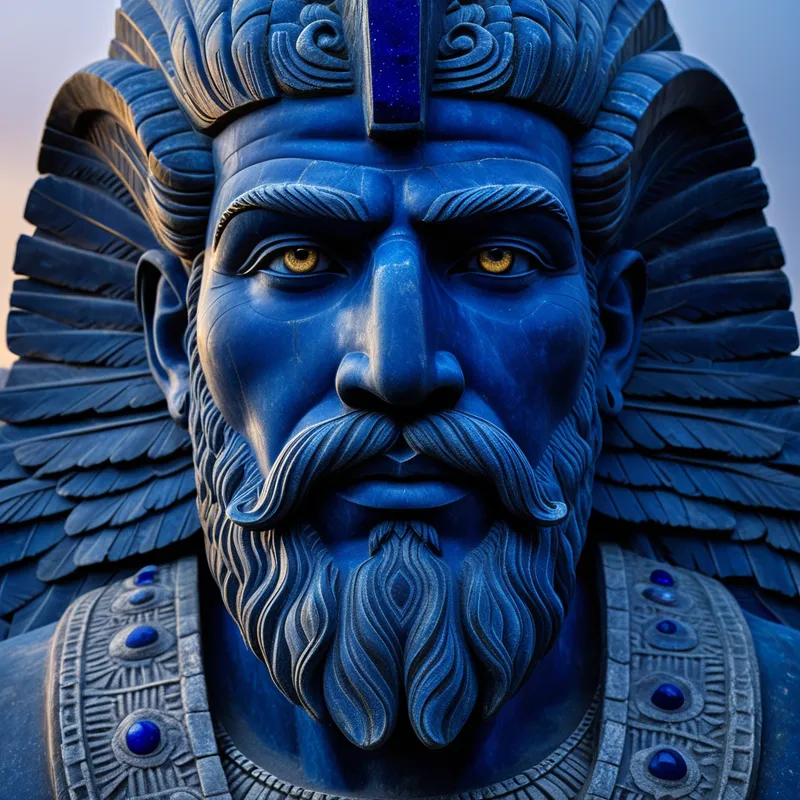
The Lamassu was not merely art; it was functional melammu, a radiant, awe-inspiring terror that was a core component of Assyrian imperial ideology. From the palaces of Nimrud to Nineveh and Dur-Sharrukin, these colossal figures were the first and most imposing "text" a visitor would "read." They flanked the gates of citadels and throne rooms, acting as psycho-spiritual filters.
Their audience was dual: the foreign envoy, who would be immediately overwhelmed by a display of superhuman power, and the citizen, who would be reassured of the king’s divine mandate to maintain cosmic and social order. The mythos of the Lamassu was transmitted not through a single epic poem, but through a repetitive, architectural liturgy. Every newly erected pair was a re-enactment of the primordial act of divine protection, reinforcing the king’s role as the earthly steward of that power. The craftsmen who carved them were likely following precise ritual prescriptions, turning stone into a permanent prayer for stability. In a world perceived as constantly threatened by chaos (Tiamat's enduring legacy), the Lamassu was a bulwark of me.
Symbolic Architecture
The Lamassu is a supreme symbol of integration. It is a conscious synthesis of three realms: the human (intellect, consciousness), the terrestrial (bull: strength, fertility, stability), and the celestial (eagle: spirit, vision, transcendence). It is not a hybrid monster born of confusion, but a deliberate, divine amalgam representing totalized awareness and capability.
It is the embodiment of the threshold itself—not as a barrier, but as a conscious interface where different orders of reality meet and are held in sacred tension.
Psychologically, it represents the Self in the Jungian sense—the archetype of wholeness and the regulating center of the psyche. Its stationary, vigilant posture symbolizes the need for a stable, central core of identity that can observe the comings and goings of emotional and instinctual forces (the "chaos" from the outside and the inside) without being overthrown. Its five-legged illusion speaks to the nature of psychic truth: from one perspective (the frontal, conscious view), we appear static and integrated; from another (the profile, the shadow side), we are caught in perpetual motion, forever in process. The Lamassu accepts and contains both truths simultaneously.
The Dreamer's Resonance
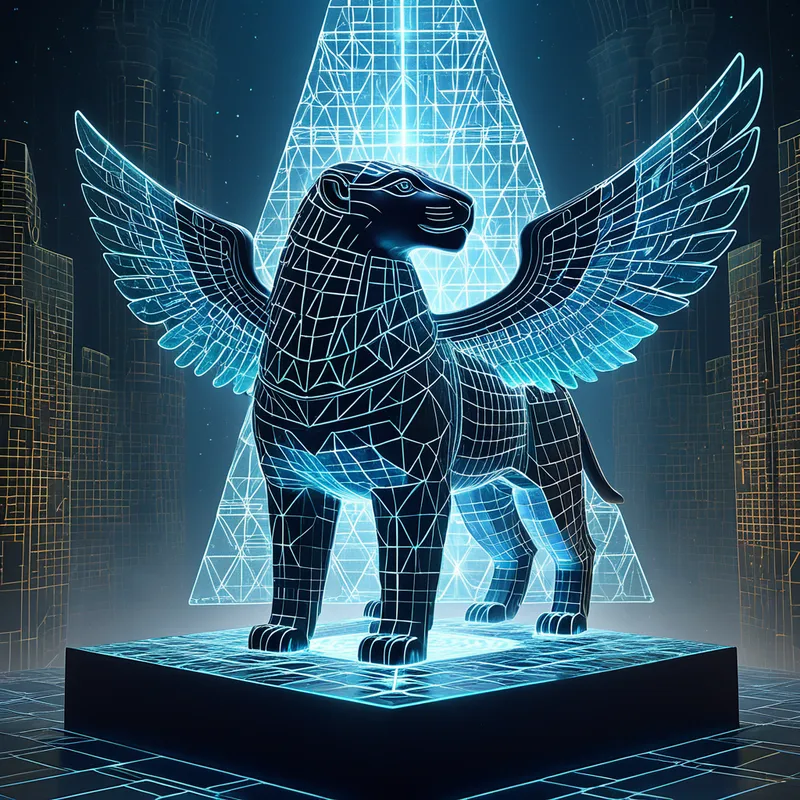
To dream of a Lamassu is to encounter the psyche’s own guardian of a critical threshold. The dream setting is paramount. Is it blocking a doorway in your childhood home? Standing in a foggy field you must cross? Or perhaps it is crumbling, or turned to glass?
Such a dream often emerges during life transitions—career changes, relational shifts, or deep inner work—where a part of the psyche feels vulnerable to being overwhelmed. The Lamassu’s appearance signals the Self mobilizing resources to protect a nascent, fragile state of being. The somatic feeling is often one of immense, grounding pressure and awe, a "sacred dread." If the dream-Lamassu is passive and watchful, it may reflect a healthy, internalized boundary. If it is aggressive or obstructing, it may point to an overly rigid defense mechanism that protects but also imprisons. A damaged Lamassu can indicate a crisis of one’s foundational values or protective structures, a feeling that the inner citadel has been breached.
Alchemical Translation
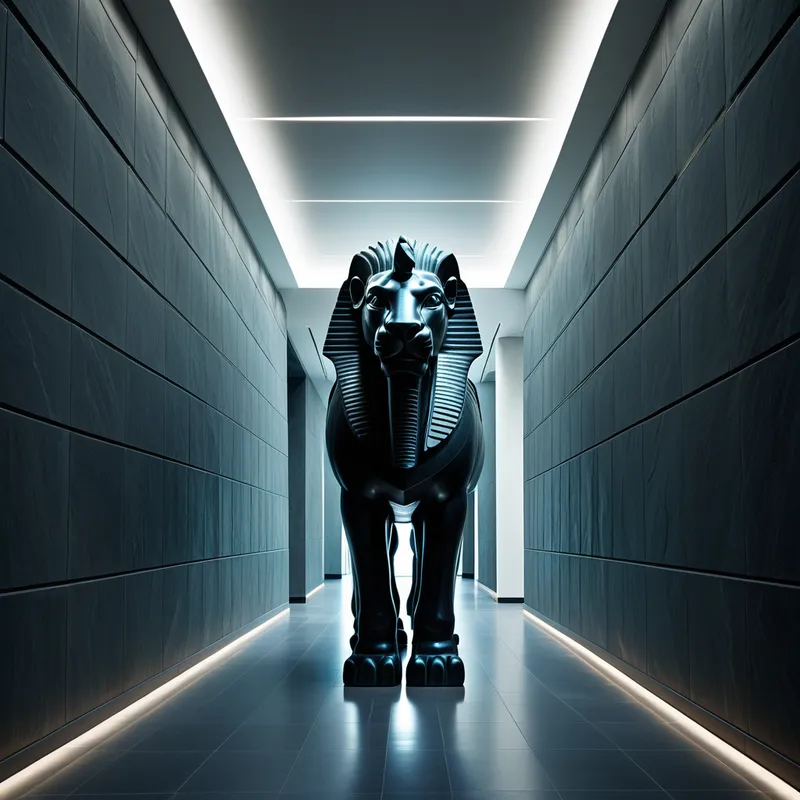
The individuation process requires building an inner citadel—a coherent Self capable of withstanding the pressures of the personal and collective unconscious. The myth of the Lamassu provides a profound model for this alchemical work.
First, we must consecrate the threshold. Identify the psychic "gateways"—where your conscious ego-life meets the unknown, be it a powerful emotion, a creative impulse, or a shadow aspect. This is the site of vulnerability and potential.
Second, we engage in divine synthesis. We consciously call upon and integrate our own "three natures": the human (our reasoned understanding and values), the bull (our embodied instincts, resilience, and life force), and the eagle (our aspirational spirit, our capacity for overview and transcendence). We do not reject our animality or spiritualize away our physicality; we architect a being that holds all.
The goal is not to become a static statue, but to become a living threshold—a permeable, conscious entity through which experience can flow without causing collapse.
Finally, we assume the posture of vigilant presence. This is the practice of the observing Self. From this centered, integrated place, we can witness the chaos—the inner critics, the fears, the chaotic impulses—without identifying with them or being destroyed by them. We pronounce, from a place of wholeness, the Lamassu’s silent decree on what may enter the sanctum of our being. In this act, we transmute raw, defensive fear into empowered, structured sovereignty. We become, in our own right, the guardian and the gateway.
Associated Symbols
Explore related symbols from the CaleaDream lexicon: