Cherubim Myth Meaning & Symbolism
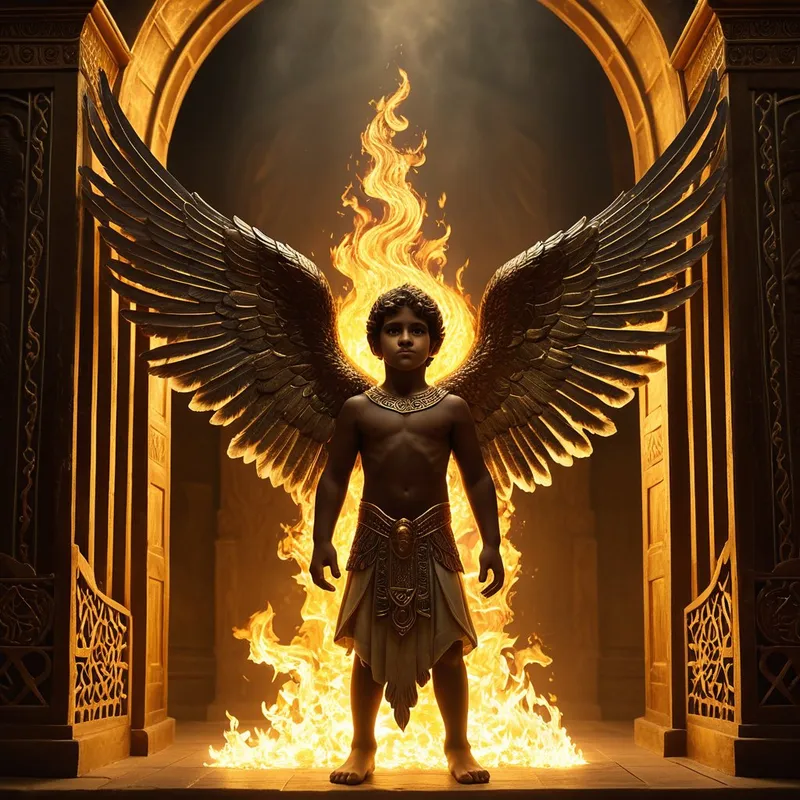
Majestic, composite beings of fire and wings, they guard the sacred boundary between the human and the divine, wielding a revolving sword of flame.
The Tale of Cherubim
In the beginning, after the great sundering, the air still hummed with the memory of a voice walking in the cool of the day. The ground of Eden was tender, wounded by the first footsteps of exile. And at the eastern edge of that lost paradise, where the path back into wholeness began to fade into the hard, wide world, the Holy One set a new kind of creation into motion.
Not from dust this time, but from the living coals of the divine council. From the heart of the Merkabah itself, He kindled them: the Cherubim. They did not step onto the earth; they manifested, a thunderclap of presence. The light was not sunlight, but the light that burns before the sun was made—a searing, silent luminescence that cast no shadow, only revelation.
Imagine them not as statues, but as a storm of being. Four faces in one ceaseless rotation: the piercing gaze of the Human, the regal fury of the Lion, the patient, grounded strength of the Ox, and the far-seeing clarity of the Eagle. Their bodies were like burnished bronze, alive with inner fire, and their wings—oh, their wings! Two to veil their towering forms in humility before the Infinite, and two stretched forth, touching wingtip to wingtip with their twin, creating a canopy, a moving vault, a living chariot for the Presence.
And in their hands, now materializing from the very air, a sword. But this was no blade of metal. It was a flame given purpose, a revolving, dancing helix of pure, cauterizing fire. It turned, and turned, and turned—a wheel of guarding, a whirlwind of denial. They placed it there, between the yearning world and the remembered garden. The gate was not closed; it was transformed. It became a threshold of fire, guarded by the fullness of creation itself in concentrated, vigilant form.
The Cherubim did not speak. Their vigil was their language. The rustle of their countless wings was the sound of boundaries being held. The shimmer of their eyes upon their wings was the unblinking watchfulness of a love that protects by saying No, a holiness that preserves the sacred by making it untouchable. They stood, they hovered, they were—the eternal sentinels at the edge of what was lost, holding the space between what is and what once was, so that what once was could remain, forever, inviolate in memory and promise.
Cultural Origins & Context
The Cherubim emerge from the deepest strata of the Hebrew scriptural tradition, their roots likely entwined with ancient Near Eastern protector deities—like the colossal lamassu or sphinx figures that guarded Assyrian palaces. But in the hands of the biblical authors, they underwent a profound theological alchemy. Stripped of independent divinity, they were wholly subsumed into the service of YHWH.
They appear at critical junctures: not just at Eden’s gate, but woven into the very fabric of sacred space. Their forms were hammered into the gold of the Ark of the Covenant, their wings forming the kapporeth, the place of atonement. They were embroidered into the massive curtains of the Tabernacle, the portable temple in the wilderness. In the visionary literature of prophets like Ezekiel, they become the terrifying and magnificent living components of God’s throne-chariot.
This was not mere decoration. It was a symbolic architecture. The Cherubim functioned as the "immune system" of the sacred. They defined the gradient of holiness, marking the transition from the profane to the holy, and from the holy to the Holy of Holies. They were taught by priests and recounted by prophets, a shared cultural code for understanding a fundamental truth: the Divine is approachable only on its own terms, and its treasures are guarded by awe.
Symbolic Architecture
The Cherubim are not monsters of prohibition, but psychopomps of boundary. They represent the psyche’s own necessary guardianship of its most sacred, vulnerable, and formative contents.
Their composite nature is the first key. They are the totality of the living creature: the human (intellect, reason), the lion (passion, sovereignty), the ox (strength, sustenance), and the eagle (spirit, overview). They are undivided wholeness, a model of integrated consciousness. To encounter them is to encounter the Self in its full, daunting complexity.
The flaming sword that turns every way guards not a place, but a state. It is the active principle of discrimination, the psychic energy that must be deployed to protect a nascent wholeness from being dissolved back into chaos.
They guard the Tree of Life. This is the core symbol. After the fall into duality (knowledge of good and evil), immediate access to undifferentiated life-force would be catastrophic—it would eternalize a fractured state. The Cherubim, therefore, protect humanity from a premature immortality, enforcing the necessary journey of growth through time, struggle, and the slow integration of experience. They make the path to the Tree one of quest, not of casual return.
The Dreamer's Resonance
When a Cherubim pattern stirs in the modern dreamscape, it seldom appears as a biblical angel. It manifests as the experience of the guarded threshold.
You dream of a childhood home you cannot enter, though the door is open. You reach for a profound creative idea, only to have a sudden, inexplicable anxiety freeze your hand. You stand before a door in a familiar building that now opens into a blinding, golden light, and a feeling of immense, impersonal power pushes you back. These are Cherubim dreams. The somatic signature is often a mix of awe and acute frustration—a pulled punch in the solar plexus, a caught breath, a sense of being rightly denied.
Psychologically, this signals a confrontation with a personal boundary of the utmost importance. The psyche is declaring, "This space—this memory, this potential, this unintegrated trauma or talent—is not yet ready for conscious occupation. It is still too holy, too raw, too powerful." The dreamer is encountering their own inner guardians protecting a nascent Self from being trampled by the ego’s greed or curiosity. The process is one of respectful recognition, not forced entry.
Alchemical Translation
The individuation journey is, at its heart, a long return to the guarded garden. But the goal is not to evade the Cherubim; it is to integrate their function and, in doing so, transmute the nature of the boundary they guard.
Initially, the flaming sword is experienced as an external prohibition, a "thou shalt not" from God, society, or the superego. The alchemical work begins when we recognize this sword as our own. We must take up the task of guardianship ourselves, learning to say a fierce, compassionate "no" to what would distract, dilute, or violate our deepening integrity. This is the stage of discipline and discernment.
The ultimate transmutation occurs when the guardian becomes the gate. The integrated Self does not banish the Cherubim; it assimilates them. The four faces become the balanced faculties of a mature personality.
The final stage is the mystery hinted at in Revelation, where the curse is reversed, and the Tree of Life stands open. This symbolizes the moment when the boundary between the ego and the Self becomes permeable through conscious relationship, not dissolution. The sword is not destroyed; its fire is internalized as the ardent, protective love one has for one’s own soul and its sacred purpose. The Cherubim no longer block the path; their synchronized movement becomes the path—the living, rotating process of a psyche that has learned to guard its own holiness, and thus, has found its way home.
Associated Symbols
Explore related symbols from the CaleaDream lexicon: