The Pandavas Myth Meaning & Symbolism
Five royal brothers, born of divine essence, navigate a world of treachery to reclaim their kingdom, embodying the eternal human struggle between cosmic order and shadow.
The Tale of The Pandavas
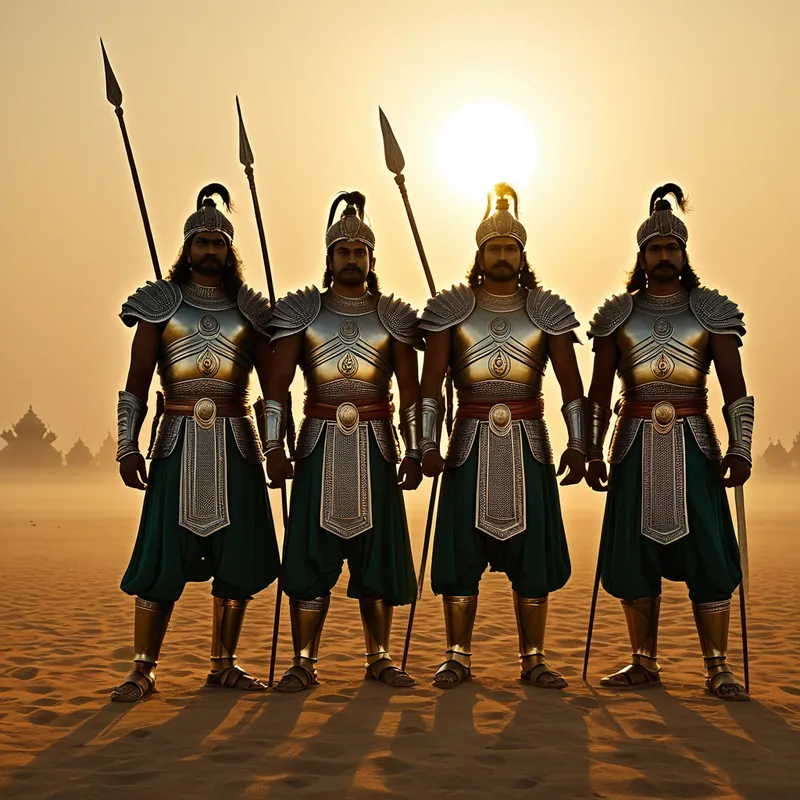
Listen. The air in Hastinapura is thick with the scent of jasmine and intrigue. In a palace of polished sandstone, a king lies dying, his lineage a tangled web. From this twilight, five princes are born, not merely of man, but of the cosmos itself. Yudhishthira, son of Dharma, whose footsteps leave no falsehood. Bhima, son of the Wind, whose strength could shake mountains. Arjuna, son of Thunder, whose arrows could part the rain. And the twins, Nakula and Sahadeva, sons of the celestial Ashwini Kumaras, masters of healing and steeds.
Their childhood is a forest of whispered threats and poisoned sweets, shadowed by their cousins, the hundred Kauravas, led by the envy-ridden Duryodhana. The air crackles with a rivalry as old as time. The Pandavas, through divine favor and sheer virtue, claim a kingdom of their own, Indraprastha, a city of wonders that gleams like a mirage. But from its tallest tower, Duryodhana sees only a reflection of his own lack, a humiliation that curdles into a plot.
He invites the eldest, Yudhishthira, to a game of dice. Not a game of chance, but of fate, loaded with deceit. The dice clatter on the ivory board. With each throw, Yudhishthira, bound by his kingly word, loses it all: his wealth, his kingdom, his brothers, himself, and finally, their shared wife, the luminous Draupadi. In the packed hall, silence screams as she is dragged by her hair. Her cry is not to a king, but to the divine presence in all things. And a miracle unfolds—her sari becomes endless, a river of cloth that cannot be stripped, shielding her dignity before the stunned court.
Exiled. For thirteen long years, they walk the earth as ascetics and in disguise, their royal selves buried deep, their suffering a forge. The forest becomes their teacher, its thorns and fruits shaping their resolve. When they return, transformed but rightful, they are met with empty hands and fortified gates. All avenues of peace crumble to dust. The only language left is that of the battlefield.
On the field of Kurukshetra, two immense armies face each other at dawn. It is here, in the chariot drawn by white steeds, that Arjuna’s spirit falters. He sees grandfathers, teachers, brothers arrayed against him, and his bow, Gandiva, grows heavy. His charioteer, who is none other than Lord Krishna, begins to speak. His words are not of war, but of the eternal soul, of duty (dharma) performed without attachment, of the cosmic dance of creation and destruction. The Bhagavad Gita is born in this moment between heartbeats, a divine song that lifts Arjuna’s gaze from the personal to the universal.
The war is eighteen days of cosmic fury. Divine weapons light the sky, heroes fall like ripe grain, and the earth drinks deep. The Pandavas, guided by Krishna’s wisdom and their own hard-won virtues, prevail. But their victory is ash in the mouth. They stand sovereign over a kingdom of widows and orphans, their own kin slain. In the silence after the storm, Yudhishthira is crowned king, but his heart is a tomb. Their final journey is not to a throne, but to the Himalayas, a slow climb toward renunciation and release, leaving the world of conflict behind, step by step, until they dissolve into the light.
Cultural Origins & Context
This epic narrative forms the core of the Mahabharata, a text of staggering scale often described as "the entire world in a single book." Its composition is layered, spanning centuries from possibly the 8th or 9th century BCE, with accretions continuing for hundreds of years. It was not penned by a single author but woven by many voices—sages, bards, and scholars—making it a living cultural repository.
Traditionally, it is said the sage Vyasa composed it and the god Ganesha served as his scribe. It was passed down orally for generations, performed by traveling storytellers (sutas) and later in elaborate theatrical and puppet traditions. Its societal function was multifaceted: it was a treatise on statecraft, a compendium of philosophy, a guide to dharma in impossible situations, and a mirror held up to the human condition. Every family, every conflict, every moral dilemma could find an echo in its verses, making it not just a story of the past, but a manual for navigating life itself.
Symbolic Architecture
The Pandavas are not merely five individuals; they are a complete psychic entity. They represent the fragmented but noble human psyche striving for integration under the principle of dharma (cosmic order/conscience).
Yudhishthira is the superego, the moral compass. His fatal flaw—the addiction to dice—is the peril of the conscious mind bound by rigid rules and blind spots, gambling away the soul's treasures for the sake of appearances. Bhima is the raw id, the somatic and emotional power, the instinct for survival and justice that operates through brute force. Arjuna is the ego, the conscious actor and achiever, the one who must integrate the inner directives (Krishna's counsel) with outer action. Nakula and Sahadeva represent the often-overlooked faculties of aesthetic appreciation, healing, and connection to nature and instinctual knowledge—the psyche's capacity for restoration and grounded wisdom.
The exile is the necessary descent into the unconscious, where the glittering persona (the kingdom) is lost so the authentic self can be forged in the wilderness of experience.
Their shared wife, Draupadi, is the anima, the soul-force itself. She is the common, luminous center that binds these disparate psychic forces together. Her violation is the ultimate psychic trauma, the threat of the soul's disintegration, and her miraculous protection signifies the indestructible core of Self when it calls upon the transcendent (Krishna). The Kauravas, led by Duryodhana, embody the shadow—the repressed envy, greed, and entitlement that reside within the same psychic family. The war, therefore, is the inevitable, cataclysmic inner conflict that erupts when the shadow is no longer managed but confronted.

The Dreamer's Resonance
When this myth stirs in modern dreams, it signals a profound internal realignment. Dreaming of being cheated in a high-stakes game may reflect a feeling of one's destiny or energy being gambled away by a part of oneself (a rigid principle, a naive trust). The sensation of exile—finding oneself lost in a familiar city or living in a cramped, hidden space—speaks to a period of necessary withdrawal, where one's public identity has become unsustainable and the soul demands a retreat for integration.
A dream of preparing for a great, inevitable conflict, often with family members or old friends as adversaries, mirrors the Kurukshetra moment. It is the psyche marshaling its resources for a decisive inner battle between who you have been (the conditioned, shadow-driven self) and who you are becoming (the integrated Self guided by a deeper wisdom). The somatic feeling is often one of both dread and grim resolution—a tightening in the gut, a clarity in the chest. The dream may not show the battle, but the tense preparation for it, indicating the conscious ego (the Arjuna) receiving guidance from a deeper, inner voice (the Krishna) before the transformation begins.

Alchemical Translation
The Pandava journey is a flawless map of the individuation process. It begins with a divine birth—the emergence of distinct, potent psychic components from the unconscious. The building of Indraprastha is the initial, brilliant but fragile construction of the conscious personality, the ego's proud achievement.
The dice game is the catalytic crisis. The conscious attitude (Yudhishthira), through its own flaws, loses everything to the shadow. This is the essential nigredo, the darkening, the utter defeat that forces a descent. The thirteen-year exile is the soul's albedo, the whitening phase of purification and reflection in the unconscious. Here, in disguise, the heroic ego is humbled, and the other psychic functions (the brothers, Draupadi) are tested and strengthened in equal measure.
Victory on the battlefield of the soul is not the annihilation of the shadow, but its conscious integration, a triumph that tastes of grief because a part of the old self must die.
The return and the war represent the rubedo, the reddening, the fierce and bloody work of confronting and differentiating from the autonomous shadow complexes (the Kauravas). The Bhagavad Gita moment is the transcendent function in action—the revelation from the Self (Krishna) that guides the ego to act not from personal desire or aversion, but from a place of aligned duty to the whole. The final, sorrowful victory and the renunciant climb to the Himalayas signify the last stage: the citrinitas, the yellowing or illumination. The integrated psyche rules, but is no longer attached to the kingdom of the worldly persona. Its work done, it turns inward toward final liberation, leaving the cycles of conflict behind, moving toward a state of wholeness that transcends even the myth itself.
Associated Symbols
Explore related symbols from the CaleaDream lexicon: