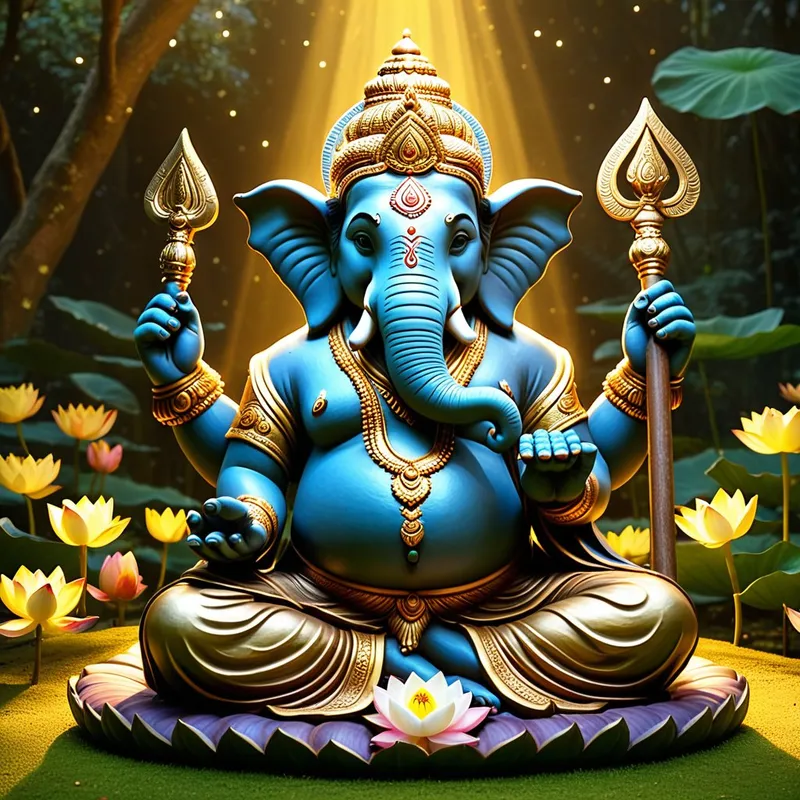
Ganesha Myth Meaning & Symbolism
A child of divine love is beheaded and reborn with an elephant's head, becoming the remover of obstacles and lord of new beginnings.
The Tale of Ganesha
The mountain was her solitude. In the high, silent chambers of Himavan's palace, the goddess Parvati desired a moment utterly her own. Her consort, Shiva, was deep in meditation, his consciousness roaming the void beyond worlds. But in her private chambers, a mother’s wish stirred—a need for a guardian born purely of her essence, untouched by any other will.
With the sacred turmeric paste from her own bath, she kneaded a figure upon the stone floor. Her love, her power, her shakti flowed into the clay-like form. She breathed upon it, and the figure stirred, swelling with life and vigor. He stood before her, a radiant youth, strong and devoted. “You are my son,” she declared. “Your name is Ganesha. Guard this threshold. Let no one pass.”
The youth took his post, a golden staff in hand, his loyalty as absolute as his origin. The sun arced across the sky. Then, a tremor in the air—the return of the Lord. Shiva, drawn back to his abode, approached the unfamiliar door. A stranger barred his way.
“Stand aside,” commanded the god, his voice the rumble of distant thunder. “My mother’s word is my law,” replied the youth, unmoving. A cosmic paradox unfolded at a household door. The guardian of the private self faced the lord of universal dissolution. Wrath, swift and terrible, ignited in Shiva. From his host of Ganas, the command was given. Battle erupted, but the boy, imbued with a goddess’s might, held fast. Finally, in a flash of unbearable fury, Shiva’s trident swept forth. The young guardian’s head was severed from his body.
The silence that followed was colder than the void. Parvati felt the severance in her own soul. Her grief erupted, not as tears, but as a primal roar that threatened to unravel creation itself. The universe darkened. Shiva, the great ascetic, stood confronted by the consequence of his unbridled force. The act demanded restitution.
“Bring me the head of the first being you find,” Shiva instructed his Ganas, “one who sleeps facing north.” They raced across the worlds and found a celestial elephant, its great head turned northward in slumber. With reverence and sorrow, they brought the head to their lord.
At the threshold of the palace, Shiva placed the elephant’s head upon the headless torso of the boy. He breathed the breath of eternal life, the prana, into the form. The child stirred. The elephantine eyes opened, wise and deep. Parvati rushed forward, embracing her son, transformed yet quintessentially hers. Shiva, in turn, embraced him as his own. “You are my son,” he proclaimed. “You shall be worshipped first, before all gods. You are Vighnaharta, the lord of beginnings.”

Cultural Origins & Context
The myth of Ganesha finds its roots in the later layers of Hindu scripture, particularly the Puranas, composed between the 4th and 10th centuries CE. While his figure may have earlier, tribal origins associated with elephant deities and thresholds, his canonical birth story solidified in texts like the Shiva Purana and the Brahma Vaivarta Purana.
This was not a myth confined to temple priests. It was a story told in homes, performed in village plays, and painted on walls. Its primary societal function was multifaceted: it established Ganesha’s supreme status as the first-deity-to-be-invoked (prathama pujya), providing a theological foundation for a ubiquitous cultural practice. More deeply, it served as a narrative vessel to reconcile and integrate powerful, often conflicting, cosmic principles—the boundless, ascetic consciousness of Shiva with the embodied, creative, and fiercely protective power of Parvati. The story taught that true order (dharma) arises not from the dominance of one principle, but from their sacred, if tumultuous, reconciliation.
Symbolic Architecture
At its heart, the myth is a profound allegory of consciousness itself. Ganesha, born of Parvati alone, represents the individual ego or personal identity, fashioned from the substance of our nature (prakriti) and initially separate from the transcendent, universal spirit (Shiva). The guarded threshold is the boundary of the personal psyche.
The first great obstacle we face is our own unintegrated self, defending its sovereignty against the very wholeness that seeks to claim it.
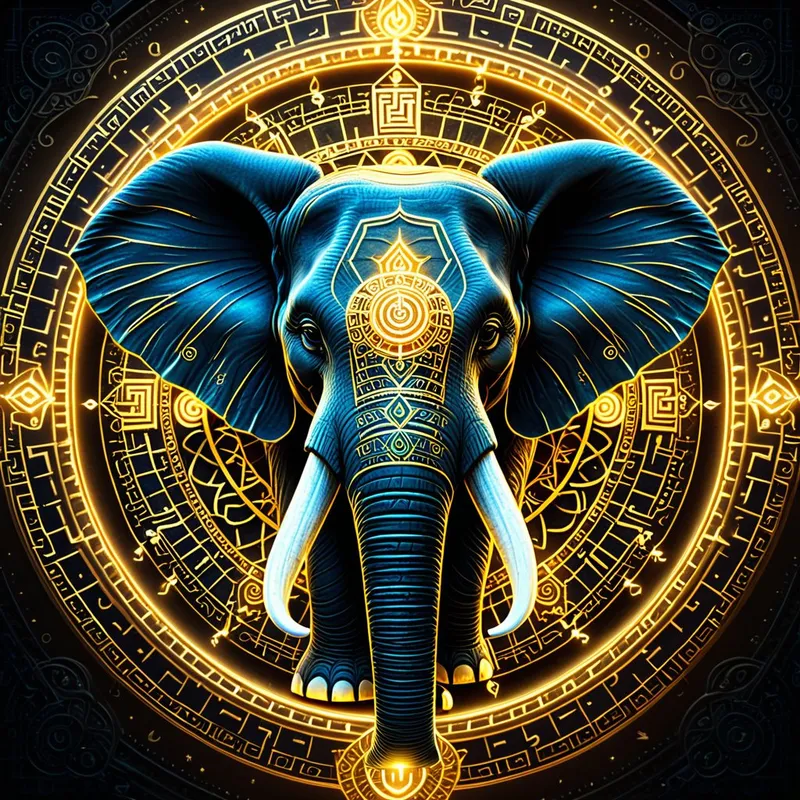
The decapitation is the inevitable, brutal death of the isolated ego. It is not a punishment, but a necessary dissolution. The old head—the limited mode of perception and identity—cannot accommodate the divine. The elephant head is no mere replacement; it is a promotion. The elephant symbolizes supreme wisdom, strength, loyalty, and the ability to traverse the dense forests of the unconscious (its natural habitat). Ganesha’s large ears hear what is unspoken; his small mouth speaks sparingly; his trunk, both powerful and delicate, can uproot trees or pick a single blade of grass—a perfect symbol of discernment.
His broken tusk, a later addition to his iconography from the story of transcribing the Mahabharata, signifies the sacrifice of a part of one’s perfection for a greater purpose: the act of writing, of creating culture and preserving wisdom.
The Dreamer's Resonance
When the archetype of Ganesha stirs in the modern dreamscape, it often signals a profound psychic initiation. To dream of an elephant-headed figure, a severed head, or a guarded door one cannot pass is to encounter the psyche’s own process of restructuring.
Somatically, this may manifest as a feeling of pressure in the head or a sense of one’s “old mind” being inadequate for a new life phase. Psychologically, the dreamer is in the space between the beheading and the rebirth. It is the terrifying, liminal state where an old identity, a stubborn attitude, or a fixed way of thinking has been (or needs to be) dismantled by a force that feels both destructive and sacred—perhaps a sudden loss, a career ending, or the collapse of a long-held belief. The grief of Parvati is felt as a deep, somatic mourning for what is lost, even if it was limiting. The dream is the psyche’s way of narrating this violent, necessary alchemy, assuring the dreamer that the guardian of the threshold is not being destroyed, but being transformed into the guide who removes obstacles.
Alchemical Translation
The individuation process, the journey toward psychic wholeness, is perfectly modeled in this myth. We all begin as creations of our personal history and conditioning (Parvati’s child). We guard our psychic boundaries fiercely. Then life—the Shiva force, the unexpected crisis, the transcendent insight—shatters that carefully constructed identity. This is the alchemical nigredo, the blackening, the descent.
The integration of the elephant head is the albedo, the whitening. It is the conscious adoption of a new, more capacious consciousness. We are asked to “wear the elephant head”: to develop the wisdom to listen more than we speak, the strength to carry heavy burdens, and the discernment to navigate complexity.
The ultimate obstacle Ganesha removes is the illusion of separation between the personal self and the vast, impersonal consciousness of the universe.
To invoke Ganesha internally is to consciously engage in this alchemy. It is to acknowledge that before any new venture—a relationship, a creative project, a spiritual practice—we must first sacrifice our old, limited mindset at the door. We must allow the Shiva-force of change to sever it, and with courage, accept the gift of a broader, wiser perspective. The reborn Ganesha within is the integrated self, the sage who sits at the crossroads of the human and the divine, ensuring that every ending contains the seed of a right beginning, and that every obstacle, rightly understood, is the path itself.
Associated Symbols
Explore related symbols from the CaleaDream lexicon: