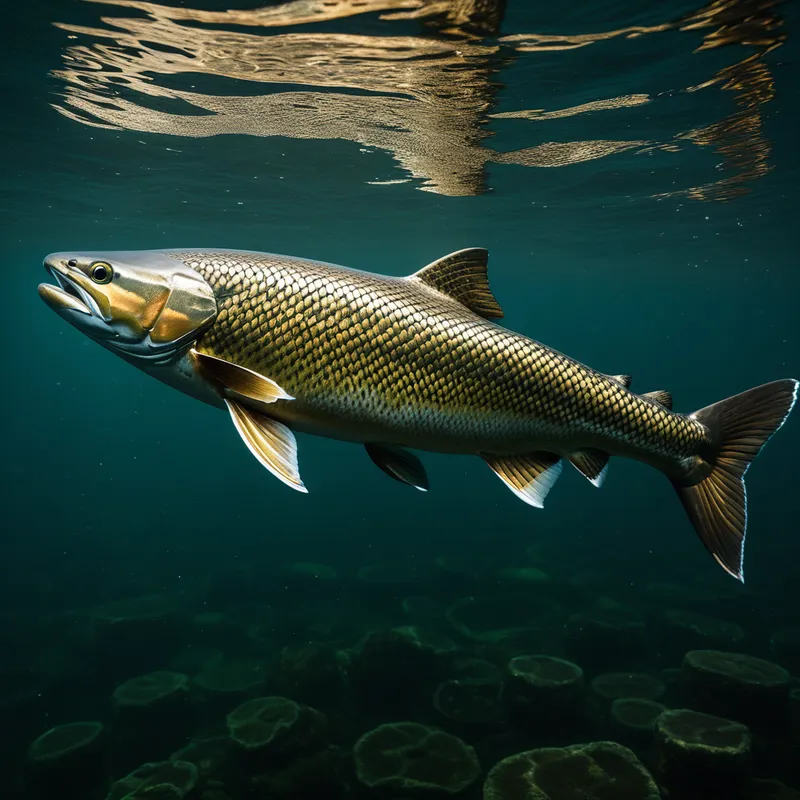
Salmon of Llyn Llyw Myth Meaning & Symbolism
A myth of a sacred salmon, keeper of all wisdom, whose capture and consumption by a hero ignites a profound transformation of consciousness.
The Tale of Salmon of Llyn Llyn
Listen, and let the mist of Annwn gather around you. In the first age, when the world was still singing its creation song, there was a lake. Not just any lake, but Llyn Llyw, a pool so deep and dark it was said to be a well of the world’s memory. Its waters were not merely water; they were the liquid silver of forgotten time.
And in those abyssal depths lived a salmon. This was no ordinary fish. It was the Salmon of Llyn Llyw, the Hazel-Eater. For centuries untold, it had fed on the sacred hazelnuts that dropped from nine hazel trees encircling the lake’s source. Each nut contained the imbas, the lightning-strike of all knowledge—of the past that was, the present that is, and the future that will be. With every nut consumed, the salmon absorbed this omniscience, until its flesh became a living library, its silver scales each a page of the world’s story.
The knowledge of the salmon was a silent, swimming gravity, a pull felt in the bones of poets and the dreams of kings. Many sought it. Warriors came with nets of iron, but the nets dissolved into rust. Druids came with chants of binding, but their words were swallowed by the lake’s silence. The salmon was the guardian of the threshold, and the threshold would not be crossed by force.
Then came the one who was meant to come. His name is often lost, for he is less a man and more an instrument of fate—the Seeker, the Vessel. He did not come with a net or a boast. He came with patience woven into his sinews and a spear carved from a single branch of rowan. He sat in a coracle of willow and hide, a speck upon the immense, glassy face of Llyn Llyw. For days and nights, he was still as a heron, his breath synced with the lap of water against his boat. He was not hunting; he was waiting for an invitation from the deep.
It came. A single, perfect ripple, concentric and deliberate, broke the mercury surface. Then, the glow—a soft, bronze light rising from the abyss. The Salmon of Wisdom ascended, not in flight, but in a slow, deliberate offering. It swam a circle around the coracle, an ancient ritual of recognition. The Seeker did not strike in hunger or greed. His arm moved with the inevitability of a season turning. The rowan spear plunged.
There was no struggle. The salmon was drawn into the boat, its great eye holding the Seeker’s gaze. In that look passed the weight of all things known. The Seeker built a fire on the shore, its smoke a grey prayer against the sky. He cooked the sacred flesh. As instructed by a voice in the wind—or perhaps by the look in the fish’s eye—he gave the first portion to his companion, a young lad who had watched in silent awe. The lad’s thumb brushed the roasting flesh and was scalded. He thrust his thumb into his mouth to cool it.
In that instant, the transfer occurred. Not through the consuming of the meal, but through that first, accidental taste. The imbas flowed not into the Seeker who performed the act, but into the youth who bore the burn. The lad’s eyes, once clear and simple, now mirrored the deep, knowing currents of Llyn Llyw. He had swallowed the light of the hazelnuts. The Seeker had facilitated the sacrifice, but the wisdom chose its own vessel. The salmon was gone, its knowledge now walking on two legs, a new kind of creature in the world. The lake fell silent, its greatest secret now breathed into the air of the human world.

Cultural Origins & Context
This myth emerges from the rich, oral tapestry of the Celtic world, particularly within the Welsh and Irish traditions where the Salmon of Wisdom is a potent archetype. It belongs not to the grand cycles of national foundation, but to the echtraí and immrama—tales of adventure and journeys to the Otherworld. These were stories told by filid (poet-seers) and bards, not merely for entertainment, but as encoded maps of reality.
The societal function was multifaceted. On one level, it was a dindshenchas, explaining the numinous significance of a specific location (Llyn Llyw). More profoundly, it served as a pedagogical and initiatory narrative. It modeled the proper relationship between humanity and the numinous sources of knowledge. Wisdom is not seized; it is received. It requires patience, respect, and a willingness to perform a sacred, often mediating, action without guarantee of personal reward. The myth reinforced a core Celtic spiritual principle: knowledge is a sacred, animate force that circulates between the worlds, and its transfer often involves a necessary sacrifice and an unexpected recipient.
Symbolic Architecture
The myth is a perfect symbolic engine. Every element is a conscious component in a drama of consciousness.
The Lake (Llyn Llyw) is the unconscious itself—deep, dark, holding the totality of latent knowledge and ancestral memory. The Hazelnuts from the nine trees are the concentrated seeds of cosmic insight, the raw data of existence. The Salmon, the consumer of these nuts, represents the psychic complex that has integrated this raw data into a cohesive, living wisdom. It is the "Self" as an autonomous, numinous entity residing in the depths of the psyche.
The hero does not conquer the guardian of the treasure; he fulfills the ritual conditions that allow the treasure to transform him.
The Seeker/Hero is the disciplined ego-consciousness. His patience and correct action (the rowan spear, a wood of protection and vision) represent the focused effort required to make contact with the deep Self. His act of cooking is the process of making the raw, numinous content of the unconscious assimilable to consciousness. The Scalded Thumb of the youth is the critical symbol. It is the wound that opens the channel. It signifies that true, transformative wisdom often comes indirectly, through a kind of "sacrificial accident" or via a facet of oneself (the innocent, the inner child) that one did not intend to forefront. The youth is the new, integrated consciousness born from the union of the seeking ego and the sacrificed Self.

The Dreamer's Resonance
When this myth stirs in the modern dreamer, it signals a profound process of psychic reorganization. To dream of a vast, intelligent fish in deep water is to feel the pull of the deep Self, the promise of integrated wisdom that lies beneath the surface of daily identity.
The somatic experience is often one of a deep, magnetic pull in the gut or chest—a "knowing" that is felt rather than thought. Psychologically, the dreamer may be in a phase where diligent effort (the Seeker's patience) has been applied to a problem or a period of growth, but the breakthrough feels elusive. The dream of catching or even seeing the salmon suggests the unconscious content is now ripe for encounter.
Conversely, dreaming of being the salmon, or of swimming in the abyssal lake, can indicate a state of identifying with this deep, all-knowing Self, perhaps at the expense of grounded ego-functioning. It can be a compensatory image during times of feeling fragmented or ignorant, a reminder of the vast inner resource. The burning or scalding in the dream is key; it points to the necessary, often painful, puncturing of the old conscious attitude to allow the new wisdom to enter. The dream asks: What old idea of yourself are you "cooking"? And what unexpected, perhaps younger, part of you is about to receive the gift?

Alchemical Translation
The myth of the Salmon of Llyn Llyw is a precise allegory for the alchemical process of individuation. The entire narrative maps the Opus.
Nigredo (The Blackening): The dark lake. The initial state is one of unconsciousness, of knowledge hidden in the depths. The seeker's long vigil is the melancholic, isolating work of confronting the shadow and the unknown within.
Albedo (The Whitening): The appearance of the glowing salmon. This is the emergence of the lapis, the philosopher's stone, the Self, from the chaos of the unconscious. It is a moment of illumination, the coniunctio (sacred marriage) between the conscious will (the Seeker) and the unconscious totality (the Salmon).
Citrinitas (The Yellowing): The cooking of the fish over fire. This is the arduous process of distillation and sublimation. The raw, overwhelming psychic content must be "cooked" by the fire of sustained conscious attention and reflection. It is made digestible, transformed from an autonomous complex into potential nourishment for the psyche.
Rubedo (The Reddening): The scalded thumb and the transfer of wisdom. This is the culmination—the production of the red tincture, the elixir of life. The wisdom is fully integrated, but not by the ego who performed the labor. It is received by the "divine child," the new, unified personality born from the process. The burn is the final, indelible mark of transformation. The individual is now a vessel for the aqua permanens, the permanent water of wisdom, which is both a wound (the scalded thumb) and a supreme gift (the gift of sight).
The ultimate alchemy is not the possession of wisdom, but becoming the vessel through which wisdom flows into the world. The salmon sacrifices its form so that consciousness may evolve.
For the modern individual, the myth instructs: Your deepest wisdom lies in the dark, nourishing waters of your own unconscious. To access it requires not conquest, but a respectful, patient ritual of attention. You may have to perform the work without knowing who will ultimately benefit. The transformative insight you seek may not come to the part of you that is striving, but to a more innocent, receptive aspect of your being that you have overlooked. The goal is not to "have" the knowledge, but to be irrevocably changed by its passage through you.
Associated Symbols
Explore related symbols from the CaleaDream lexicon: