
Mist Myth Meaning & Symbolism
The tale of Mist, a Valkyrie who serves the mead of memory and oblivion, embodying the essential tension between knowing and unknowing for the soul's journey.
The Tale of Mist
Hear now a whisper from the edge of the world, where the breath of the giants becomes the wind and the tears of the gods fall as dew. This is not a tale of thunder, but of the silence between the claps. This is the story of Mist.
In the high halls of Valhalla, where the rafters are spears and the roof is shields, there is a service deeper than the serving of ale. After the eternal battles, when the Einherjar lay down their weapons, a different thirst awakens. Not for mead alone, but for meaning. For memory. And for the mercy of forgetting.
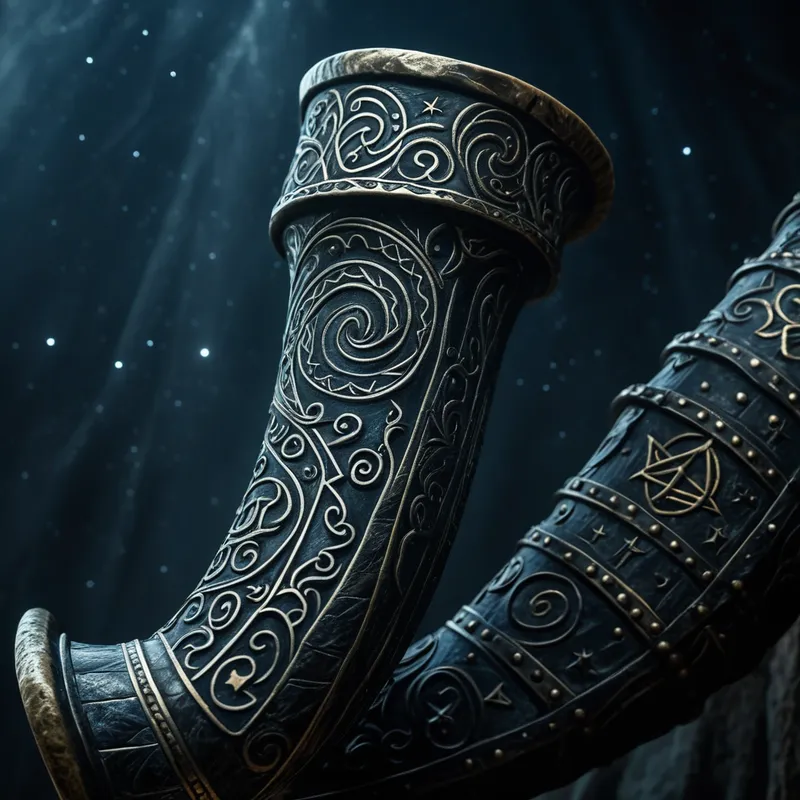
It is then that Mist walks among them. Her step is silent, her armor not gold but the grey of a winter dawn. In her hands, she does not bear a sword, but a horn. This horn is older than the halls themselves, carved from the tusk of a beast that swam in the primordial rivers before the sun was lit. From it, she pours.
To one warrior, she offers a draught that shines like liquid amber and summer honey. As he drinks, his eyes clear. He remembers the smell of pine in his homeland forest, the grip of his father’s hand teaching him the spear, the laughter of his child. The pain of his mortal end dissolves into the golden tapestry of a life fully lived. This is the mead of memory, and it makes him whole.
To another, she offers a drink dark as a moonless midnight, cool as a mountain spring. He drinks, and the searing agony of his final wound fades. The terror of the charge, the face of the foe who struck him down, the unfinished business that clawed at his spirit—all soften, blur, and sink into a gentle fog. This is the mead of oblivion, and it grants him peace.
Mist moves between the benches, a weaver at the loom of consciousness. She knows that to bear the weight of an eternal warrior’s existence, a soul needs both anchor and release. To remember why he fights, and to forget the torment of endless dying. Her duty is the balance. Her magic is in the choice—a choice she makes not by chance, but by a knowing deeper than sight, a reading of the soul’s own need.
She is the keeper of the threshold between what was and what is, the tender of the sacred fog that separates the agony of the past from the possibility of the present. And in her silent service, the great hall of the slain does not become a madhouse of echoing trauma, but a sanctuary where the dead can truly prepare to live again, at the world’s final hour.
Cultural Origins & Context
The name Mist appears in the Old Norse poem Grímnismál, found within the Poetic Edda, where she is listed among the Valkyrjur who serve the chosen warriors in Valhöll. Unlike the dramatic narratives of Sigurd or the doom of the gods in the Völuspá, Mist’s story is not a saga. It is an implication, a fragment of a larger system of belief.
Her role was likely elaborated in the oral tradition—the stories told by firelight in the longhouses of Scandinavia and Iceland. In a culture that revered memory (embodied in the god Óðinn himself, who sacrificed an eye for a drink from the Mímisbrunnr) yet lived with the visceral, immediate presence of death in battle, the psychological need for both remembrance and release was acute. The skalds and storytellers, acting as proto-psychologists of their time, gave form to this need in figures like Mist. Her myth served a societal function: to model a dignified reconciliation with death’s trauma. She provided a divine rationale for the complex emotional work required of a community constantly touched by loss, suggesting that even in the afterlife, the process of integrating experience was sacred and necessary.
Symbolic Architecture
Mist is not merely a server of drinks; she is the personification of a fundamental psychic operation. She represents the faculty of discernment applied to the contents of our personal history. In her two meads, we see the twin poles of consciousness: assimilation and dissolution.
The mead of memory is the act of integration. It is the process of taking raw, painful experience and distilling it into wisdom, identity, and narrative. It is what makes us who we are.
The mead of oblivion is the act of release. It is the necessary forgetting, the letting go of paralyzing trauma, shame, and fixation that prevents growth. It is not denial, but a sacred erasure for the sake of continued life.
Mist herself symbolizes the liminal space where this decision is made. She is the fog on the moor—not obscurity for its own sake, but a medium that softens harsh edges, allowing some shapes to emerge with clarity while others recede. Her name is her essence: mist is the boundary between the seen and the unseen, the known and the unknown. Psychologically, she is the self-regulating function of the psyche that knows when to hold on and when to let go, when to examine a wound and when to allow it to scar over.

The Dreamer's Resonance
When the archetype of Mist surfaces in modern dreams, the dreamer is often at a psychological crossroads concerning their past. The dream imagery may not be of a Valkyrie, but of foggy landscapes, choices between two doors or two vessels, or a profound sense of being offered something to drink.
Somatically, this can feel like a pressure in the chest or a thickness in the throat—the physical sensation of something that needs to be either fully swallowed and digested (integrated) or expelled (released). The dreamer might be grappling with a past trauma that haunts them (needing the dark mead of oblivion to soften its sharpness) or, conversely, feeling unmoored and identity-less, cut off from their personal history (needing the golden mead of memory to reconnect with their core self). The Mist-dream is a signal from the unconscious that the time for passive endurance is over; the time for active, discerning relationship with one’s own history has come.

Alchemical Translation
The individuation process, the journey toward psychic wholeness, is a constant alchemy of memory and oblivion. We cannot carry everything with us; the weight would crush us. Nor can we abandon our foundational experiences; we would become ghosts. The myth of Mist provides a model for this internal alchemy.
The first operation is Nigredo, the blackening. This is the raw, unprocessed pain, the traumatic memory that feels like a poison. Mist’s dark mead represents the beginning of work on this material—not by reliving it in agony, but by allowing it to be contained and transmuted in the vessel of the unconscious. It is the “forgetting” that is actually a profound digestion in darkness.
The second is Albedo, the whitening. This is the emergence of clarity, the extraction of meaning. Mist’s golden mead is this process. It is the conscious recollection that has been purified of its destructive affect, leaving behind the shining essence of lesson, strength, or love. It is the “remembering” that now serves the ego, not torments it.
Mist, as the operator of this inner still, teaches that the goal is not a spotless memory or a blank slate, but a curated soul. The modern individual must become their own Valkyrie, learning to sit in the mist of their own uncertainty and ask: Does this memory need to be integrated into my story, or does its emotional charge need to be dissolved so I can move forward? In holding both horns—the dark and the light—we perform the sacred service for ourselves that Mist performs for the Einherjar: we make our inner world a place where we can reside, not just endure, and prepare our consciousness for whatever final battles or dawns may come.
Associated Symbols
Explore related symbols from the CaleaDream lexicon: