
Otherworld Myth Meaning & Symbolism
A hero journeys to the timeless, paradoxical Otherworld, facing tests of truth and desire to retrieve a lost treasure, guided by a sovereign goddess.
The Tale of Otherworld
Listen, and let the fire’s shadows tell you of a place that is not a place, a time that is not time. It lies not over the sea, nor beyond the mountains, but beside you, as close as your own breath on a cold morning. It is the Sídhe.
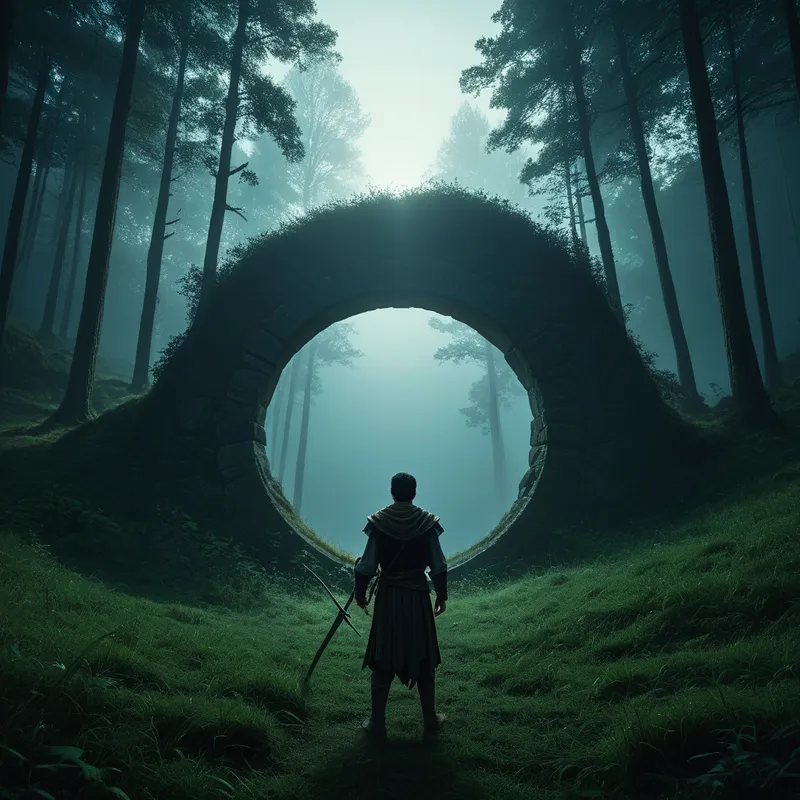
A hero, let us call him Conn, walks the borderlands where the forest grows thick and the mist clings to the ground like a memory. He is driven by a loss—a stolen cauldron of plenty, a vanished lover, a song heard once in childhood and never again. His world is grey with the lack of it. As twilight bleeds the last colour from the day, he sees a light where no hearth should be: a soft, gold-white glow emanating from the side of a great, grassy mound.
A figure emerges. She is The Sovereignty, clad in a gown the colour of dawn and a cloak pinned with stars. In her hand is a branch of silver, from which hang nine apples of crystal that chime with a sound that stills the heart. She does not speak, but her eyes hold the depth of still lakes. She turns and passes into the mound. The light beckons.
Conn crosses the threshold. The air changes—it is sweeter, heavier, alive. He is in a hall vaster than any king’s, yet it feels like the heart of the world. Time unravels here. A feast is perpetually laid, but those who eat find neither hunger nor fullness. He sees his lost one, smiling, yet her eyes look through him to a horizon he cannot see. The Aos Sí move in a graceful, slow dance, their laughter like bells, their silence profound.
The goddess presents him with a cup. "Drink," her voice is the whisper of wind through oak leaves. "And know the truth of your desire." This is the test. To drink without questioning is to be trapped forever in beautiful stasis, to forget the world of struggle and growth. Conn hesitates. He remembers the grey world, the unfinished task, the love that was real in its pain and its joy. He sets the cup down, untasted.
A shadow passes over the hall. The test was not of obedience, but of discernment. The goddess smiles, a true smile now, warm as summer sun. "You have chosen the harder path," she says. "The path of return." She gestures, and there, resting against her chair, is what he sought—the cauldron, the lover’s token, the source of the song. It was always there, but he could only see it once he proved he could leave.
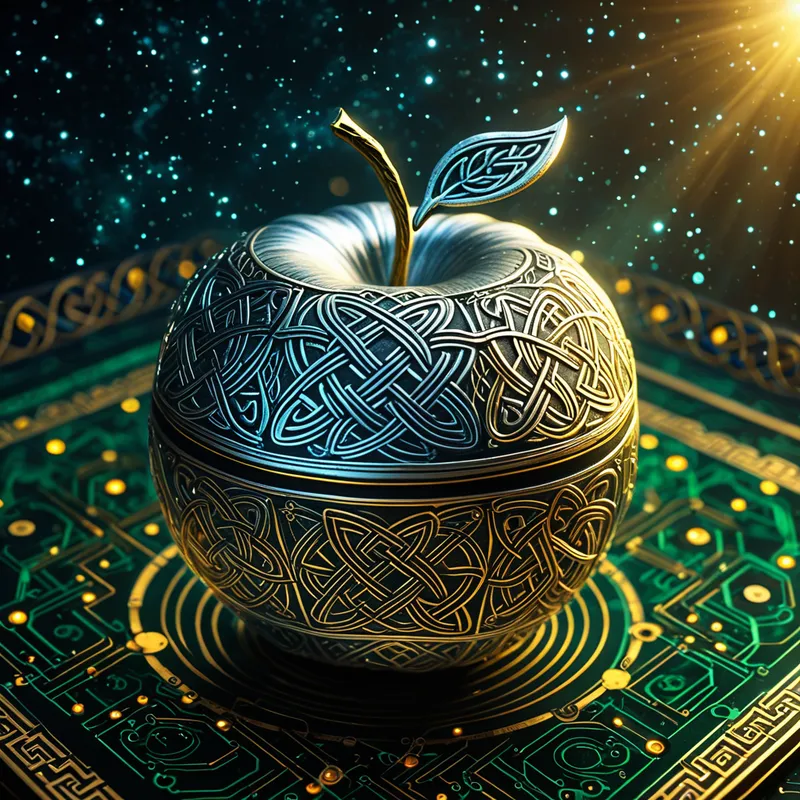
She leads him to a different door, one veiled by a waterfall that flows upward. "Remember," she says, "this world and that are two sides of the same leaf." He steps through the cold, bright curtain and stumbles onto the damp grass of his own world. The mound is just a hill behind him. In his hand is a simple apple from a wild tree. But when he bites into it, the taste is of starlight and deep earth, and he knows nothing will ever be the same.
Cultural Origins & Context
The myth of the Otherworld is not a single story but a deep, pervasive pattern woven through the tapestry of Celtic cultures, from the insular traditions of Ireland and Wales to the continental Gauls. It was the living breath of a worldview that saw reality as permeable. These narratives were the province of the Filid and bards, who preserved them not as mere entertainment but as a sacred technology for understanding the cosmos and the human place within it.
Transmitted orally for centuries before being recorded by Christian monks, the tales of voyages (Immrama) and adventures in the Tír na nÓg served multiple societal functions. They were maps of the afterlife, guides for ethical and sovereign conduct, and explanations for the inexplicable—the sudden disappearance of individuals, the strange lights on the bog, the genius of a poet or the madness of a seer. The Otherworld was the source of both blessing and blight, of artistic inspiration (Imbas) and supernatural terror. It was the ultimate "outside," against which the community defined its values of hospitality, courage, truth, and the sacred bond with the land.
Symbolic Architecture
The Otherworld is not a fantasy of escape, but a profound symbolic depiction of the psyche's own uncharted depths. It represents the unconscious itself—timeless, paradoxical, and governed by its own intrinsic laws that defy rational logic.
The hero’s journey to the Otherworld is the ego’s necessary, perilous descent into the unconscious to retrieve a vital but neglected aspect of the self.
The Sídhe mound is the threshold, the point of entry where conscious awareness begins to dissolve into deeper psychic layers. The sovereign goddess is the archetypal Anima, the guide and ruler of this inner realm. She offers both temptation (the enchanted cup) and the gift of wholeness (the sought treasure). Her tests are not of brute strength but of integrity and self-knowledge.
The treasure—be it a cauldron, a sword, or a loved one—symbolizes a lost or unrealized potential: creativity, sovereignty, authentic feeling, or the unifying Self. The critical choice to refuse the cup of forgetfulness is the pivotal moment of conscious differentiation, where the ego asserts its connection to the world of responsibility and time, thereby earning the right to integrate the treasure rather than be consumed by it.
The Dreamer's Resonance
When this mythic pattern stirs in the modern dreamer, it signals a powerful call from the unconscious. It is the psyche's initiation into a process of deep transformation. To dream of finding a hidden door in a familiar landscape, of meeting a majestic or enigmatic guide, or of being in a place of breathtaking beauty where the rules of physics are suspended, is to receive an invitation to the inner Sídhe.
Somatically, this may be preceded by a feeling of stagnation, a "grey world" of depression or meaninglessness—the psychological equivalent of the wasted kingdom. The dream is the call to adventure. The rising action in the dream narrative mirrors the internal conflict: the allure of numbing escape versus the daunting task of retrieving one's own "treasure"—a repressed talent, a buried trauma, a denied aspect of one's identity. The resolution, whether triumphant or anxious, reflects the dreamer's current capacity to engage with this profound inner work. The emotion upon waking—awe, longing, or disorientation—is the somatic residue of touching the timeless.

Alchemical Translation
The myth of the Otherworld provides a precise alchemical map for the process Jung termed individuation—the journey toward psychic wholeness. The hero's external quest is an allegory for the internal work of transmuting the lead of a fragmented life into the gold of an authentic self.
The first stage, the Nigredo or blackening, is the hero's sense of loss and the grey, barren world he inhabits. It is the necessary despair that motivates the search. Crossing the threshold into the mound is the Solutio—a dissolution of the rigid ego into the fluid, ambiguous waters of the unconscious.
The feast in the hall represents the Albedo, the whitening: the dazzling, often deceptive promise of purity and escape found in unconscious contents. To be captivated here is to identify with an archetype (the eternal child, the perfect lover) and remain in spiritual inflation.
The critical refusal of the cup is the Rubedo, the reddening. It is the application of conscious discernment, the "fire" that separates the essential from the seductive. It is the courage to choose the difficult path of embodied life, with all its conflicts, over the bliss of unconscious unity. This act of conscious sacrifice is what transmutes the experience from mere fascination into earned wisdom.
Finally, the return with the treasure is the Citrinitas, the yellowing or illumination. The integrated self brings the gold of the Otherworld—insight, creativity, sovereignty—back into the realm of time and action. The simple apple that tastes of starlight is the symbol of this completed work: the numinous is now embodied in the ordinary, and the individual lives, at last, in alignment with both worlds.
Associated Symbols
Explore related symbols from the CaleaDream lexicon: