Odysseus' return to Ithaca Myth Meaning & Symbolism
A warrior king, lost for twenty years, must disguise himself to reclaim his throne, his home, and his true name from the chaos that has usurped it.
The Tale of Odysseus' Return to Ithaca
Hear now the tale of the man of many turnings, the one who was driven far and wide after he had sacked the sacred citadel of Troy. For ten years he fought, and for ten more he wandered, a plaything of the gods. Poseidon, whose son he blinded, stirred the wine-dark sea to fury against him. Athena, grey-eyed and cunning, watched from afar, her heart divided between justice and fondness for the mortal whose mind was most like her own.
He endured the lotus that makes men forget home, the cyclops in his bloody cave, the seductive song of the Sirens, and the yawning whirlpool of Charybdis. He walked as a ghost in the sunless land of Hades, speaking with shades of comrades and his own mother. He was held captive in luxury by the nymph Calypso, who offered him immortality if he would stay, yet he sat each day on the rocky shore, weeping for his rocky Ithaca.
His home, in his absence, had become a hall of wolves. Suitors, believing him dead, devoured his wealth and besieged his faithful wife, Penelope, in his own palace. His son, Telemachus, was a boy when he left, now a young man burning with helpless rage.
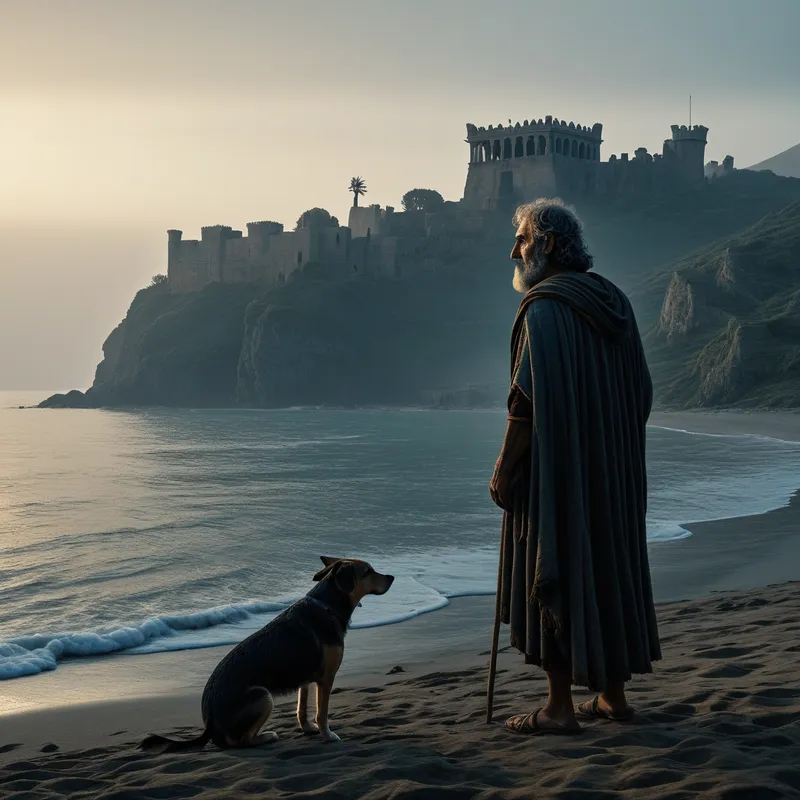
His final journey home was not on a proud ship, but on a humble raft, shattered by Poseidon’s wrath. He washed ashore on Ithaca, naked, crusted with salt, alone. He did not recognize his own land. It was then that Athena came to him, not in glory, but disguised as a shepherd. She cloaked his form in age and poverty, wrinkling his skin, dimming the fire in his eyes. She made him a stranger in his own kingdom, a beggar at his own gate.
In this disguise, he walked the familiar paths. He met his loyal swineherd, Eumaeus, who showed the ragged stranger kindness, speaking of his lost master with a love that made the disguised king’s heart ache. He saw the arrogance of the suitors, their gluttony, their contempt. He endured their insults, their thrown stools, the spittle of their scorn, all while the cold fire of strategy burned within him.
The final test was the bow. Penelope, in her wisdom, had declared she would marry whoever could string her husband’s great bow and shoot an arrow through twelve axe-heads. One by one, the braggarts failed, their soft hands unable to bend the weapon of the warrior. Then the beggar asked to try. Laughter filled the hall. He took the bow, tested its curve, and as easily as a bard strings his lyre, he strung it. The laughter died. In that silence, he notched an arrow, drew, and sent it flying clean through all twelve rings. Then he turned to the suitors, shed his rags like a second skin, and revealed himself, standing tall before his own hearth. “You thought I would not return.” The hall became a slaughterhouse, a necessary, brutal restoration of order. Only then, in the quiet aftermath, did he approach Penelope. She, the weaver of schemes, tested him one last time, speaking of their marriage bed—a secret known only to them, built around a living olive tree. At his precise description, the last wall fell. After twenty years, the king and queen were home, not just to a place, but to each other.
Cultural Origins & Context
This epic is the second half of Homer’s Odyssey, a foundational pillar of what we now call Western literature, composed in the 8th or 7th century BCE. It emerged from an oral tradition, sung by bards (aoidoi) at aristocratic gatherings. These poems were not mere entertainment; they were the cultural database of the Heroic Age, encoding values of xenia (guest-friendship), piety, cunning (metis), and the sacred nature of the household (oikos). The story of Odysseus’s return functioned as a societal anchor. It explored the tension between the heroic individual and his social obligations, the trauma of war, and the paramount importance of restoring rightful order to the family and the community. It asked a profound question of a mobile, maritime culture: what does it mean to be from somewhere, and what must you become to find your way back?
Symbolic Architecture
The return to Ithaca is not a geographical event, but a psychological and spiritual achievement. Ithaca itself symbolizes the integrated Self, the core identity from which one has been exiled. The twenty-year journey represents the necessary detours of life—the trials, seductions, and losses that forge (and nearly break) consciousness.
The hero must become a beggar at his own door to truly know what home is worth.
Odysseus’s disguises are central. To return, he must relinquish the identity of the “famous Odysseus,” the Trojan War hero. He must embody Nobody (the name he gave the Cyclops) and then a ragged stranger. This is the ego’s necessary humiliation, the stripping away of persona to contact a more essential, strategic core. The suitors symbolize the parasitic complexes that consume one’s psychic energy (libido) in one’s absence—the doubts, distractions, and false selves that occupy the inner palace. Penelope represents the anima, the soul’s faithful, weaving intelligence that holds the center against chaos, using cunning to preserve the possibility of wholeness. The final recognition at the olive-wood bed is the ultimate symbol: the marriage of the conscious ego (Odysseus) and the soul (Penelope) is rooted in something living, natural, and eternal—the indestructible core of the psyche.
The Dreamer's Resonance
When this myth stirs in modern dreams, it speaks to a profound process of re-identification. The dreamer may find themselves in a familiar house that feels alien, or unable to recognize loved ones who have changed. They may be searching for a lost room or object that represents a forgotten part of themselves. The somatic feeling is often one of deep frustration, longing, and a burdensome weight of time passed.
This is the psyche signaling a phase of reintegration after a long period of exile—perhaps after a career change, the end of a relationship, recovery from illness, or simply a midlife sense of being lost. The “suitors” in the dream could be draining obligations, addictive patterns, or internal critics that have taken up residence. The dreamwork involves the hard, often humbling task of “disguising” the inflated self-image and taking stock of the inner landscape with ruthless honesty, preparing for the difficult but necessary act of reclamation.

Alchemical Translation
The alchemical process mirrored here is the opus contra naturam—the work against nature. It is the reversal of dissolution, the coagulation of the scattered self. The long journey at sea is the solutio, where the hardened, war-like identity is dissolved in the unconscious (the sea). The captivity with Calypso is a tempting mortificatio, a death-in-life offering false immortality through stasis.
The return is the coagulatio: the spirit made flesh again, but now consciously, purposefully, and on its own terms.
Athena’s disguise is the crucial rubedo, the reddening—not of glory, but of the shame and humility required for the final operation. By becoming the beggar, Odysseus performs the ultimate alchemy: he transmutes his legendary prowess (arete) into patient, strategic wisdom (metis). The slaughter of the suitors is not mere vengeance, but the violent, necessary separatio—the cutting away of psychic parasites that prevent the coniunctio, the sacred marriage. For the modern individual, this models the individuation journey: one must leave home (the unconscious identification), be utterly changed by the world, and then return not to resume an old life, but to reclaim and re-consecrate the Self with hard-won consciousness. The goal is not to arrive as you left, but to arrive as who you have become, and to make that person the rightful ruler of your inner kingdom.
Associated Symbols
Explore related symbols from the CaleaDream lexicon: