Minotaur's Labyrinth Myth Meaning & Symbolism
A king's broken oath births a monster, confined in a maze of stone. A hero enters, armed with a thread and divine aid, to face the beast and end the bloody tribute.
The Tale of Minotaur's Labyrinth
Hear now the tale of a monster born from a king’s pride and a god’s wrath. In the sun-drenched kingdom of Crete, King Minos, favored son of Poseidon, prayed for a sign of his right to rule. From the wine-dark sea, the god sent a magnificent white bull, a sacred offering, demanding its sacrifice in return. But Minos, his heart ensnared by the beast's beauty, betrayed his oath. He kept the bull for his own herds and sacrificed another in its place.
Poseidon’s vengeance was not swift thunder, but a slow, twisting curse. He inflamed Pasiphaë, the queen of Crete, with an unnatural passion for the white bull. Consumed by a desire that defied nature and reason, she sought the aid of the master craftsman Daedalus. From wood and hide, he built for her a hollow cow, a deceptive shell. Within its dark confines, the queen waited. From this blasphemous union was born a creature of nightmare: a boy with the body of a man and the head and tail of a bull. They named him Asterion, but the world would know him only as the Minotaur.
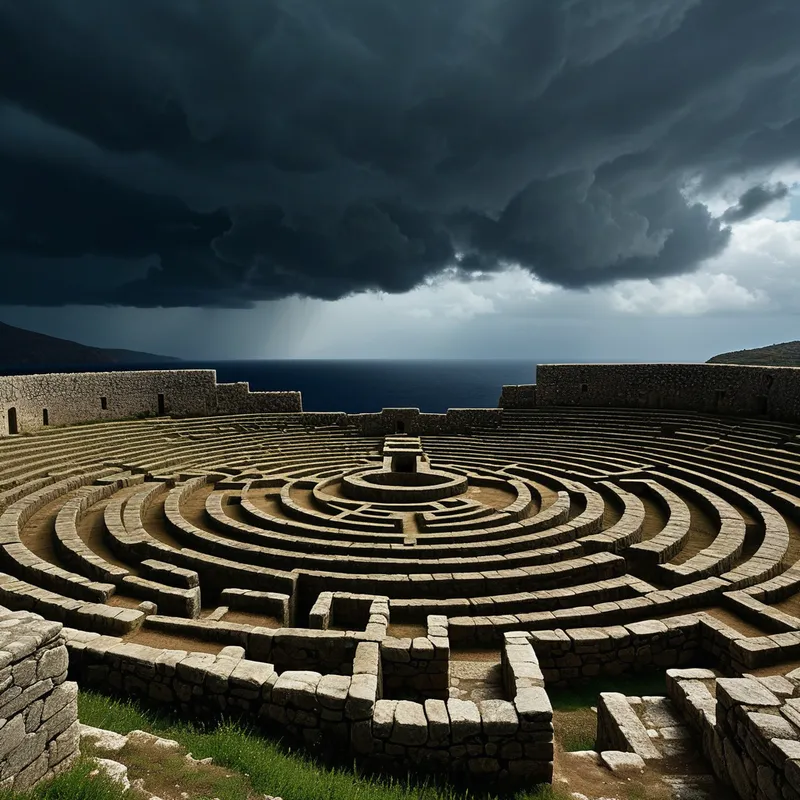
The child’s bellow was not that of an infant, but of a beast. Horror and shame filled the palace of Knossos. King Minos, desperate to hide this living evidence of his folly and his wife’s disgrace, again summoned Daedalus. “Build me a prison,” he commanded, “from which nothing that enters may ever find its way out.” And so Daedalus, his genius turned to a dark purpose, conceived the Labyrinth. Not a simple maze, but a place of profound confusion, a twisting, turning architecture of despair built deep beneath the earth. Its corridors doubled back on themselves, its passages led only to dead ends, and at its absolute, silent center, the Minotaur was sealed away.
Yet a prison requires a purpose. To feed the monster and to assert his dominion, Minos imposed a terrible tribute on the city of Athens, which he had conquered. Every nine years, seven youths and seven maidens were to be sent into the black mouth of the Labyrinth, a sacrificial offering to the hunger of the beast within. The cycle of terror continued, until a hero’s destiny intersected with Crete’s shame.
His name was Theseus, son of Aegeus. When the third tribute was drawn, he volunteered to go, vowing to his father that he would slay the monster and end the bloody debt. His ship sailed with black sails, a sign of mourning, but Theseus promised to raise white sails upon his victorious return.
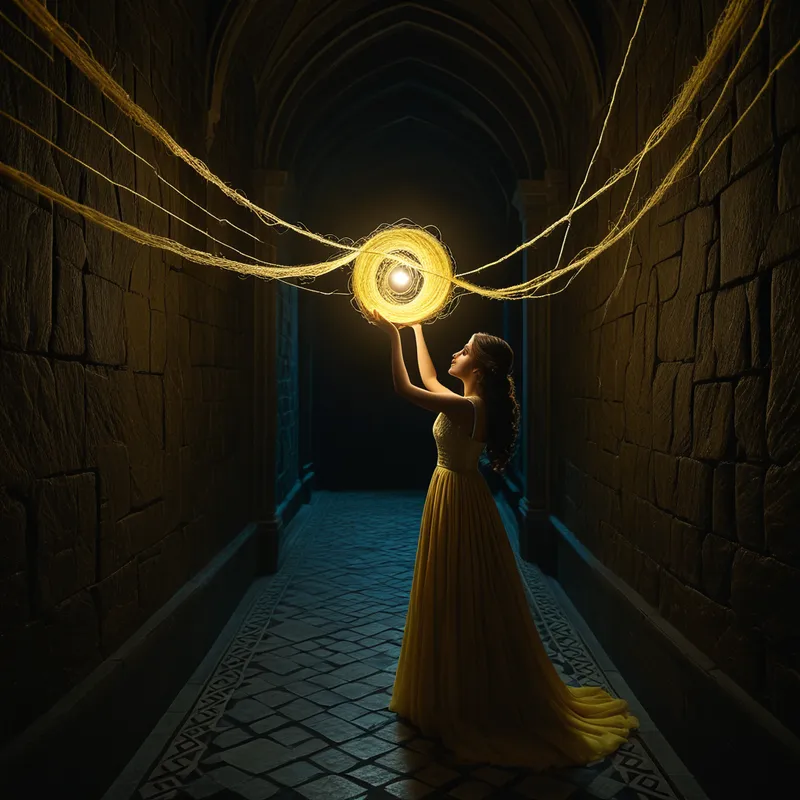
On Crete, another heart chafed against the tyranny of the Labyrinth. Ariadne, the princess, saw Theseus and was struck not only by his courage but by a desperate hope for liberation—from the monster, from her father’s secret, from the very stone of the prison that defined her kingdom. She came to him in secret, offering a way to conquer the unconquerable maze: a simple ball of thread. “Tie one end to the entrance,” she whispered, her voice barely stirring the dank air of the holding cell. “Unwind it as you go. It will be your memory in stone, your path back from oblivion.”
Into the darkness Theseus went. The air grew cold and still, thick with the scent of damp earth and old fear. The only sounds were the scuff of his sandals, the whisper of the thread paying out behind him, and, from somewhere in the profound blackness ahead, a low, guttural breathing. He followed the sound, the thread his sole tether to the world above. The corridors seemed to breathe, walls pressing close then falling away in vast, echoing chambers. He walked for what felt like days, his own heartbeat loud in his ears.
Then, in a central chamber, he found it. The Minotaur was not just a beast; it was a tragedy given form, a hulking mass of muscle and sorrow, its human eyes holding a terrible, trapped intelligence within its bovine skull. With a roar that shook dust from the ceiling, it charged. The fight was brutal, primal, a dance of death in the absolute dark. Theseus, fueled by the fate of Athens and guided by the favor of the gods, wrestled the monster, finally driving his sword home. The beast fell, its final breath a sigh that seemed to sigh through the very stones of the Labyrinth.
Silence, deeper than before, descended. Then, hand trembling, Theseus took up the slender thread, his lifeline, and began to rewind his fate, following the path back through the winding stone intestines, past the bones of those less fortunate, back to the light, to Ariadne’s waiting hand, and to a sea awaiting a sail’s color.
Cultural Origins & Context
The myth of the Minotaur and the Labyrinth is a foundational story of the Minoan and Mycenaean world, later codified by Athenian poets like Euripides and retold by historians such as Herodotus. It functioned as an etiological tale, explaining and perhaps justifying the historical shift of power from Minoan Crete to Mycenaean (and later, Athenian) Greece. The story encodes very real anxieties about maritime dominance, tribute, and the terrifying "otherness" of a more ancient, sophisticated, and potentially brutal island culture.
Passed down orally by bards and later inscribed, the myth served multiple societal functions. For the Athenians, it was a narrative of heroic national identity, with Theseus embodying the civic virtues of courage and self-sacrifice. For the Greeks broadly, it was a cautionary tale about hubris (Minos’s broken oath), the dangers of unnatural desire (Pasiphaë’s passion), and the monstrous consequences of trying to hide one’s sins. The Labyrinth itself may echo the complex, multi-leveled architecture of the very real Palace of Knossos, whose ruins likely inspired later Greek imaginations to conceive of it as an inescapable maze.
Symbolic Architecture
At its core, the Labyrinth is not merely a prison for a monster, but a map of the unconscious psyche. The Minotaur is the ultimate shadow—the repressed, bestial, and shameful aspect of the self that results from a betrayal of one's sacred oath (to the Self or to a higher principle). It is the child of a deceptive act (the wooden cow) and a hidden passion, fed by periodic sacrifices of one's vitality (the Athenian youths).
The Labyrinth is the convoluted structure of denial and complex we build to contain what we refuse to integrate. The monster at its center is not what we fear, but what we have forgotten we created.
Theseus represents the heroic ego-consciousness that dares to descend into this confusion. He does not go unarmed; his weapons are divine lineage (his father is a king, his mother is touched by the gods) and, crucially, Ariadne’s thread. This thread is the symbol of relatedness, of the guiding connection to another consciousness (anima, in Jungian terms, or the therapeutic alliance), or to a slender but unbreakable thread of intuition, memory, or purpose. It is the antithesis of the Labyrinth’s principle of confusion. Without it, the hero becomes just another skeleton in the dark, another sacrificed part of the self.
The Dreamer's Resonance
When this myth pattern emerges in modern dreams, the dreamer is navigating a profound psychological process of confronting a deeply entrenched, seemingly monstrous complex. Dreaming of being lost in a maze or endless hallways signals a state of confusion, feeling trapped by life’s circumstances, or circling a core anxiety without being able to locate its source.
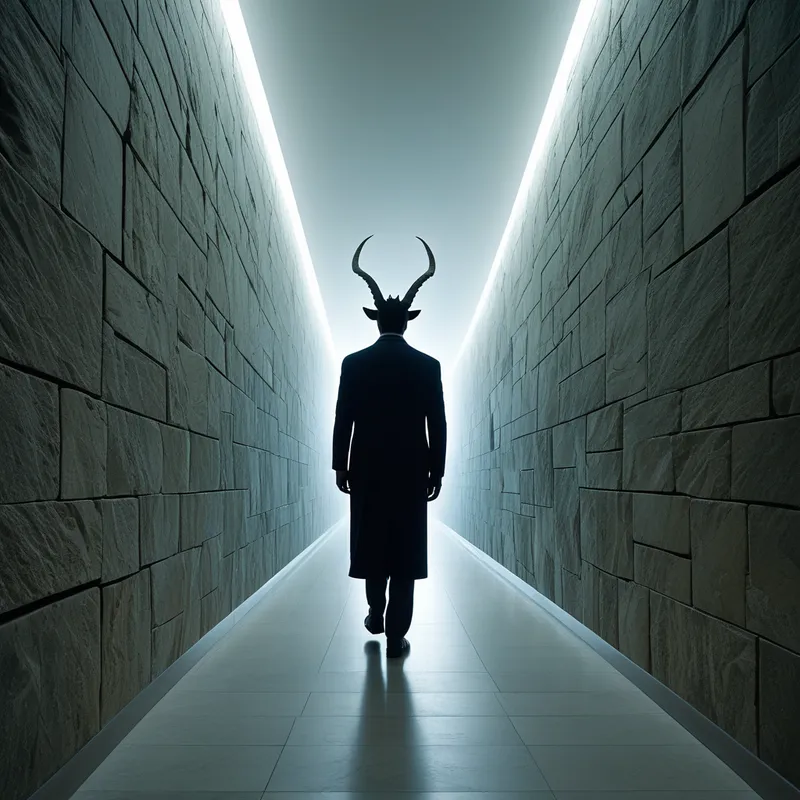
The appearance of a bestial or hybrid figure—a threatening presence with animal features—is the somatic signal of the shadow’s activation. The body may feel heavy, frozen, or filled with adrenaline. This is not a call to literal battle, but an indication that an aspect of the self, long-fed by “sacrifices” (of time, energy, authenticity), has grown powerful in its confinement and demands recognition. The dream is the psyche’s Labyrinth, and the feeling upon waking is often one of dread mixed with a cryptic urgency. The question the dream poses is: Do you have a thread? What is your connection back to your own consciousness, your own reality, once you dare to face this?
Alchemical Translation
The myth models the complete cycle of psychic transmutation, or individuation. The initial state is one of nigredo—the blackening. This is the rule of Minos: a consciousness built on a hidden betrayal, leading to a shameful secret (the Minotaur) that consumes vital energy (the tributes).
The heroic journey into the Labyrinth is the mortificatio—the descent into the dark, putrefying matter of the soul. It is the conscious decision to stop feeding the complex and instead to seek it out. Here, the alchemical agent is the thread: the filum Ariadnes, the guiding principle of Eros (connection, relatedness) that prevents total dissolution in the chaos.
The confrontation is the separatio and coniunctio occurring simultaneously. Theseus separates from the monster by slaying it—differentiating his conscious humanity from the unconscious beast. Yet, in a deeper sense, a conjunction occurs: the hero consciously engages with and integrates the raw, instinctual power the shadow held. The beast’s energy is not destroyed but assimilated; the hero emerges stronger, having reclaimed the vitality once sacrificed to it.
The triumph is not the death of the beast, but the hero’s return with the knowledge of the maze. The integrated self is the one who has walked the labyrinthine paths of its own soul and can now navigate them consciously.
Emerging with the thread rewound is the albedo—the whitening, the dawn of a new clarity. For the individual, this is the end of an old, sacrificial cycle. The monstrous complex loses its power to dictate terms. The final stage, however, is often forgotten in the tale: Theseus abandons Ariadne. This warns that the guiding principle (the thread-giver) used in the descent may itself need to be transcended or left behind for the next stage of the journey, lest one remain dependent. The true prize is not the princess, but the liberated self, capable of setting its own sail home.
Associated Symbols
Explore related symbols from the CaleaDream lexicon: