
Melissae Myth Meaning & Symbolism
The Melissae were sacred bee-nymphs, priestesses of the Great Goddess, who guarded the threshold between life, death, and divine ecstasy.
The Tale of Melissae
Listen, and let the scent of thyme and wild honey carry you back. Before the marble temples of the Olympians rose to dominate the sky, the earth herself was the temple. In the deep, shadowed clefts of Mount Parnassus, and in the whispering groves sacred to Artemis, there moved a sisterhood not born of mortal womb. They were the Melissae—the Honey-Bees.
Their origin is whispered in the oldest songs, those that remember the Titaness Mnemosyne. From her, it is said, they first learned the secret language of remembrance, the drone that connects all life. Others say they sprang from the body of the primordial prophet Python, when the young god Apollo claimed the oracle at Delphi. Where his arrows struck the earth, nymphs of prophecy arose, but the oldest spirits of that place transformed—not into fleeing nymphs, but into a humming, purposeful swarm. They became the guardians of the threshold, the tenders of the sacred omphalos, the world’s navel.
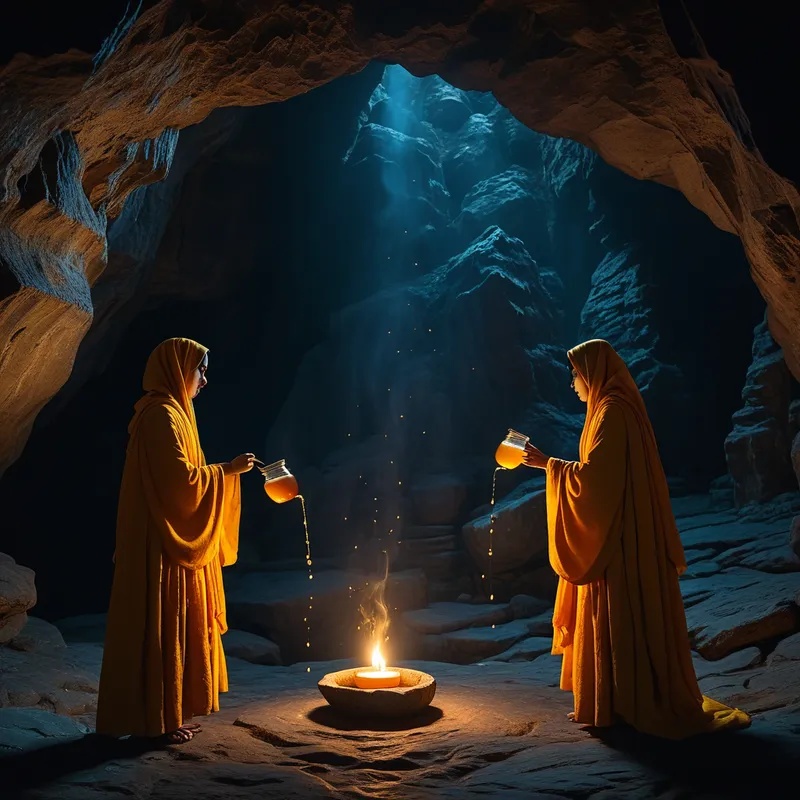
Their life was a sacred rhythm, a liturgy written in flight paths and seasons. They did not dwell in houses of stone, but in the living rock of caves and the hollows of ancient oaks. Their work was the alchemy of the wild: gathering the essence of a thousand sun-drenched flowers, transforming it in the dark warmth of the hive into golden ambrosia. This was no mere harvest. It was a sacrifice and a offering. The thick, sweet honey was poured into stone bowls, libations for the chthonic gods, for the spirits of the dead, for the Great Goddess in her many forms—Artemis of the wilds, Demeter of the fertile grain, and the mighty Persephone herself.
They were the first priestesses. At the rustic shrines, before the Olympian cults formalized worship, it was the Melissae who received the seekers. They would lead the trembling initiates into the grove’s heart, their low chanting a mimicry of the swarm’s hum, a sound to dissolve the mind’s chatter. With honey-smeared lips and crowns of bee’s-balm, they guided souls through rituals of purification and ecstatic release. They were the midwives not of bodies, but of psychic births and sacred deaths, standing at the crossroads where the human soul met the raw, buzzing life-force of the world itself. Their story has no single hero’s climax, for it is the story of the background hum of creation itself—persistent, communal, and sweetly, fiercely transformative.
Cultural Origins & Context
The myth of the Melissae is not the stuff of Homeric epic, but of older, earth-stained strata. It belongs to the world of local cults, mysteries, and the veneration of nature spirits that preceded the patriarchal pantheon of Olympus. These stories were passed not by bards in royal halls, but by priestesses in sacred groves, by farmers who left offerings at rustic shrines, and through the rituals of the Thesmophoria and other women’s mysteries.
Archaeology and fragmentary hymns tell us bees were intimately linked to the divine feminine. The title “Melissa” was given to priestesses of Rhea, Demeter, and Hecate. At the famous oracle of Delphi, the Pythia herself was sometimes called “the Delphic Bee.” The society of the hive—communal, industrious, centered on a queen—provided a powerful natural metaphor for matrilineal and matrifocal social structures. The myth functioned as a sacred charter, explaining and legitimizing the authority of these female religious figures. It rooted their power not in political decree, but in a direct, metamorphic lineage from the earth and the titanic forces of memory and prophecy.
Symbolic Architecture
The Melissae are a profound symbolic complex, representing the psyche’s own transformative instincts.
At their core, they symbolize the Soul as a Hive. The individual bee is fragile, transient, but the hive is enduring, intelligent, and productive. This mirrors the relationship between the conscious ego (the single bee) and the vast, communal unconscious (the hive). Our conscious life gathers experiences (pollen), which are then taken inward and transformed in the darkness of the unconscious (the hive) into something nourishing and enduring (honey)—the wisdom and substance of the self.
The true work of the soul is done in the dark, communal warmth of the unconscious, where the fleeting impressions of day are alchemized into the lasting gold of meaning.
They are also Guardians of the Threshold. As beings born from a slain serpent at the world’s navel, they mediate between opposites: life and death (offering honey to the dead), wild nature and human culture (making wilderness productive), ecstasy and order (their chaotic flight results in geometric comb). They represent the psychic function that manages transition, initiation, and the integration of shadowy, chthonic contents.
Finally, they embody Feminine Generative Wisdom. Their creativity is not about solitary artistic genius, but about a receptive, gathering intelligence that transforms what is given by the world. The honey is not made by the bee in a factory sense; it is a miraculous transmutation of gathered essence through communal bodily process. This is a model of creation as reception, relationship, and biological mystery.
The Dreamer's Resonance
When the motif of the Melissae stirs in the modern dreamscape, it signals a profound process underway in the dreamer’s psyche. To dream of a sacred bee, a humming swarm in a calm, purposeful pattern, or particularly of a bee-priestess, is to encounter the archetype of deep, organic transformation.
Somatically, this may correlate with a feeling of humming vibration in the body, a sense of gathering energy, or a pull toward natural, rhythmic cycles. Psychologically, the dreamer is likely in a phase where scattered experiences, ideas, or emotions are being drawn inward for integration. The ego may feel small and fragile (the single bee), but the dream affirms a larger, intelligent process at work (the hive).
If the bees in the dream are agitated or the hive is threatened, it suggests a rupture in this transformative process. Perhaps the conscious mind is interfering, rejecting the necessary “darkness” of the unconscious work, or failing to “gather” from life’s experiences. The dream becomes a call to create sacred space—to become the priestess of one’s own inner mysteries, to allow the silent, golden work of integration to proceed.

Alchemical Translation
The journey of the Melissae offers a precise map for the alchemical process of individuation—the psychic transmutation of base, scattered experience into the gold of a cohesive Self.
The first stage, gathering (the bee in flight), is the conscious life: our engagements, sufferings, joys, and learnings. This is the raw, multicolored “pollen” of daily existence. The modern individual must consciously participate in this gathering, but without immediate comprehension of its purpose.
The crucial second stage is return to the hive (the descent into darkness). This is the often-neglected step of withdrawal, reflection, and incubation. It is the depressive or introverted phase where we stop doing and start processing. The ego must surrender its gathered contents to the larger, unconscious self. This is the Melissae leading the initiate into the cave, the sacred grove. In psychological terms, it is engaging with dreams, journaling, therapy, or simple solitude—entering the temenos, the sacred container.
Individuation is not an act of willful construction, but of patient, receptive fermentation within the sealed vessel of the self.
The final stage is transmutation into honey (the creation of meaning). In the warm darkness of the hive/unconscious, enzymes of psyche—complexes, archetypes, memory—break down and reconstitute the raw material. Pollen becomes honey; experience becomes wisdom, insight, or art. This is the “gold” that nourishes the individual and can be offered to the world. The Melissae, as priestesses, model this offering—the libation. The integrated Self does not hoard its gold but offers it back to life, to the community, and to the divine, completing the sacred circuit.
Thus, to heed the call of the Melissae is to commit to this ancient, buzzing rhythm: to gather widely, to retreat deeply, and to transform sacrificially, emerging not as a solitary hero, but as a nourishing part of the eternal, humming hive of being.
Associated Symbols
Explore related symbols from the CaleaDream lexicon: