
Mount Parnassus Myth Meaning & Symbolism
The sacred mountain of Apollo and the Muses, a sanctuary for prophecy and art, born from the floodwaters of a world cleansed and reborn.
The Tale of Mount Parnassus
Listen, and let the breath of the north wind carry you to a time when the gods walked closer, and the bones of the earth held memory. In the age of bronze, when humanity’s arrogance rose like a foul smoke to the nostrils of Zeus, he unleashed his terrible judgment. The heavens opened, and the rivers of the deep broke their banks. For nine days and nine nights, the rains fell, a deluge to scour the world clean. All lands drowned, all cities silenced, all life washed away—save for one speck, one promise.
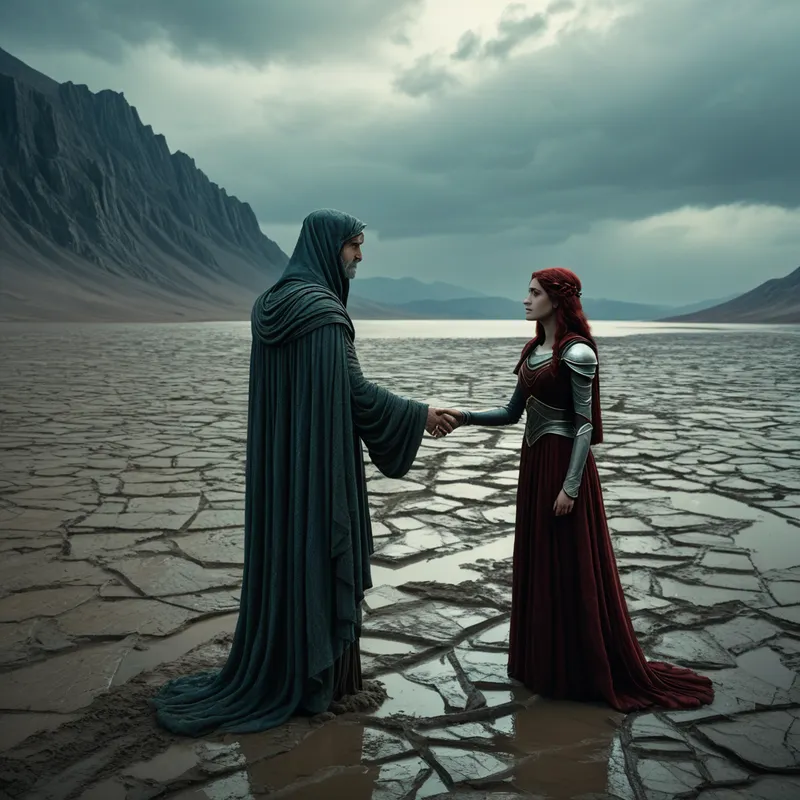
Two peaks, like the shoulders of a slumbering giant, refused the flood. This was Mount Parnassus. And upon its sodden, lonely slopes, a single boat of wood, now grounded, held the last of mortals: Deucalion and his wife, Pyrrha. The water stretched around them, a vast, grey mirror reflecting a vacant sky. Their tears salted the mud. They had survived the wrath, but to what end? A world empty, a legacy erased.
Driven by a desperate piety, they climbed higher, seeking an oracle, a sign. They came upon the ancient sanctuary of Themis, its altar cold. Falling to their knees, they poured out their lament. “Great Titaness,” Deucalion cried, his voice raw against the silence, “how can we, two alone, restore the race of man? How can life begin again from this universal grave?”
Then, a voice, not in the air, but in the stone beneath them, resonant and deep: “Depart from my temple. Veil your heads. Loosen the girdles of your garments. And cast behind you the bones of your great mother.”
The couple stood, stunned and trembling. The bones of their mother? Horror seized Pyrrha. To desecrate a parent’s tomb was the deepest sin. But Deucalion, son of the foreseer Prometheus, pondered. “Our great mother,” he whispered, “is not a woman, but the Earth itself, Gaia. Her bones… are the stones that lie upon her body.”
A wild hope, fragile as a newborn lamb, kindled between them. They covered their heads with their cloaks, loosened their tunics, and, walking away from the temple without looking back, bent to the wet earth. They gathered stones—rough, water-smoothed, the very bones of Parnassus—and cast them over their shoulders.
A sound began, a soft cracking, like ice in a spring thaw. The stones Deucalion threw softened, stretched, grew warm with blood and breath, becoming men, tall and sturdy as the mountain rock from which they sprang. The stones from Pyrrha’s hand unfolded into women, their forms graceful, their strength deep as the earth. From the sterile slopes of the purged world, a new race was born, autochthonous, sprung directly from the soul of the land that saved them. And watching from the newly cleared heavens, Apollo smiled. He saw in this act of sacred interpretation the very essence of prophecy. He claimed Parnassus as his own. Soon, the Muses would dance there, and the Pythia would breathe the vapors from its deep fissures, and the mountain would become not just a refuge from death, but a sanctuary for the birth of everything that makes life worth living: song, prophecy, and divine madness.
Cultural Origins & Context
The myth of Parnassus is not a single story, but a layered tapestry woven from strands of pre-Greek earth worship, Mycenaean cult, and classical Greek synthesis. Its physical reality—a towering limestone massif in central Greece with the twin peaks of the Phaedriades—made it a natural omphalos, a navel of the world. Before Apollo arrived with his lyre, the mountain was sacred to older, chthonic powers like Themis and Gaia, and to Python. The myth of Deucalion’s flood represents a profound cultural memory, a resetting of the cosmic clock, and Parnassus is the ark that is not a ship, but a piece of the primordial world itself.
This story was the foundational “origin myth” for the Hellenes, the Greeks’ own account of their genesis as a people born directly from the sacred landscape. It was recited and performed, not in dusty libraries, but at the very site of its happening—the Sanctuary of Delphi. Pilgrims climbing the Sacred Way to consult the Oracle would pass monuments and hear hymns that reinforced this narrative. It served a crucial societal function: it legitimized Delphi as the spiritual center of the Greek world, explained the unique “Greekness” as tied to the land, and modeled the proper relationship between humanity and the divine—one based on pious interpretation, not blind obedience.
Symbolic Architecture
At its core, Parnassus is the archetypal Axis Mundi, the world pillar connecting the underworld, the earthly realm, and the heavens. It is the place of mediation between chaos and order, the unconscious and consciousness, drowning silence and articulate sound.
The mountain is not merely high ground; it is the psyche’s capacity to find a vantage point above the flood of undifferentiated emotion and instinct.
The flood represents the nigredo of the soul—a period of overwhelming dissolution, where all prior structures of identity and meaning are washed away. Parnassus is the enduring core of the Self that survives this cataclysm. Deucalion and Pyrrha symbolize the conscious mind and its allied soul, tasked with the impossible: recreating a world from the ruins. The oracle’s riddle is the critical moment where raw instinct (throwing literal bones) must be alchemized into symbolic understanding (stones as the bones of Mother Earth). This is the birth of true intelligence—not just knowledge, but the wisdom to translate the cryptic language of the deeper Self.
The subsequent dedication of the mountain to Apollo and the Muses signifies the flowering of this hard-won consciousness into culture, art, and inspired thought. The Castalian Spring represents the cleansing of the personal past and the opening to the prophetic, poetic waters of the collective unconscious.

The Dreamer's Resonance
To dream of Parnassus is to be in a state of profound psychic transition. You may dream of climbing a steep, rugged mountain while a great flood rages below, feeling both terrified of the waters and isolated on the peak. This is the somatic signature of the ego clinging to a newfound, fragile integrity after a period of emotional or psychological devastation—a divorce, a loss, a collapse of a life structure.
The dream may present a version of the “oracle’s riddle”: a cryptic message from a wise but stern figure, or a seemingly nonsensical task. The anxiety in the dream centers on the fear of misinterpretation. This mirrors the psyche’s process of presenting solutions from the depths in symbolic, non-linear forms. The dreamer is being asked to perform the act of interpretation itself—to move from literal, desperate thinking to symbolic, creative problem-solving. Dreaming of throwing stones that turn into people suggests a phase where one’s own discarded, hardened aspects (“stony” defenses, old wounds) are being miraculously transformed into living, vital parts of a new internal community.
Alchemical Translation
The myth of Parnassus is a master map for the individuation process. It begins with the catastrophic flood: the necessary, often painful, dissolution of the outworn personality (the opus contra naturam). The ego, like Deucalion’s ark, is dashed upon the mountain—it survives, but stranded and bereft.
The ascent to the oracle is the conscious engagement with the Self. The riddle is the gift of the unconscious, presenting the problem in its own symbolic language.
The critical alchemical operation is the interpretatio. The “bones of the mother” are the prima materia—the rejected, base matter of one’s own history and psyche (the stones). The instruction to “cast them behind you” is the act of projection and transformation. One must take these unloved, unconscious elements (shame, grief, anger) and, without staring at them directly in an analytical glare (veiled heads), engage with them through an act of creative, almost ritualistic, disregard. You work with them by not working on them egotistically; you transform them by redirecting your conscious attention forward, allowing the unconscious to do its work of transmutation.
The new race that springs forth is the nascent personality, no longer built on borrowed identities or societal expectations, but autochthonous—sprung from the very substance of your unique being. The establishment of Apollo and the Muses on the heights represents the final stage: the conscious mind, now in service to the Self (Apollo as prophet), giving beautiful, ordered form (the arts of the Muses) to the energies that rise from the deep. The mountain becomes a permanent inner sanctuary—a achieved state where one can regularly access inspiration, prophecy (self-knowledge), and the healing waters of purification, having been irrevocably forged in the flood.
Associated Symbols
Explore related symbols from the CaleaDream lexicon: