
Persephone Myth Meaning & Symbolism
The maiden goddess abducted to the underworld becomes its queen, embodying the eternal cycle of life, death, and rebirth that governs nature and the human psyche.
The Tale of Persephone
Listen, and hear the story that the earth herself tells when she grows cold, and the story she whispers when the green shoots break through again.
In the first days, when the world was young with light, there was a meadow. It was not any meadow, but a place where Demeter’s love pooled so deeply that every flower grew twice as bright, every blade of grass sang with life. And in that meadow danced her daughter, Kore, whose laughter was the sound of spring streams and whose footsteps coaxed violets from the soil. She was the unopened blossom, the promise held in the bud, and her mother’s whole world.
But beneath that world, in the sunless depths, another watched. Hades, lord of the invisible realms, of wealth drawn from deep stone and the silent multitude of shades. He saw the light above and longed for it not to possess, but to complete his kingdom’s terrible lack. He went to his brother, Zeus, and received a silent, fateful consent.
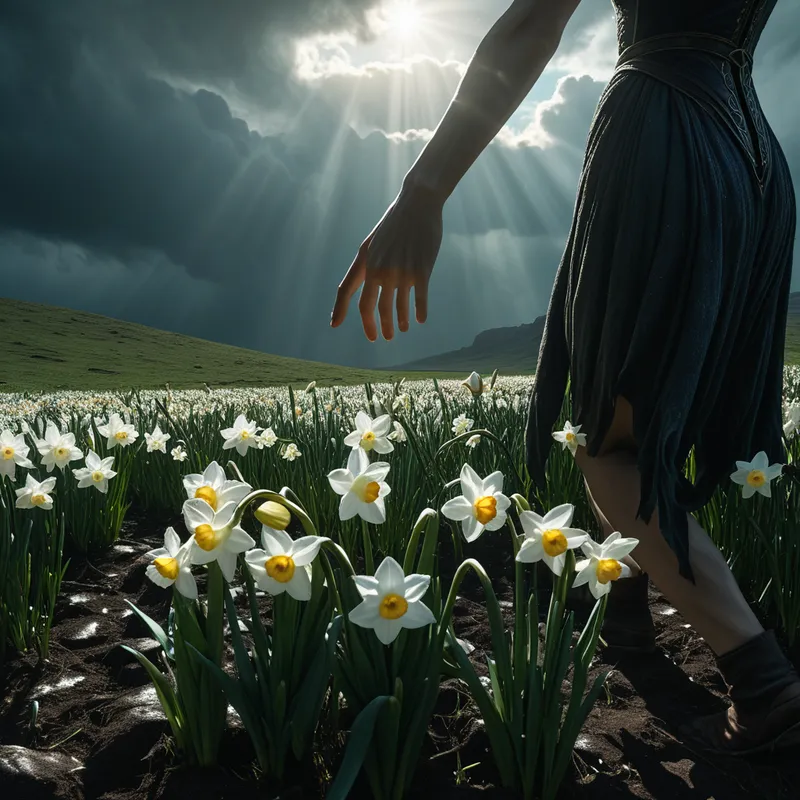
The day it happened was a day of perfect gold. Kore was with her companions, the Oceanids, gathering roses and lilies. Then she saw it—a narcissus of such stunning, hypnotic beauty that its hundred blossoms seemed to drink all the light of the sky. As she reached for it, the earth beneath Nysa’s plain did not just crack; it roared. From the abyss, a chariot of black adamant drawn by immortal, smoke-maned horses erupted. A hand, strong as the roots of mountains, seized her. Her cry was swallowed by the closing earth. All that remained was a torn garland and the fading scent of trampled blossoms.
Demeter’s grief was a force of nature unleashed. She cast off her divinity, wrapped herself in the guise of an old woman, and wandered the mortal world, a living drought. Where her sorrow fell, seeds shriveled in the furrow, vines turned to dust, and the breath of life fled from the land. Famine gripped the earth. The gods received no smoke from altars, for mortals were dying.
In her wanderings, she came to Eleusis and served in a king’s household, tending a mortal boy, trying to burn away his mortality in the hearth-fire to make him immortal—a desperate, twisted echo of her own loss. Revealed, she commanded a temple be built. There she sat, in ceaseless, stony mourning, and the world died with her.
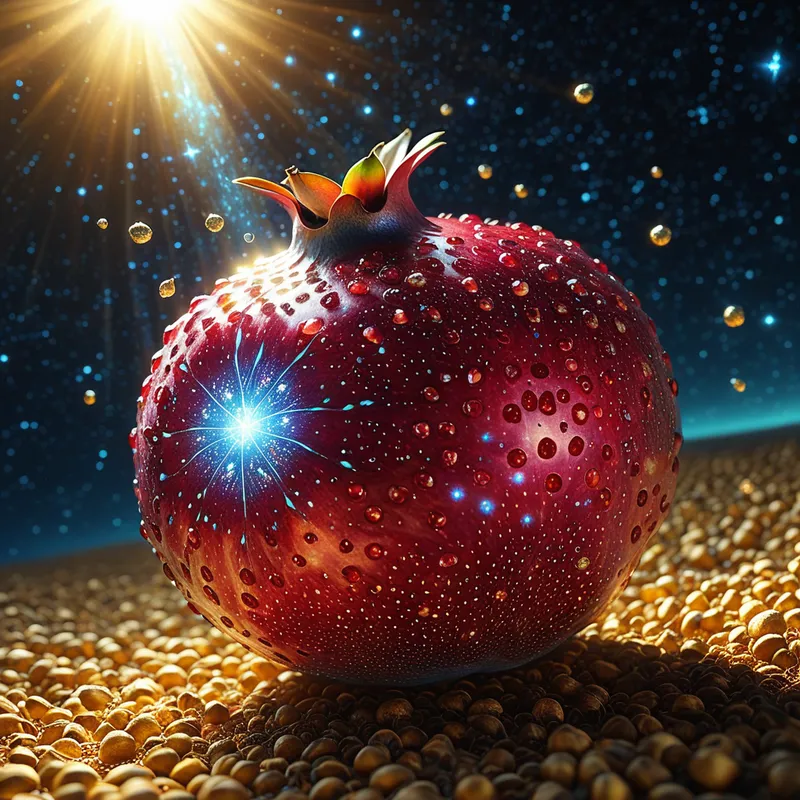
Meanwhile, in the Hades, a transformation was unfolding. The maiden Kore was gone. In her place was a woman who walked the fields of asphodel and faced the lord of that land. He offered her not a prison, but a throne. She ate not a meal, but fate itself: six seeds from the ruby heart of a pomegranate, the fruit of the dead. With that act, she bound her life to the realm of death.
Finally, the suffering of the world forced Zeus’s hand. He decreed a compromise, delivered by the messenger Hermes. For the seeds she had eaten, Persephone—for that was her name now—would spend a portion of each year in the dark halls beside Hades. The rest, she could return to the light and her mother’s arms.
Hermes guided her up through the long dark paths. When she emerged, Demeter’s winter-gray eyes saw her, and life rushed back into the world in a great, green gasp. But the pact stood. And so, each year, when Persephone descends, Demeter’s grief brings winter. And each year, her return brings the spring. The maiden became the queen, and in that becoming, gave the world its rhythm of loss and return.
Cultural Origins & Context
This myth, central to what scholars call the Homeric Hymn to Demeter, was far more than a story. It was the sacred, secret heart of the Eleusinian Mysteries, the most famous and revered initiatory cult of the ancient Greek world for nearly two thousand years. The myth was not merely recited; it was enacted in secret rites that promised initiates (mystai) a better fate in the afterlife and a profound, personal encounter with the truth of life, death, and rebirth.
Its societal function was multifaceted. On one level, it was an etiological myth explaining the seasonal cycle, giving meaning to the agricultural reality upon which civilization depended. On a deeper, religious level, it offered a powerful counter-narrative to the bleak, shadowy existence promised in common Greek mythology of the afterlife. Persephone’s journey modeled a possibility: that the soul could undergo a transformative ordeal and attain a dignified, even queenly, status beyond death. The myth thus mediated humanity’s greatest anxieties—the fear of famine (through Demeter) and the terror of death (through Persephone’s transformation).
Symbolic Architecture
The myth of Persephone is a perfect symbolic map of the psyche’s necessary descent into its own depths. Kore, the Maiden, represents the conscious ego in its initial state: innocent, attached to the mother (the personal and cultural matrix), existing wholly in the "upper world" of daylight consciousness, social persona, and known territories.
The abduction is not a crime, but a calling. The psyche cannot grow by staying in the light; it must be claimed by the depth it has ignored.
Hades is the ruler of the unconscious, the "invisible one." His realm is not evil, but essential—it holds the wealth of the psyche (instincts, forgotten memories, archetypal patterns) and the reality of mortality. The pomegranate seeds are the ultimate symbol of conscious choice within the unconscious realm. By eating them, Persephone actively participates in her own fate. She is no longer a passive victim; she accepts a portion of the underworld as part of her identity. This is the moment the Maiden (Kore) integrates her experience to become the Queen (Persephone), a unified being who rules over both life and death, consciousness and the unconscious.
The cyclical resolution embodies the fundamental law of psychic energy: integration is never a one-time event. The self must continually navigate between the demands of the inner world (the underworld) and the outer world (Olympus and the mortal realm), between introspection and engagement.
The Dreamer's Resonance
When this myth stirs in modern dreams, it often signals a profound initiation underway in the dreamer’s life. One may dream of being pulled into a basement, a subway tunnel, or a deep forest against their will—a classic "abduction" motif reflecting a feeling of being overwhelmed by depression, a life crisis, or a sudden encounter with one’s own shadow material.
Dreams of eating forbidden fruit in a dark place, or of finding a single, significant seed, mirror the pomegranate’s choice. This suggests the dreamer is on the cusp of accepting a difficult but transformative truth about themselves, perhaps integrating a past trauma or acknowledging a powerful, instinctual part of their nature they have long denied.
The somatic experience is key. There is often a feeling of coldness, weight, or paralysis—the "Demeter winter" within the body. As the process moves towards integration, dreams may shift to images of ascending a dark staircase into light, or of being in a dark place that feels strangely familiar and sovereign—the "Persephone as Queen" realization. The dreamer isn’t just visiting the underworld; they are learning its geography and discovering their authority within it.

Alchemical Translation
For the modern individual, Persephone’s myth is the archetypal blueprint for individuation. The "alchemical work" begins with the nigredo, the blackening: the abduction. This is the inevitable crisis—the loss of a job, the end of a relationship, a depression, a diagnosis—that shatters the maiden-consciousness and plunges us into the dark.
The throne in the underworld is not a consolation prize; it is the hard-won seat of self-knowledge. We do not escape the dark; we learn to reign there, and in doing so, find our true authority.
The pomegranate seeds represent the mortificatio and separatio—the dying of the old, naive self and the separation from the purely maternal (or paternal) psychic ground. By consciously "eating" our experience—assimilating the pain, the insight, the shadow—we perform the sacred act that transforms victimhood into sovereignty. This is the albedo, the whitening, where the divided self begins to unify.
The final, cyclical stage is the rubedo, the reddening or culmination, which is not a static state but a dynamic rhythm. The integrated Self (Persephone the Queen) is not a person who never feels sorrow or descends into their depths. Rather, they are one who has a conscious, rhythmic relationship with those depths. They know when to engage with the outer world of creativity and relationship (spring/summer) and when to withdraw for necessary introspection, grief, or incubation (autumn/winter). The goal is not to live in perpetual spring, but to become the one who consciously governs the cycle itself, bringing the wisdom of the depths to the world of light, and the vitality of the light to nourish the depths. In this, we become whole.
Associated Symbols
Explore related symbols from the CaleaDream lexicon:
- Fruit
- Bite
- Winter
- Niece
- Freezer
- Loss
- Upset
- Taste
- Peach
- Freshman
- Anymore
- Scented Flower
- Abandoned Swing
- Berry Basket
- Vegetable Garden
- Fruit Salad
- Summer Dress
- Floral Pants
- Flowery Kimono
- Floral Blouse
- Rotting Flesh
- Dropping Keys
- Eclipsed Light
- Wildflower Blooms
- Rustling Leaves on Pathway
- Mint Green
- Poppy Red
- Spinel Jewel
- Rustling Amber Flower
- Budding Clove Flower
- Wilted Dandelion
- Poppy Lane
- Petal Rain
- Flower Crown
- Twilight Lilac
- Wisteria Canopy
- Midnight Bloom
- Wildflower Meadow
- Flowering Almond
- Camellia Bud
- Scented Garden
- Magnolia Blossoms
- Tree in Full Bloom
- Wisteria Vine
- Frosted Pansies
- Cascading Petals
- Crowned Daisy
- Dreamy Lilac
- Joyful Cherry Blossom
- Dew-Kissed Zinnia
- Softly Crying Willow
- Withered Rose
- Budding Daffodil
- Faded Tulip
- Ripe Pomegranate
- Emerging Seedling
- Spectral Key
- Banshee's Tear
- Frostbitten Rose
- Yuki-onna Snow
- Hide and Seek
- Flower Arrangement
- Autumn Leaves
- Floral Crown
- Seasonal Bouquet
- Leaf Pile
- Broderie Anglaise Bonnet
- Burned Out Lightbulb
- Flowering Meadow
- Urban Garden
- Curled Leaf
- Cascading Flowers
- Blossoming flower
- Rotting Food
- Stale Bread
- Flower Petal
- Blossoming Flower Petals
- Floral Wallpaper
- Snowdrop Bloom
- Sunflower Seeds
- Honeysuckle Vine
- Ripe Pomegranates
- Buried Seeds
- Spring Thaw
- Foraged Berries
- Seed Offerings
- Cavernous Root Cellar
- Root foraging
- Winter Snowfall
- Underground Storage
- Seasonal Wildlife
- Berries for Gathering
- Wildfire Scar
- Decomposing Leaf Pile
- Seasonal Change
- Spring Bloom
- Buried Seed
- Spring Rain
- Seasons Turning
- Corn Husks
- Honeysuckle Trail
- Frost-covered Foliage
- Renewed Growth
- Yuki-onna
- Autumn Moon
- Veil Thin
- Seed
- Regression
- Remission
- Anemia
- Descending
- Tulle
- Melancholy
- Tart
- Floral
- Fruity
- Rot
- Yuzu
- Gardenia
- Innocent