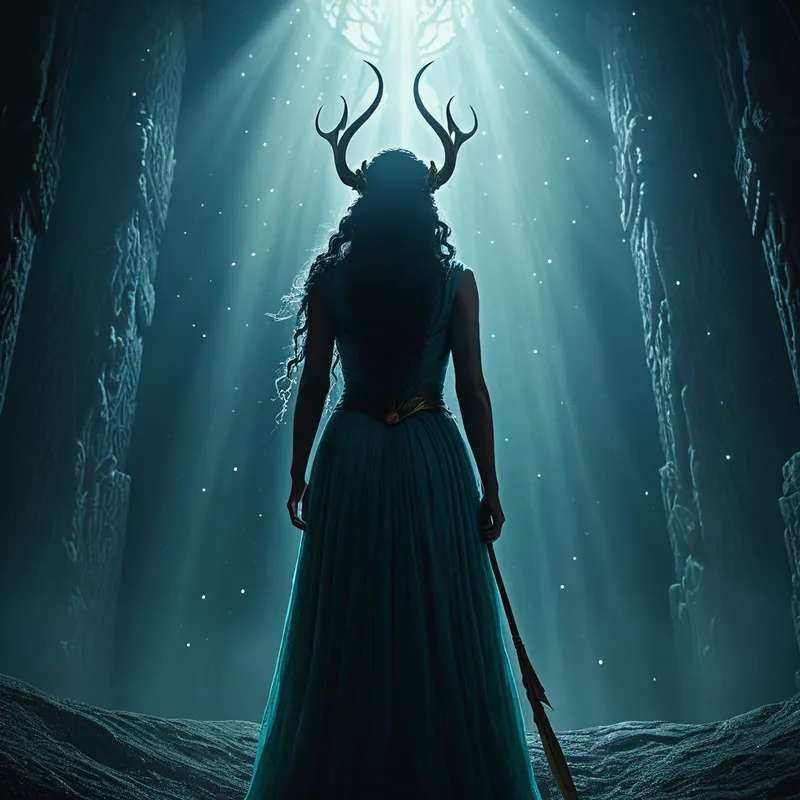
Laozi and the Water Buffalo
The Taoist sage Laozi's departure riding a water buffalo embodies the paradox of effortless action and natural harmony central to Taoist philosophy.
The Tale of Laozi and the Water Buffalo
The world of the Zhou dynasty grew heavy with the clatter of ambition and the rigid scaffolding of human order. In the western frontier, at the Hangu Pass, a weary watchman named Yin Xi sensed a change in the very air. The winds from the east carried not dust, but a profound silence that seemed to still the clamor of the world. He looked to the road, and there, emerging from the shimmering horizon, came a figure that moved with the unhurried rhythm of the earth itself.
It was Laozi, the ancient keeper of the archives, his face a map of timeless contemplation. He did not walk, nor was he borne by a chariot of state. He rode a great, grey water buffalo, a creature of immense, placid strength. The beast moved with a slow, swaying gait, its hooves planting themselves upon the road as deliberately as seals in clay. Its eyes were deep pools of unperturbed awareness, and upon its broad back, Laozi sat not as a master, but as a passenger in harmonious accord. He was departing, it was said, leaving the kingdom of knowing for the wilderness of unknowing.
Yin Xi, whose duty was to question and to bar, felt the weight of his office dissolve. He did not see a fugitive or a wanderer, but a convergence. He halted the sage and his bovine companion. “Master,” he implored, “you seek to conceal yourself in the vastness. But I perceive you carry the ultimate teaching within you. Will you leave the world without a trace?”
Laozi regarded the watchman. In that gaze was neither refusal nor acquiescence, but the simple acknowledgment of a request made in alignment with a greater necessity. The water buffalo lowed softly, a sound like stone grinding in a deep river. Without dismounting, Laozi consented. There, at the threshold between the known world and the formless Dao, he spoke—or perhaps the Dao spoke through him. Yin Xi took up his brush and bamboo slips, and the words flowed: “The Dao that can be spoken is not the eternal Dao…” Thus was the Daodejing born from the encounter between a gatekeeper’s intuition and a sage’s silent journey.
When the final character was inscribed, Laozi said nothing more. He simply nodded, a gesture as slight as a leaf turning. He urged the water buffalo forward with a touch, and together, sage and beast passed through the gate. They did not gallop into oblivion; they faded into the landscape, becoming one with the mist of the western mountains, leaving behind a text of five thousand characters and an eternal image of serene departure.
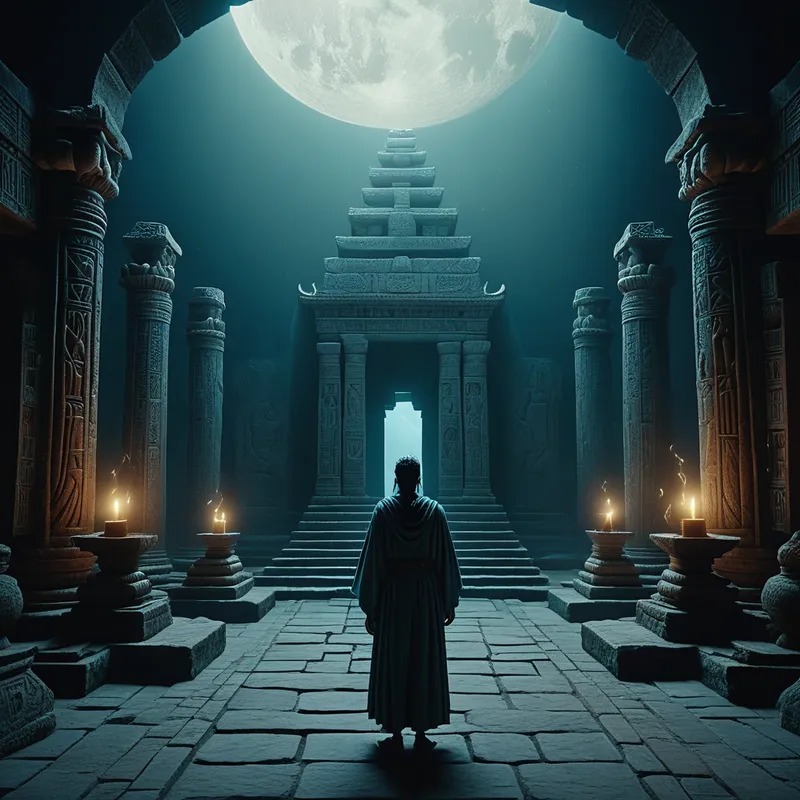
Cultural Origins & Context
The figure of Laozi is shrouded in the mists of historicity and myth. Sima Qian’s Records of the Grand Historian presents him as an elder contemporary of Confucius, a archivist of the Zhou court named Li Er. His departure west, likely in the 6th or 5th century BCE, is presented as a historical event tinged with the miraculous. The myth, however, transcends biography. It crystallizes at a pivotal moment in Chinese thought, when the philosophies of Confucianism were codifying social ritual and hierarchical order (li).
Laozi’s journey is the antithesis and the necessary complement to this project. He does not move deeper into the civilized center, but away from it, toward the wild, undifferentiated west. The pass (guan) is a powerful liminal symbol—not just a border of a kingdom, but a threshold between consciousness and the unconscious, between language and silence, between human artifice and the natural ziran. The myth legitimizes the Daodejing by framing it not as a composed treatise, but as an inspired, spontaneous utterance, forced forth only at the point of exit. It is the ultimate teaching of a wisdom that prefers not to teach, given only to prevent its complete disappearance.
Symbolic Architecture
The power of this myth lies in its stark, potent symbology, where every element is a vessel of paradoxical truth.
Laozi as the Sage: He is the embodiment of wu wei—effortless action. His wisdom is not an accumulated hoard, but a state of being so integrated that his very departure is an act of profound instruction. He does not seek followers; he evokes recognition in those ready to see.
The Water Buffalo: This is the masterstroke of the imagery. It is not the noble horse of warriors and kings, nor the mystical dragon. It is a peasant’s beast, slow, strong, patient, and intimately connected to water and earth. It symbolizes unadorned strength, groundedness, and a nature that is utterly compliant yet immovably steadfast. It does not carry Laozi; it enacts his philosophy.
The West: In Chinese cosmology, the west is associated with autumn, metal, decline, and the setting sun—the direction of endings and return. It is the realm of the mythical Queen Mother of the West (Xiwangmu), a keeper of secrets and immortality. Laozi’s journey west is thus a return to the origin, a merging with the primordial source.
Yin Xi, the Gatekeeper: He represents the receptive, feminine (yin) aspect of consciousness that can recognize and request wisdom. He is not a passive barrier but an active participant whose discernment (“I perceive you wish to conceal yourself”) makes the revelation possible. He is the necessary human counterpart to the transcendent sage.
The myth presents the ultimate paradox: the Daodejing, one of the world’s most translated texts, exists only because a man who believed “those who know do not speak” was persuaded to speak at the very moment of his final silence.
The water buffalo’s slow gait is the temporal expression of the Dao. It does not move toward a goal; its movement is its being. In riding it, Laozi demonstrates that wisdom is not about reaching a destination, but about the quality of motion itself.

The Dreamer's Resonance
Psychologically, this myth speaks to the moment of integration and release. Laozi represents the accumulated wisdom of a lifetime—the internalized archives of experience. The journey west is the ego’s surrender, not into annihilation, but into the larger, instinctual ground of the Self, symbolized by the buffalo. To “ride the buffalo” in a dream or active imagination is to experience a state where consciousness is no longer driving the personality, but is carried by a greater, instinctual intelligence.
Yin Xi is the inner voice of longing that arises at life’s thresholds. He is that part of us that, sensing a profound transition (a crisis, an ending, a midlife passage), demands meaning from it. He refuses to let the transformative energy simply pass out of consciousness unrecorded. The myth thus models a profound internal process: the ego (Yin Xi) successfully petitions the deep Self (Laozi) for its guiding text before allowing a dominant conscious attitude to dissolve.
The tension is not conflict, but creative necessity. Without the sage’s inclination toward silent unity, there is no depth. Without the gatekeeper’s insistence on form, there is no transmission. The myth resolves in a sublime image of non-resolution: the sage disappears, but the words remain. The Self withdraws, but leaves a compass for the soul.

Alchemical Translation
In the alchemy of the soul, this myth describes the final stage of the opus: the rubedo or citrinitas giving way to the ultimate return. The sage’s red cinnabar of achieved wisdom mounts the grey lead of the primal, unformed materia. Their union at the pass is the conjunctio, the sacred marriage of spirit and nature, conscious insight and animal instinct.
The resulting text, the Daodejing, is the lapis philosophorum, the Philosopher’s Stone. It is not a physical object, but a living, paradoxical formula born from the union of opposites. It cannot be possessed, only applied. Its function is to transmute the base metal of striving, rigid consciousness into the gold of flexible, flowing awareness—to teach the mind to move like water and be strong like the buffalo.
Laozi’s disappearance is the final dissolution of the alchemist into the work. The adept does not become a king on a throne, but vanishes into the landscape of the Dao, having become identical with the transformative process itself. The goal is not to rule the world, but to be so in harmony with it that one’s passage leaves no trace but a beneficial influence, like water shaping stone over millennia.
The water buffalo is the prima materia, the “vile and despised” substance that contains the secret of the work. Its slow, patient nature is the necessary tempo of inner transformation, which cannot be rushed by the will.
The Hangu Pass is the vas, the sealed vessel of the alchemical operation. Within its confines (the confrontation between Yin Xi and Laozi), the great work of distillation and condensation occurs, producing the elixir of the text.
Associated Symbols
Explore related symbols from the CaleaDream lexicon:
- Water — The supreme symbol of the Dao itself, representing softness, adaptability, persistence, and the power that wears away the rigid.
- Journey — Not a quest for conquest, but a movement of return, a flowing back toward the source of one’s being.
- Gate/Door — The liminal space of transformation, where one state of consciousness is left behind and another is entered, often requiring a exchange or password.
- Mountain — The enduring, immutable aspect of the Dao, and the distant, mysterious destination of the sage’s withdrawal.
- Buffalo Strength — The power of grounded, patient, unassuming force; strength that is inseparable from gentleness and connection to the earth.
- Silence — The unspoken ground from which all true speech arises, and the ultimate destination of wisdom.
- Roots of Wisdom — Knowledge that is not intellectual, but drawn from the deep, nourishing soil of direct experience and primal connection.
- Harmony of Opposites — The dynamic, non-conflictual balance exemplified by the sage and the buffalo, speech and silence, departure and legacy.
- Contemplative Waters — The still, reflective mind that can perceive the movements of the Dao, as Yin Xi perceived Laozi’s intention.
- Cascading Waterfall into Ocean — The individual consciousness (the waterfall) returning to and merging with the undifferentiated source (the ocean), as Laozi merges with the Dao.
- Circle — The completion of the cycle, the return to the origin, and the seamless, endless movement of the Dao.
- Dream — The mythic, symbolic realm where such profound encounters between the conscious mind and the archetypal Self take place.