Labrys Myth Meaning & Symbolism
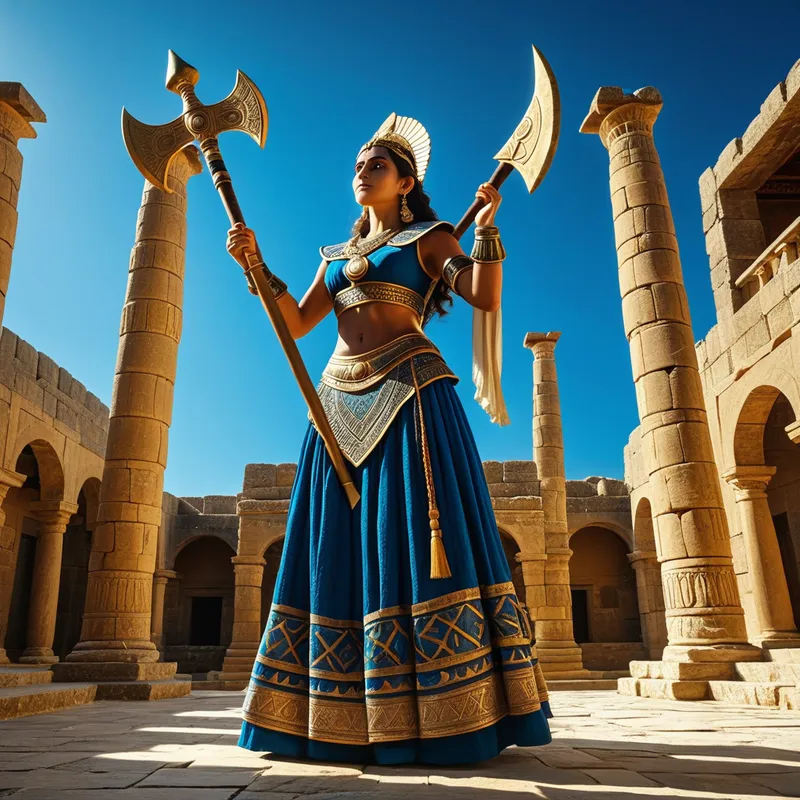
The sacred double axe, a symbol of divine power and labyrinthine complexity, guiding the soul through its own inner maze to confront the shadow and find wholeness.
The Tale of Labrys
Listen, and let the scent of cypress and salt air carry you back. To an island of white stone and blue sea, where the earth itself trembles with a rhythm older than kings. This is Crete, and at its heart lies a palace not of straight lines and simple squares, but of winding passages, of rooms that lead nowhere and everywhere. They call it the Labyrinth, a name that whispers from the very walls, a name born from the object we seek: the Labrys.
In the central court, under the relentless sun, the air is thick with incense and anticipation. The crowd is a silent sea of color—saffron robes, intricate jewelry, eyes wide with awe. They have come not for a king, but for the Goddess. She whose feet tread the mountain peaks and the dark places under the earth. Her priestess stands before them, not as a woman, but as a vessel. In her hands, she does not hold a scepter, but the Labrys. Its haft is polished wood, warm with the touch of generations. Its twin blades, of shining bronze, catch the light like captured moons. They are not tools for war, but for ceremony. With a motion both graceful and terrible, she raises the axe. The crowd holds its breath. This is the moment the world is cut in two, and made whole again.
The rhythm begins. Not from drums, but from the earth. The thunder of hooves. From the shadowed entrance, he comes—the Minotaur. A form of nightmare and profound mystery, half-man, half-bull, a breathing paradox. He is the dweller in the maze, the secret at the center. The priestess does not flinch. The Labrys in her hands becomes a pivot around which the universe turns. The beast charges, a force of pure, untamed nature. The dance is not one of slaughter, but of sacred encounter. The gleaming arcs of the Labrys trace patterns in the air, a geometry of containment and reverence. It is a dialogue of power. The wild, chaotic strength of the beast meets the precise, ritualized authority of the symbol. One does not destroy the other; they are held in a terrible, beautiful tension. The axe falls, not to kill, but to consecrate. The offering is made. The labyrinth has witnessed its purpose. The Labrys, stained now with more than oil, is lowered. In the sudden silence, you understand: the center of the maze was not a monster to be slain, but a truth to be faced. And the key was this double-edged blade, capable of both severance and connection.
Cultural Origins & Context
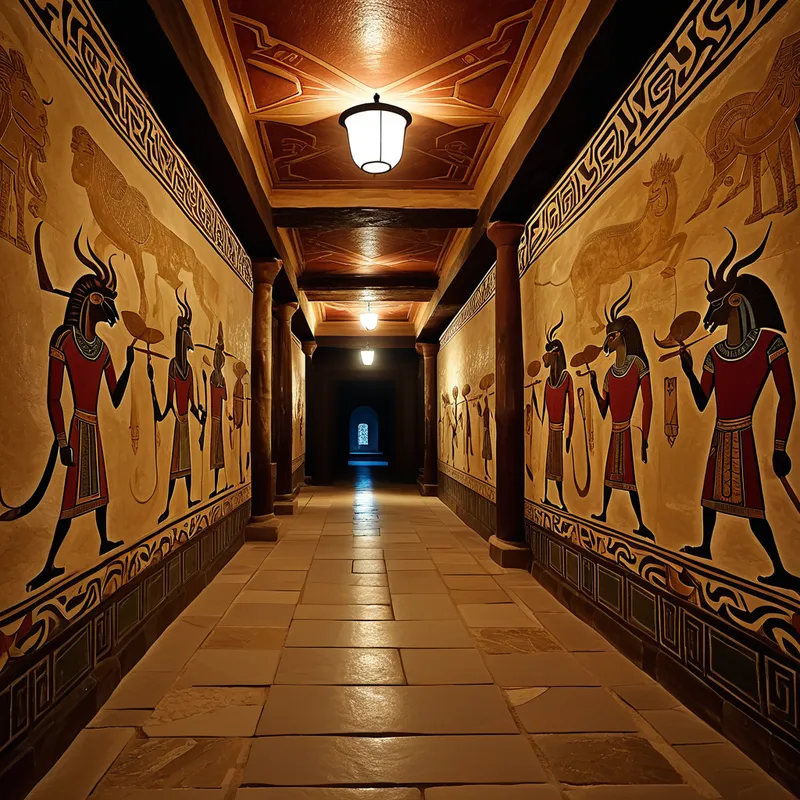
The myth of the Labrys is not a single story penned by a poet like Homer, but a silent narrative etched into stone, painted on palace walls, and cast in precious metal. It belongs to the Minoan civilization, a culture that flourished a thousand years before the rise of classical Athens. For the Minoans, the Labrys was ubiquitous. It appears in frescoes, on seals, and as a sacred motif in the very architecture of palaces like Knossos. The word "labyrinth" itself likely derives from "labrys," meaning "the house of the double axe."
This was a symbol of supreme, likely feminine, divine authority. It was wielded by goddesses and their priestesses in rituals that may have involved bull-leaping and other acts of confronting primal power. Its function was societal and spiritual: it was an emblem of the palace's religious and temporal power, a tool for sacrifice (likely of bulls, potent symbols of strength and fertility), and a guarantor of cosmic order. The myth was passed down not through epic verse, but through ritual repetition and artistic symbolism—a language of power, duality, and the sacred containment of chaos within the complex, labyrinthine structures of both palace and cult.
Symbolic Architecture
The Labrys is a masterpiece of symbolic condensation. Its form reveals its function in the psyche. The central handle represents the axis mundi, the world pillar or the individual spine of consciousness, the firm "I" that must hold the center. From this axis extend two perfectly balanced, opposing blades.
The double axe does not choose between opposites; it is the instrument that holds them in a single, potent unity.
One blade faces outward, representing active, solar, penetrating consciousness—the power to cut through illusion, to make decisions, to act in the world. The other blade faces inward, symbolizing receptive, lunar, introspective consciousness—the capacity to cut away internal falsehoods, to sacrifice outmoded parts of the self, to delve into the unconscious. Together, they symbolize the union of all dualities: male and female, sky and earth, life and death, creation and destruction. The labyrinth it is associated with is not a prison, but a sacred precinct for initiation. The winding path represents the convoluted journey of self-discovery, where linear thinking fails. The Minotaur at the center is the ultimate shadow—the untamed, instinctual, and potentially monstrous aspect of the self that we spend our lives avoiding. The Labrys is the tool, both physical and psychic, needed to confront this inner beast, not to annihilate it, but to engage with it, to make it sacred through conscious encounter.
The Dreamer's Resonance
When the Labrys appears in a modern dream, it signals a profound initiation into the labyrinth of one's own psyche. The dreamer is not lost in a hedge maze, but navigating the complex, often non-linear corridors of a deep psychological process. Somatic sensations may accompany it: a feeling of being turned around, the weight of a momentous decision in the hands, or the tense anticipation before a confrontation.
To dream of finding or holding a Labrys suggests the dreamer is accessing a new, potent form of personal authority. They are developing the capacity to "cut through" a complex life situation or a tangled emotional knot. To dream of it hanging on a wall, immovable, might indicate a sacred power that is recognized but not yet integrated or actively wielded. A dream of a crumbling or broken Labrys could reflect a crisis of personal power or a feeling that one's ability to balance opposites has failed. The most potent dreams involve using the Labrys within a labyrinthine space. This is the psyche announcing a state of active shadow-work. The dreamer is being summoned to face their own "Minotaur"—perhaps a buried rage, a shameful desire, a creative force perceived as too wild—and is being given the symbolic tool to do so with conscious intention, rather than blind fear.
Alchemical Translation
The myth of the Labrys provides a precise model for the alchemical process of individuation—the journey toward psychic wholeness. The first stage, nigredo or blackening, is the descent into the labyrinth itself: the confusion, depression, or sense of being lost that often precedes major growth. One must willingly enter the maze of one's own complexity.
The Minotaur represents the shadow, the rejected and unconscious content that must be integrated. Confronting it is the perilous albedo stage. Here, the Labrys is essential. Its dual blades symbolize the conscious work (sol) of analyzing and understanding the shadow, and the unconscious, receptive process (luna) of allowing it to be felt and experienced.
Individuation is not the slaying of the beast, but the sacred dance with it, where the raw material of instinct is transmuted into conscious power.
The final act of the myth—the ritual encounter, not a simple slaughter—is the rubedo, the reddening. It is the integration. The beast's power is not destroyed but is now in relationship with the conscious self, symbolized by the priestess who holds the Labrys. The chaotic force is consecrated, becoming a source of vitality rather than fear. The individual who completes this process emerges from their personal labyrinth not with a trophy, but with the Labrys itself now an internalized principle. They become capable of wielding the power of conscious choice (one blade) with the wisdom of deep self-acceptance (the other blade), no longer torn by opposites but standing firm at the axis where they meet, whole.
Associated Symbols
Explore related symbols from the CaleaDream lexicon: