
Saffron Robes Myth Meaning & Symbolism
A mythic tale of a sacred garment dyed by the sun's fire, symbolizing the radical renunciation of worldly identity to clothe oneself in pure consciousness.
The Tale of Saffron Robes
Listen, and let the wind carry you back to a time when the world was younger, and the veil between the earthly and the eternal was thin as morning mist.
In the high, silent places where the air bites cold and the snow never fully melts, there lived a seeker. He was not always of the mountains. Once, he walked in the sun-drenched plains, a man of name and family, bound by the threads of duty and desire. But a great unrest had taken root in his heart, a thirst that no river of worldly pleasure could quench. It whispered of a truth that lay beyond the horizon of the known, a freedom untouched by birth or death.
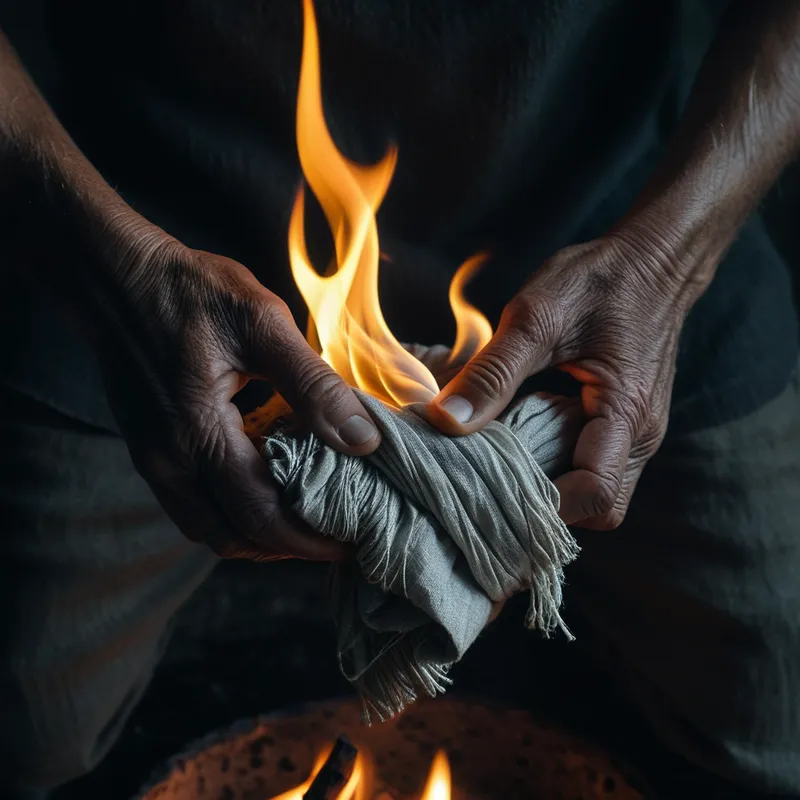
So, he turned his back on the world. He walked until the sounds of the marketplace faded into the cry of eagles, until the walls of his home were replaced by the vast, open sky. He came to the foot of the great, white-capped peaks, the abode of gods and sages. With his own hands, he tore the fine cloth from his back—the last emblem of his old life—and stood shivering in the raw truth of his being. From the humble śāṇa plant, he gathered fibers. With patient, blistered fingers, he spun a thread, and on a simple loom, he wove a cloth. It was coarse, plain, and the color of dust.
But this was not enough. The cloth was a shell, empty. The true dye, he knew, was not of this earth. For forty-nine days and nights, he sat in unwavering meditation, his gaze fixed on the eastern horizon. He sought not a god in the sky, but the god within—the inner sun, the Agni of consciousness. As he sat, the outer world mirrored the inner. The winter solstice passed, and the sun, which had seemed to flee, began its slow return.
On the dawn of the fiftieth day, as the first sliver of light breached the black peaks, it did not merely illuminate him—it answered him. A ray, pure and concentrated as a laser of divine intent, fell upon the bundled cloth at his knees. Where it touched, the dull fabric did not just brighten; it transmuted. It drank the light and blazed with the essence of sunrise itself—a deep, luminous, impossible orange-gold. It was the color of flame without burning, of sunset held in perpetual dawn. It was the color of the Bhṛgu’s wisdom and the Tathāgata’s compassion, woven into a single garment.
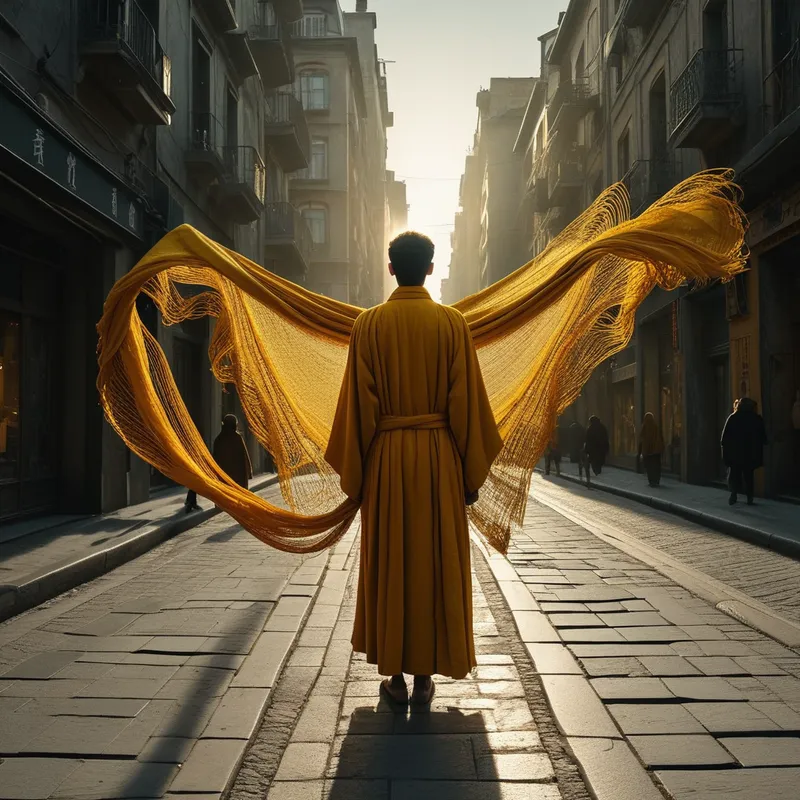
He stood, and with reverence, he wrapped himself in this stolen piece of the sky’s own fire. The coarse cloth was now a robe of light, weightless yet warmer than any fur. He was no longer a man who had left the world; he was one who had clothed himself in the principle that illuminates it. The Saffron Robe was born—not a uniform of poverty, but a banner of the ultimate wealth, a skin of awakened consciousness.
Cultural Origins & Context
This is not a single myth with one author, but a living, breathing motif woven into the spiritual fabric of the Indian subcontinent. Its origins are as diffuse as sunlight, found in the earliest Vedic reverence for fire and the sun (Surya, Agni) as purifying, transformative forces. The narrative crystallized with the Śramaṇa movements, most notably in Buddhism and Jainism, around the 6th century BCE.
It was passed down not in royal courts, but in forest groves and cave monasteries, from teacher to disciple. The story was told to novices as they received their own robes, a visceral explanation for the most external sign of their new life. Its societal function was radical: it legitimized and sacralized the path of renunciation (Sannyāsa). In a culture structured by duty (Dharma) and social identity, the saffron robe was a public declaration of a higher duty—to truth itself. It signaled one who had "gone forth," becoming a living symbol and a spiritual resource for the community.
Symbolic Architecture
The myth is a masterclass in symbolic alchemy. The coarse, undyed cloth represents the raw, unrefined self—the ego with all its attachments, histories, and pains. It is the "old garment" of conditioned identity.
The Saffron Robe is not something you put on; it is what is revealed when everything else is willingly taken off.
The act of weaving it oneself signifies the arduous, personal work of constructing a new vessel of being. But the pivotal symbol is the saffron dye—the divine, external light that must be invoked to complete the transformation. This represents grace, awakening, or the irruption of the Self (Ātman/Śūnyatā) into the personal psyche. The color saffron is itself a complex glyph: it is the hue of the rising sun (new consciousness), of sacred fire (purification and sacrifice), and of the autumn leaves (the beautiful letting go of the old).
The robe, then, is the psychic skin of the integrated individual. It is the visible form of an invisible process—where the personal will (the weaving) meets the transpersonal revelation (the sun's dye) to create a new, authentic identity rooted not in society, but in the cosmos.
The Dreamer's Resonance
When this myth stirs in the modern unconscious, it often surfaces in dreams of clothing transformation. To dream of finding, putting on, or being given a saffron robe speaks to a profound psychological threshold.
The dreamer is likely in a process of radical inner reorientation. They may feel the coarse "undyed cloth" of their current life—a career, relationship, or self-image that feels authentic yet incomplete, meaningful yet lacking vital color. The dream signals that a deeper, non-negotiable part of the psyche (the inner sun) is demanding recognition. It is a call to sit in the "cold mountain" of one's own truth, to engage in a sustained meditation on what is essential, and to await the inner dawn. Somatic sensations might accompany this—a feeling of being exposed or cold (the renunciation), followed by a profound, glowing warmth (the integration). The dream is the psyche’s way of robing the ego in the authority of the Self.
Alchemical Translation
For the individual, this myth maps the journey of individuation—not as a path of adding more to the personality, but of a sacred subtraction and a subsequent infusion.
The first alchemical stage is Nigredo: the "tearing off" of the old identity. This is the painful, necessary disillusionment with the persona, the worldly masks we wear. The seeker weaves their new vessel in the darkness of this uncertainty. The second stage is Albedo: the purification, the forty-nine nights of meditation, the washing in the fires of introspection. It is a bleaching of the complexes, a making-ready.
The ultimate transmutation occurs when the personal quest is held, empty and patient, until it is filled by a light that does not belong to it.
The final, glorious stage is Rubedo: the reddening, the dawn. This is the moment of psychic synthesis where the labor of the ego is met by the affirming power of the Self. The "saffron" is the color of this completed work. The newly integrated consciousness is both humble (it is just cloth) and majestic (it is dyed by the sun). The modern individual undergoing this alchemy moves from being a person defined by the world to being a presence that, quietly and radiantly, illuminates their corner of it. They wear their authenticity not as a boast, but as a simple, luminous fact—a saffron robe woven in the loom of their own experience, dyed in the dawn of their own awakening.
Associated Symbols
Explore related symbols from the CaleaDream lexicon: