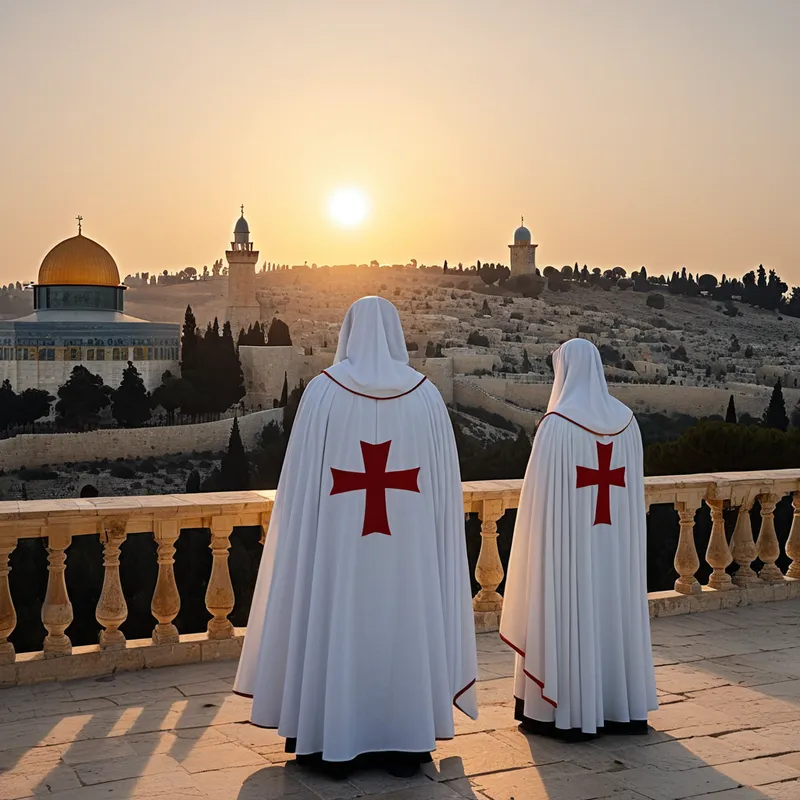
Knights Templar Myth Meaning & Symbolism
A myth of warrior-monks sworn to protect a sacred mystery, who become martyrs to power, transforming into an eternal symbol of hidden truth.
The Tale of Knights Templar
Listen, and hear the tale not of mere men, but of a living sigil forged in the holy fire of a contested land. It begins in the smoke and clamor of the First Crusade, after the bloody stones of Jerusalem had been taken. Pilgrims, wide-eyed with devotion, flooded the dusty roads to touch the Sepulchre, only to be preyed upon by bandit and blade. From this chasm between faith and terror, an answer was whispered into being.
Nine knights, led by the fervent Hugues de Payens, came before the King of Jerusalem. They were not lords seeking land, but warriors seeking a vow. They took the triple oath of the monk—poverty, chastity, obedience—but girded it with the sword. They became a paradox made flesh: the Pauperes commilitones Christi Templique Salomonici. Their mission was singular: to protect the pilgrims. Their emblem, a blood-red cross stark upon a field of white, declared their purpose—to make their bodies a living wall between the faithful and the abyss.
They were given quarters upon the very foundation of myth, the Temple Mount. There, in vaults rumored to hold secrets older than Christendom, they kept their austere vigil. Their rule was iron, their lives a rhythmic chant of prayer and drill. For decades, they were the steel spine of Outremer, their white mantles a beacon on every battlefield from Ascalon to the gates of Damascus. Kings and popes bestowed upon them unimaginable privilege—exemption from all law save the Pope’s, the right to build their own churches, to hold vast lands across Europe. Their houses became fortresses and banks, their network a silent, humming nervous system connecting the continents of faith and finance.
But as their earthly power grew, a shadow lengthened. In the lush courts of Europe, where they were once hailed as angels of war, eyes now watched with avarice and fear. The whisper began: what true treasure did they unearth in their Temple excavations? What rites did they perform in their secret chapters? The myth of their hidden knowledge grew fat on the envy of kings, particularly Philippe IV, whose coffers were drained and whose pride chafed at their sovereignty.
Then, on a Friday the thirteenth shrouded in autumn fog, the hammer fell. The King’s men moved with synchronized malice across France. At dawn, the knights were torn from their pallets, accused not of military failure, but of spiritual treason—of spitting on the cross, of idolatry, of obscene kisses. The long night of torture began. Under the relentless press of the question, confessions were ripped from broken bodies. The perfect Order was declared a heresy.
The final act was played out on the Isle of the Jews in the Seine. There, the last Grand Master, Jacques de Molay, bound to the stake, found his voice once more. Before the flames consumed him, he lifted his head and issued not a plea, but a prophecy. He called the King and the Pope to meet him before God’s tribunal within the year. The crowd fell silent. The smoke rose. And within the year, both Pope and King were dead. The Order was dissolved, its wealth scattered, its brothers broken. But from those ashes, the true myth was born—not of their power, but of their silence; not of their guilt, but of their enduring mystery.
Cultural Origins & Context
The myth of the Templars is unique, for it is a legend that germinated within living memory and documented history. Its origins are not in prehistoric oral tradition, but in the parchment and stone of the 12th to 14th centuries. It began as a chanson de geste of a new kind: the holy warrior-monk, a figure that captured the medieval imagination struggling to reconcile the teachings of Christ with the brutal necessities of the Crusading era. The tale was told first by chroniclers like William of Tyre, and later sanctified by the papal bull Omne Datum Optimum.
Its societal function was multifaceted. For the Church and nobility, it was a potent propaganda tool—the living ideal of Christian militancy and sacrifice, encouraging support and funding for the Crusades. For the common people, it provided a tangible, heroic intermediary between their earthly struggles and the distant drama of the Holy Land. After their suppression, the narrative was seized and transformed by their persecutors. The trial transcripts themselves, circulated widely, became the primary "text" of a new, darker myth: the secret society, the heretical cult. This version was perpetuated by the crown to justify its theft and by a public eager for scandalous tales of the mighty fallen.
In the centuries that followed, the myth was kept alive not by the Church, but by fringe historians, occultists, and later, novelists and filmmakers. It became a blank parchment upon which every era projected its own anxieties and desires—a symbol of lost purity for Romantics, of esoteric wisdom for occult revivalists, of corrupt institutional power for conspiracy theorists. The Templars thus evolved from historical actors into a permanent fixture of the Western collective unconscious, a ghostly presence at the crossroads of faith, power, and secrecy.
Symbolic Architecture
At its heart, the Templar myth is a profound symbol of the conjunctio oppositorum—the sacred marriage of opposites. The knight and the monk, the sword and the cross, the battlefield and the cloister, earthly wealth and a vow of poverty. They represent the heroic attempt to hold irreconcilable tensions within a single, disciplined vessel.
The true temple they guarded was not made of stone, but of the paradoxical space where the will to power kneels before the will to surrender.
Their legendary treasure is the ultimate MacGuffin of the soul. Whether literal gold or spiritual gnosis, it symbolizes the elusive, transformative prize sought in the depths of one's own being—the Philosopher's Stone or the integrated Self. Their suppression represents the inevitable shadow of such an endeavor: the ego, or the collective power structure (the King), cannot tolerate a center of gravity outside its control. The trial is the ritual scapegoating, where the complex, ambiguous truth of the individual or group is forced into the simplistic, binary categories of orthodoxy and heresy.
Jacques de Molay’s fiery prophecy completes the symbolic arc. It transforms the narrative from one of mere victimhood to one of archetypal martyrdom and cosmic justice. His death is not an end, but a sublimation. The physical order is destroyed so the mythic pattern can be liberated, ascending from history into legend.
The Dreamer's Resonance
When the Templar pattern stirs in the modern dreamscape, it often signals a critical phase of inner consolidation and the threat of its dissolution. To dream of being a Templar knight, or of discovering Templar relics, suggests the dreamer is in the process of building or has built a profound inner structure—a personal code, a spiritual practice, a hard-won integration of opposing drives (e.g., ambition and compassion, logic and intuition). The white mantle with the red cross may appear as a symbol of this hard-earned, consciously adopted identity of sacred guardianship.
Conversely, dreams of Templar trials, betrayals, or being hunted for one's "secret knowledge" point to the vulnerability of this inner temple. The dream ego may feel its deeply held values, its private sense of truth, or its non-conforming spirituality is under attack by external authorities (a job, family, societal norms) or by an internal "King Philip"—the tyrannical, conformist part of the psyche that demands allegiance to outdated rules. The somatic sensation is often one of constriction in the chest (the burned heart), a feeling of being bound or imprisoned, or the cold clarity of betrayal. The dream is a rehearsal, asking: What inner truth am I being asked to confess under torture? And what, like de Molay, must I retract to reclaim my soul?
Alchemical Translation
The alchemical journey of the Templar myth maps perfectly onto the individuation process. It begins with the Nigredo, the calling. The nine knights answering the call to guard the pilgrim's path is the ego's first, conscious commitment to serve something higher than itself—to protect the fragile, pilgrim aspect of the soul seeking wholeness.
Their establishment on the Temple Mount and their accumulation of wealth and skill represent the Albedo and Citrinitas—the whitening and yellowing. This is the long, disciplined work of building the conscious personality, refining one's talents (the martial and financial skills), and constructing a robust "order" of the self. Yet here lies the peril: identification with this structure. The Order begins to believe in its own inviolability, its special status. This is the inflation before the fall.
The arrest and trial are the brutal, necessary Rubedo—the reddening, often symbolized by the lion's blood or fire. It is the stage of mortification and calcination. The carefully constructed persona, the "white mantle" of one's idealized self-image, is violently stripped away. The soul is subjected to the "question" of life's crises: failure, betrayal, illness, loss. The confessions extracted under this pressure are the false narratives we accept about ourselves—"I am a heretic to my own potential; my deepest beliefs are shameful."
The alchemical fire does not destroy the gold; it liberates it from the dross of identification. The burning of the Order is the burning of the ego's claim to the Self.
De Molay's retraction and his prophetic curse are the ultimate act of psychic transmutation. He reclaims his prima materia—his essential, unbroken truth—from the jaws of the process that sought to annihilate it. His death is the final dissolution, but his prophecy ensures the work is not lost. The myth, the pattern, the archetype survives. For the modern individual, this translates to the realization that while our external forms—careers, relationships, status—may be crucified by circumstance, the essential pattern of our quest, the gold of our lived truth, becomes part of the eternal legend of the soul. We are not the ruined fortress, but the ghostly standard still flying from its crumbling tower, a testament to what was sworn, guarded, and ultimately, transcended.
Associated Symbols
Explore related symbols from the CaleaDream lexicon: