Kiku Myth Meaning & Symbolism
A myth of a maiden who becomes the immortal chrysanthemum, embodying sacrifice, eternal return, and the soul's promise of renewal beyond the physical world.
The Tale of Kiku
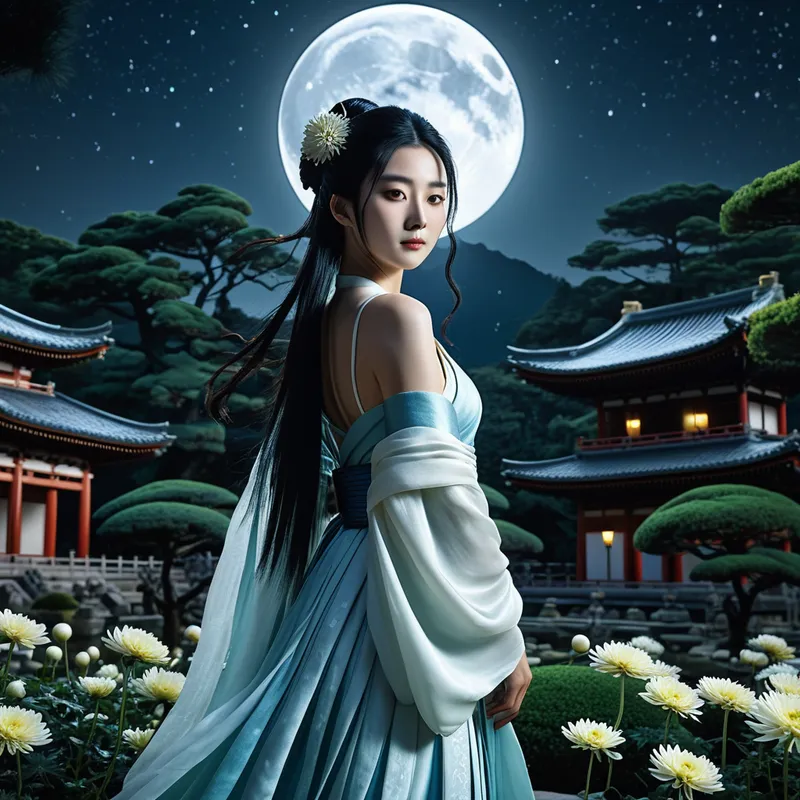
Listen, and let the mists of time part. In an age when the world was closer to the kami, there lived a maiden named Kiku. She was not of noble birth, but her beauty and spirit were such that the very sunlight seemed to linger on her path. She served in the household of a kind lord, her life a quiet stream of service and gentle grace. Her true love was a young fisherman, his heart as steady as the tides, and they shared a promise as simple and deep as the ocean.
But a shadow fell upon the land. A terrible sickness, a creeping cold that stole the breath from the lungs and the light from the eyes, swept through the province. It touched the lord’s own household, and his beloved daughter, the young mistress, was seized by its fevered grip. Healers came and went, their herbs and chants useless against the silent thief. The lord’s despair was a palpable fog that filled the halls.
One night, as the full moon hung like a ghostly pearl, a venerable ascetic appeared at the gate. His eyes held the depth of ancient forests. “There is a cure,” he whispered, his voice like dry leaves, “but its price is the ultimate currency. The sickness is of the mortal coil; it can only be broken by a sacrifice of pure, selfless life given before its natural end. One must drink a dew gathered only from the Chrysanthemum Throne at dawn, and in doing so, offer their own dawn in exchange.”
The household was struck silent. Who could make such a trade? Kiku, who had been listening from the shadows, felt not fear, but a terrible, clear certainty. She thought of her fisherman, of their future by the sea, and her heart ached like a physical wound. Yet, she also thought of the young mistress’s laughter, of the lord’s kindness, of the countless others the sickness might claim. Her love was not a chain, but a root—it connected her to one, and thus to all.
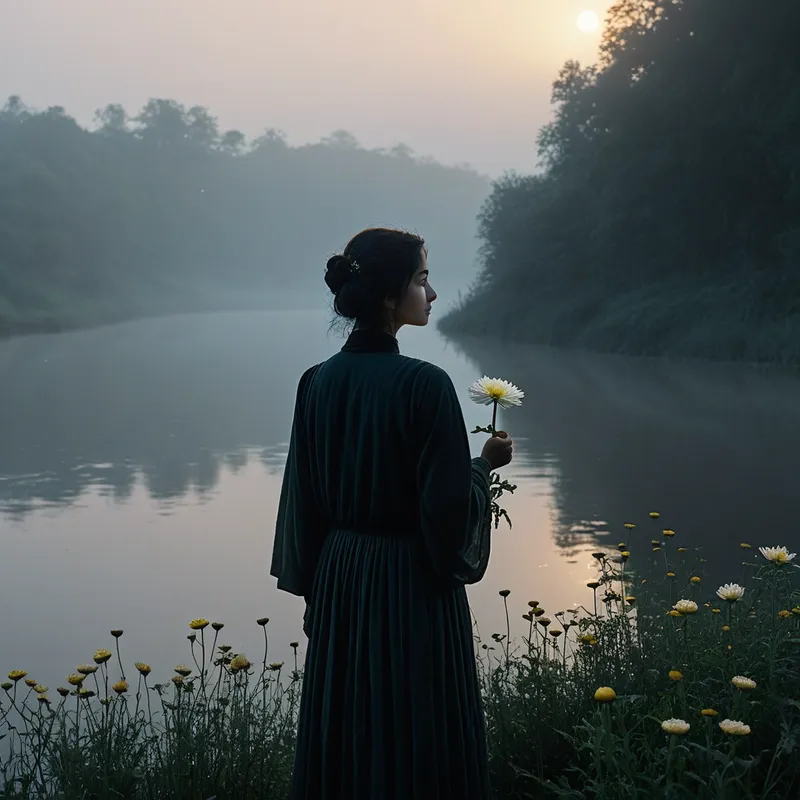
Without a word to her beloved, she slipped away in the deepest dark before dawn. She journeyed to the sacred hill where the imperial chrysanthemums grew, their petals holding the last stars of night. As the first sliver of sun gilded the horizon, she knelt. With a shell given by her love, she collected a single, perfect bead of dew from the heart of the most majestic bloom. She did not drink it for herself. She poured it into a vial, and with a final breath that was not a sigh but a release, she felt her own vitality, her future, her very chronology, flow into that tiny vessel.
She returned, placed the vial by the sleeping mistress’s bedside, and faded like the morning mist. By the time the sun was high, the mistress awoke, healed and radiant. Of Kiku, there was no trace—save for where she had knelt on the sacred hill. There, a new, impossibly beautiful chrysanthemum had bloomed overnight, its petals holding the exact hue of her spirit, its resilience a testament to her choice. It was a flower that would not wither with the seasons, but return, eternal.
Cultural Origins & Context
The tale of Kiku is woven into the broader tapestry of Japanese folklore concerning transformation and the interpenetration of the human and natural worlds. Unlike the grand, nationally codified chronicles of the Shinto Kojiki or Nihon Shoki, this myth belongs to the realm of mukashibanashi (folktales) and local legend, often told to illustrate profound moral and spiritual principles. It likely circulated orally for generations, told by village elders and storytellers, particularly in regions associated with chrysanthemum cultivation or near ancient imperial lands.
Its societal function was multifaceted. On one level, it reinforced the Confucian and Buddhist-inflected values of self-sacrifice, loyalty (chu), and duty (giri), especially potent in a feudal context. On a deeper, animistic level, it explained the origin and sacred nature of the chrysanthemum (kiku), a flower already deeply symbolically charged as the emblem of the Imperial family and a symbol of longevity and rejuvenation. The myth served as an etiological story, giving a soul-reason for the flower’s beauty and perennial nature, anchoring a natural phenomenon in a human drama of heart and spirit. It taught that the most enduring things—whether a flower, a virtue, or a legacy—are often born from a conscious surrender of the individual self to a larger pattern of life.
Symbolic Architecture
At its core, the myth of Kiku is a profound map of psychic transformation through self-relinquishment. Kiku is not a warrior-hero who conquers through force, but a caregiver-hero who transforms through offering.
The Sickness represents not just physical ailment, but any pervasive, life-denying stagnation in the psyche or the community—a depression, a collective fear, a spiritual paralysis. The Chrysanthemum Throne Dew is the elixir vitae, the concentrated essence of life and order, but it exists only in the realm of the sacred (the Throne). It cannot be taken; it can only be received through a channel of purity.
The ultimate sacrifice is not the destruction of the self, but its conscious translation into a more enduring form.
Kiku’s Sacrifice is the pivotal symbol. She does not merely die; she transmutes. Her act is an alchemical one: she exchanges her linear, mortal life-story for a cyclical, symbolic existence. The fisherman represents the personal life of attachment and earthly joy—a life fully valid and beautiful. Her choice to leave him signifies the painful but necessary separation from purely personal desires to answer a call from the transpersonal Self. Her transformation into the chrysanthemum signifies that her essence is not lost but repatterned. She becomes an archetype—the Ever-Returning, the Beautiful That Serves, the Life That Nourishes Through Its Own Passing.
The Dreamer's Resonance
When this myth stirs in the modern dreamer, it often surfaces during periods of profound inner conflict between personal desire and a felt sense of greater responsibility or calling. To dream of being Kiku—of making a silent, world-altering sacrifice—is to feel the psyche wrestling with the caregiver archetype in its most absolute form.
Somatically, this might manifest as dreams of giving away a vital part of oneself: offering one’s heart, breath, or voice to heal another. There may be imagery of crossing a river alone at dawn, of holding a luminous object that drains one’s color as it brightens, or of feeling one’s body slowly turn into plants or flowers. The emotional tone is rarely one of martyrdom, but of a deep, resonant, and sorrowful clarity. The conflict is not against an external monster, but against one’s own attachment to a cherished future-self.
Psychologically, this dream pattern signals a process of ego-dethronement. The conscious personality (the ego) is being asked to relinquish its central authority for the health of the broader psychic system. It is the pain of ending a chapter, leaving a relationship, or abandoning a long-held identity because a deeper, soul-level imperative demands it. The dream is the psyche’s way of framing this painful but necessary death as a sacred, mythic act of creation.

Alchemical Translation
The journey of Kiku is a precise model of Jungian individuation—the process of becoming the integrated, whole Self. It maps the nigredo, albedo, and rubedo of the soul.
The Nigredo (the blackening) is the initial sickness, the shadow that falls over the land of the psyche. It is a crisis that reveals the insufficiency of the old order. The Albedo (the whitening) is Kiku’s moment of lucid decision—the pure, moonlit clarity where she sees the necessary operation. This is the conscious engagement with the shadow, the willingness to bear the conflict.
The supreme act is the Rubedo (the reddening), the achievement of the philosopher’s stone. Here, the stone is the immortal chrysanthemum. Kiku’s sacrifice is the coniunctio oppositorum—the marriage of opposites. She unites mortal and immortal, personal love and transpersonal love, death and eternal return. She does not avoid death; she incorporates it into a higher pattern of meaning.
Individuation is not about becoming perfect, but about becoming complete; it often requires the sacrifice of the good for the sake of the whole.
For the modern individual, the “dew from the Chrysanthemum Throne” is that elusive quality of meaning, authenticity, or wholeness that can only be accessed when we stop seeking it for our small, separate selves. We must offer up our ego’s rigid plans—our “fisherman’s future”—to serve a truth larger than our personal narrative. The “immortal chrysanthemum” we become is not a literal afterlife, but the achieved state of symbolic living. It is when our actions, our love, our work cease to be merely personal and become part of a timeless, nourishing pattern—a legacy of spirit that, like the perennial flower, returns to bless the world long after the individual season has passed. We trade chronology for kairos—clock time for soul-time.
Associated Symbols
Explore related symbols from the CaleaDream lexicon: