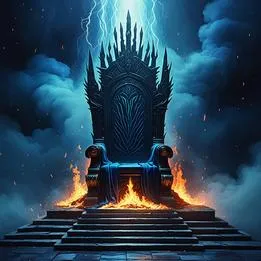
Throne
The Oracle's Essence
A seat of authority, power, and sovereignty, representing leadership, divine right, or social hierarchy.
Interpretive Themes
✧ Archetypal Essence
Ruler
Dominant Influence ( 85%)
The throne embodies the archetypal seat of governance and divine mandate.
The Light
The throne embodies the archetypal seat of governance and divine mandate.
The Shadow
The throne embodies the archetypal seat of governance and divine mandate.
Modern Visibility
In contemporary settings, thrones symbolize institutional authority, corporate leadership, or ceremonial roles, often critiqued as symbols of inequality.
◈ Mythological Resonance
The Siege Perilous
Arthurian traditionThe empty seat at the Round Table reserved for the knight destined to find the Holy Grail; it would bring death to any unworthy who sat in it, symbolizing the throne's demand for purity and destiny.
The Throne of Zeus
Greek traditionThe golden, eagle-adorned seat on Mount Olympus from which the king of the gods dispensed justice and wielded thunderbolts, representing ultimate cosmic authority and order.
Beriah the World of Creation Myth Meaning & Symbolism
Kabbalistic traditionThe central symbol of Beriah, representing established divine authority, the seat of consciousness, and the structured mind from which governance of the lower worlds emanates.
Bahram the Warrior King Myth Meaning & Symbolism
Persian traditionThe seat of power and psychological wholeness, which is empty until the inner conflict between civilized identity and wild instinct is resolved.
Ereškigal Queen of the Underworld Myth Meaning & Symbolism
Sumerian traditionThe fixed, central locus of inner authority and sovereignty, often encountered in dreams as the seat of a shadow aspect or the true self.
Erlik Khan Siberian Myth Meaning & Symbolism
Siberian traditionThe sovereignty of the Shadow; the established, authoritative power of the repressed contents that must be formally acknowledged.
Erra and Ishum Myth Meaning & Symbolism
Babylonian traditionThe seat of Marduk’s authority, its vacancy symbolizing the collapse of a ruling conscious attitude, creating a vacuum for the shadow to fill.
Metatron Archangel Myth Meaning & Symbolism
Hebrew traditionRepresents established authority, divine governance, and the stable center of consciousness from which one can oversee the inner and outer realms.
Metatron in Kabbalah Myth Meaning & Symbolism
Kabbalistic traditionRepresents a stable, centered seat of consciousness from which one administers the inner world and mediates between different levels of reality, mirroring the divine order.
Nergal and Ereshkigal Myth Meaning & Symbolism
Sumerian traditionThe seat of power in the underworld; claiming it alongside Ereshkigal represents achieving sovereignty through the integration of shadow, not through its suppression.
Queen Nzinga Warrior Queen Myth Meaning & Symbolism
African traditionSymbol of established power and center of governance; Nzinga’s myth teaches that the true throne is an act of consciousness, built from one’s own resources and authority.
Sulayman's Ring Myth Meaning & Symbolism
Islamic traditionThe symbol of conscious identity and worldly authority; its usurpation marks the ego's dethronement and the beginning of the transformative crisis.
The Descent of Nergal Myth Meaning & Symbolism
Babylonian traditionThe dual thrones of heaven and the underworld symbolize the centers of conscious and unconscious power; the ultimate goal is to claim the throne in the realm of shadow.
The Sleeper Awakened Myth Meaning & Symbolism
Arabian traditionThe seat of power and identity; the myth asks who has the right to sit upon it, and exposes it as a transferable object, not an intrinsic quality.
The Throne of God Kursi Myth Meaning & Symbolism
Islamic traditionThe central symbol of divine authority, sovereignty, and the ultimate seat of order from which all creation is governed and sustained.
Ezekiel's Wheel Vision
Hebrew traditionThe seat of sovereignty, divine authority, and the established center of cosmic order, from which judgment and grace emanate.
Feridun and the Three Sons
Persian traditionThe sacred center of power and identity; its division represents the fragmentation of the Self and the inevitable conflict that arises from splitting a unified whole.
Inanna and the Huluppu Tree
Sumerian traditionA symbol of established sovereignty, rightful authority, and the stable center of consciousness or a kingdom.
The Exaltation of Inanna
Sumerian traditionThe established seat of authority and judgment, one of the primary me, representing the stable center from which power is exercised.
The Four Living Creatures
Hebrew traditionThe seat of ultimate authority and divine presence, representing the fixed center around which all cosmic order revolves and from which sovereignty emanates.
The Heavenly Court
Jewish traditionThe immovable center of divine authority and the seat from which cosmic order emanates.
The Heart as the Throne of God
Sufi traditionThe seat of ultimate sovereignty and authority, symbolizing the center of consciousness where the true Self reigns.
The Jade Emperor Korean
Korean traditionThe fixed center of the universe, the seat from which all mandates flow and to which all reports return, symbolizing the unwavering point of governance.
The Merkabah Chariot Vision
Hebrew traditionThe seat of ultimate authority and the stable center around which all cosmic activity revolves, symbolizing divine sovereignty and the Self.
The Seraphim and Cherubim
Hebrew traditionThe ultimate context for both beings; the Seraphim attend it, the Cherubim form its foundation, symbolizing divine authority, sovereignty, and the stable center of all creation.
The Queen of Sheba Bilqis
Islamic traditionThe seat of sovereignty and conscious identity; the established center of power within the psyche or a kingdom.
The Prophet Isaiah's Vision
Hebrew traditionThe symbol of absolute sovereignty, foundational order, and the ultimate center of authority around which all reality revolves.
Cultural Lenses
Jungian
Learn More →Represents the Self archetype—integration of consciousness and unconsciousness. The throne as mandala symbolizes wholeness, with the ruler as individuated psyche achieving balance between personal and collective.
Freudian
Learn More →Phallic symbol representing paternal authority and superego demands. Sitting on a throne may indicate Oedipal desires for power over the father, with the seat itself as a regressive anal fixation on control.
Gestalt
Learn More →Projection of the dreamer's relationship with authority figures. The throne represents unfinished business with power dynamics—whether the dreamer feels entitled to sit or unworthy to approach.
Cognitive
Learn More →Mental schema for processing social hierarchy and personal agency. The throne activates neural networks associated with status evaluation, triggering emotional responses based on perceived legitimacy or threat.
Evolutionary
Learn More →Adaptive symbol for navigating dominance hierarchies. The throne triggers ancient brain circuits for assessing alpha status, with responses shaped by evolutionary needs for group leadership and resource control.
Global/Universal
Learn More →Cross-cultural symbol of sovereignty found in virtually all hierarchical societies. From Egyptian pharaohs to modern CEOs, represents the human need for centralized authority and social order.
East Asian
Learn More →In Chinese tradition, the Dragon Throne symbolizes Mandate of Heaven—imperial authority granted by cosmic order. Japanese Chrysanthemum Throne represents unbroken lineage and harmony with nature spirits.
South Asian
Learn More →In Hindu-Buddhist traditions, the throne (simhasana) represents dharma—righteous rule. Often depicted with lions, symbolizing spiritual sovereignty where the ruler protects cosmic order (rita).
Middle Eastern
Learn More →In Islamic and pre-Islamic traditions, the throne (arsh) represents divine sovereignty. From Solomon's judgment seat to Allah's heavenly throne, symbolizes perfect justice and ultimate authority.
European
Learn More →Medieval concept of divine right monarchy, where the throne represents God's earthly authority. Coronation rituals transform the seat into sacred object, blending Christian and pagan sovereignty symbols.
African
Learn More →Among Akan and Yoruba peoples, the stool or throne (ase) contains the ruler's soul and ancestral power. Not merely furniture but living entity connecting present rule to lineage spirits.
Modern Western
Learn More →Critiqued as symbol of inequality but persists in ceremonial contexts. Corporate 'corner office' as modern throne, representing both achievement and systemic privilege in capitalist hierarchies.
✦ The Oracle's Prediction
A significant test of leadership or an offer of greater responsibility.
Contextual Nuances
Sitting on throne
Claiming personal authority.
Empty throne
Power vacuum fear.
Falling off throne
Loss of status.
Guarding a throne
Protecting authority.
Building a throne
Creating power structure.
Integrative Mantra
"Affirmation"
Integration Ritual
Ritual Practice
Place a sturdy chair in the center of a room. Light a single white candle on a small table beside it. Sit in the chair for five minutes in silence, hands resting on your knees, back straight. Visualize the weight of a decision you must make. Then, stand, blow out the candle, and write the decision on a piece of paper. Fold the paper and place it under the chair's cushion for one full day.
Questions for Reflection
- "What authority do I feel entitled to in my waking life?"
- "Who or what currently 'sits on the throne' in my personal relationships?"
- "How does this dream throne reflect my relationship with societal power structures?"
Related Weavings
The Portal is Always Open
Every dream is a personalized dispatch from the deep. Don't let yours fade into static.
Interpret Full Dream