Heracles' Labors Myth Meaning & Symbolism
A hero's brutal atonement becomes a path to immortality, as Heracles battles monstrous projections of his own psyche to achieve divine integration.
The Tale of Heracles' Labors
Hear now the tale of the strongest man who ever lived, and the heaviest burden he was made to bear. It begins not with glory, but with a crime born of madness. Hera, whose wrath is as cold and enduring as mountain snow, cast a fit of madness upon Heracles. In that black fog, he saw not his beloved wife and children, but phantoms of the enemy. When the fog lifted, he was surrounded by their true, broken bodies. The blood on his hands was his own heart’s.
Seeking purification, the shattered hero journeyed to the oracle at Delphi. The Pythia’s voice, thin and ancient as wind through rocks, gave him his sentence: he must go to his cousin, Eurystheus, a small man who wore a crown too large for his spirit. For ten years, Heracles would serve him, performing any task set. Only then might the stain be lifted.
Thus began the Labors. Not glorious quests, but impossible errands for a spiteful king who hid in a giant bronze jar whenever Heracles returned, alive, with the proof.
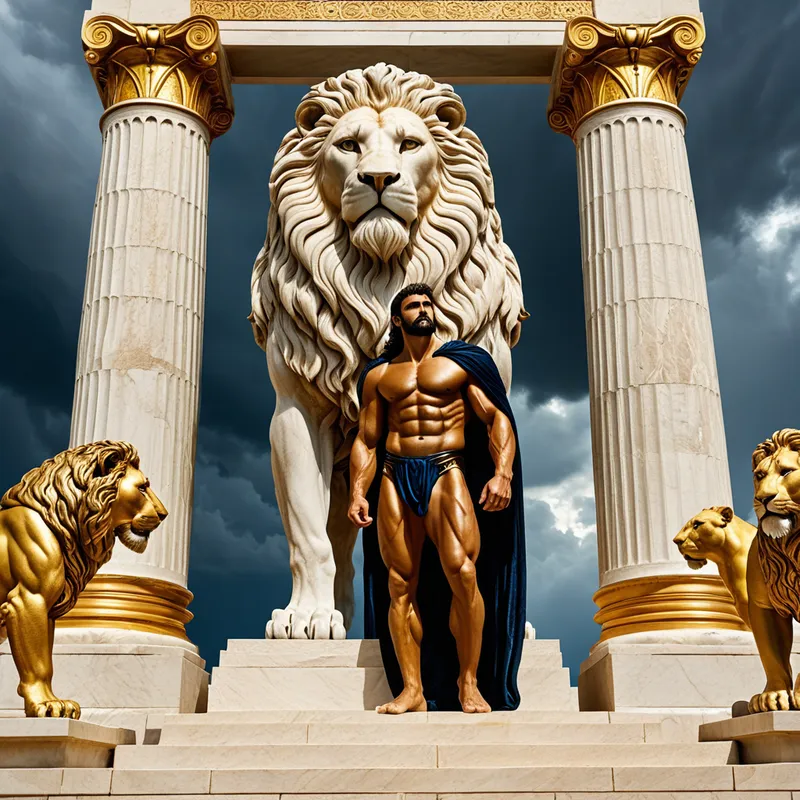
He went first to the valley of Nemea, where a lion with a hide impervious to bronze or iron stalked. Heracles’ arrows rattled off its golden fur like hail. Cornered in its dark cave, he discarded his weapons. Man and beast met in a primal embrace of strength, and the hero strangled the life from it, using the lion’s own claws to skin it. The pelt became his armor, the gaping maw his helmet.
Next, the Lernaean Hydra, a serpent with nine heads that grew two for each one severed, its breath a poisonous mist over the swamps. Heracles seared the neck-stumps with fire, burying the one immortal head under a stone. He dipped his arrows in the beast’s venom, a poison he would one day feel himself.
He chased the Ceryneian Hind, sacred to Artemis, for a year, capturing it without harm. He trapped the monstrous Erymanthian Boar in deep snow. He cleansed the stables of King Augeas, diverting two rivers in a single day, a labor of humiliating, Herculean sanitation.
He drove away the Stymphalian Birds, their bronze feathers deadly as arrows. He mastered the Cretan Bull, father of the Minotaur. He tamed the man-eating Mares of Diomedes. He claimed the girdle of the warrior-queen Hippolyta, a task that ended in bloodshed not of his own making.
He journeyed to the edge of the world, to the land of the setting sun, and stole the cattle of the monster Geryon. He descended into the very realm of the dead, Hades, to leash its three-headed guardian, Cerberus, and bring the beast, trembling, into the light of the living world.
And for his final labor, he shouldered the sky itself so the Titan Atlas could retrieve the Golden Apples of the Hesperides. When Atlas returned and refused to take the weight back, Heracles tricked him, asking only for a moment to adjust his cloak. He took the apples and walked away, leaving the Titan once more burdened.
Twelve labors. Twelve years. When it was done, the hero stood before Eurystheus for the last time. The king cowered, the tasks exhausted. The atonement was complete, but the man who returned was not the one who had left. He was something else—scarred, poisoned, weary to his immortal bones, yet unbroken. The path to Olympus was now open, but it was a path paved with blood, sweat, and the ghosts of every beast he had been sent to kill.
Cultural Origins & Context
The myth of Heracles’ Labors is not a single, frozen story but a living river of oral tradition that flowed through the Greek world for centuries before being crystallized by poets like Homer and later systematized in texts like the Bibliotheca. He was the Panhellenic hero par excellence—claimed by every city-state, yet belonging to none. His cult was one of the most widespread, functioning as a bridge between the mortal and the divine, the human capacity for horrific error and the superhuman potential for redemption.
The Labors served a profound societal function. They were a map of the known and imagined world, from the local marshes of Lerna to the hyperborean gardens of the Hesperides. Each labor conquered a form of chaos: wild nature (the Lion, Boar, Bull), monstrous perversion (the Hydra, Birds, Mares), and even death itself (Cerberus). By narrating Heracles’ success, the community symbolically reaffirmed its own cultural order over the terrifying unknowns at its borders. Furthermore, the myth modeled a crucial Greek concept: that even the greatest pollution (miasma) could be cleansed through immense, directed effort (ponos), transforming shame into a legacy of strength.
Symbolic Architecture
At its core, the myth is a masterclass in the psychology of the shadow. Heracles’ madness and crime represent the eruption of the unconscious, the parts of the self so terrible they must be disowned and projected outward. His sentence is not merely punishment, but a prescriptive, albeit brutal, course of therapy.
The Labors are not about killing monsters, but about confronting the fact that the monsters are, and have always been, within.
Each beast is a facet of the unintegrated psyche. The Nemean Lion is untamed, devouring aggression. The Lernaean Hydra is the problem that multiplies when attacked directly—the swamp of repressed emotion or deceit. The Augean Stables are the accumulated filth of neglected duty and spiritual stagnation. The journey to Hades to fetch Cerberus is the ultimate descent into the underworld of the personal unconscious, to confront and bring awareness to the primal guardian of our deepest fears.
Eurystheus, the petty king, represents the fragile, cowardly ego that sets these impossible tasks, hoping the heroic Self will fail. The triumph is that Heracles succeeds not by being a perfect god, but by using every tool at his disposal—raw strength, cunning, endurance, and even trickery—integrating all aspects of his being to accomplish the goal.
The Dreamer's Resonance
When this myth stirs in modern dreams, it signals a profound process of psychic integration is underway. The dreamer may not see Heracles, but they will feel the architecture of the Labors.
They may dream of being given an impossible, demeaning task by a weak or spiteful authority figure (an employer, a parent, an inner critic). They may find themselves in a labyrinthine basement (the Stables) facing a backlog of emotional "filth," or wrestling a shape-shifting creature (the Hydra) in a murky landscape. The somatic experience is key: overwhelming fatigue, the strain of holding immense weight (the sky), or the visceral struggle of hand-to-hand combat with a beast.
These dreams indicate the ego is being compelled by the Self to engage with repressed content. The feeling of being "sentenced" reflects a deep, often moral, recognition that one must face the consequences of one's own ignored shadows. The labor is the work of consciousness, and the dream is its nightly briefing.
Alchemical Translation
The alchemical journey of Heracles is the opus contra naturam—the work against one’s own base nature—to achieve the lapis philosophorum, the philosopher’s stone of a unified Self. His path models individuation in its rawest form.
The process begins with nigredo, the blackening: the murder of his family, the utter dissolution of his old identity in guilt and madness. The Labors are the long, arduous stage of albedo, the whitening, where the disparate elements of the psyche are confronted, purified, and separated. He faces the red rage (the Lion), the green, swampy envy or poison (the Hydra), the black depression (the Stables, Hades).
Immortality is not the reward for the Labors; it is the state of being that results from having performed them. The god is revealed not by avoiding the mess of life, but by wading through it.
His apotheosis—his ascent to Olympus and marriage to Hebe, Youth—is the rubedo, the reddening, symbolizing the final integration. He does not become a sterile, distant god. He becomes a divine being who has fully incorporated the human experience of error, suffering, and relentless effort. For the modern individual, the myth teaches that wholeness is not found in avoiding one’s personal labors, but in accepting the sentence, picking up the club, and walking into the dark wood, knowing that each beast subdued makes the soul more complete, and each river diverted cleanses the temple of the self.
Associated Symbols
Explore related symbols from the CaleaDream lexicon: