Golden Fleece Myth Meaning & Symbolism
A hero's perilous quest for a magical ram's fleece, guided by a sorceress, reveals the high price of destiny and the shadow of ambition.
The Tale of Golden Fleece
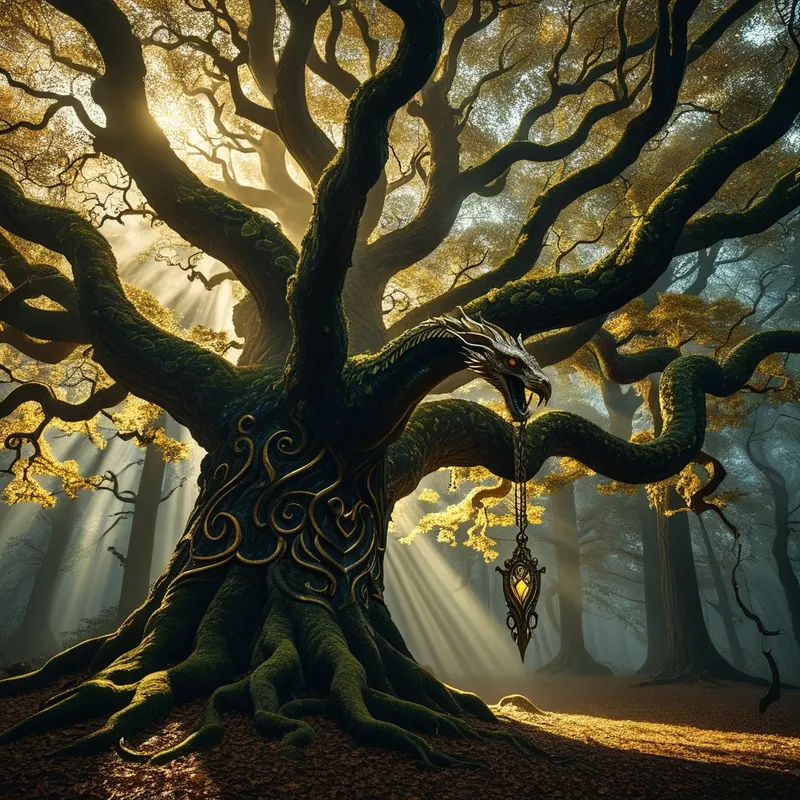
Hear now the story of a kingdom stolen, and the impossible price to win it back. In the shadowed halls of Pelias, a prophecy hung like a sword: a man with one sandal would be his doom. And so he came, Jason, having lost a sandal crossing a river, his gaze clear with the fire of his stolen birthright. The usurper king smiled a serpent’s smile. “The throne is yours,” he said, “if you bring me the Golden Fleece. Hang in a distant grove, guarded by a dragon that never sleeps.”
Thus, the great quest was born. Jason summoned heroes—Heracles, the divine musician Orpheus, the swift sons of the North Wind. They built the first great ship, the Argo, which groaned with the souls of speaking timber from Dodona. The sea spray was salt on their lips, the wind a constant companion, as they sailed to the edge of the known world, past clashing rocks and harpy-haunted shores, to the barbaric kingdom of Colchis.
There, in the palace of King Aeëtes, fate took a darker turn. The king set impossible labors: yoke fire-breathing bronze bulls, plow a field with them, and sow the teeth of a dragon, which would sprinto armed warriors. Jason’s doom seemed certain. But the king’s daughter, the sorceress Medea, was pierced by Eros’s arrow. Her heart, a tumult of passion and cunning, chose the stranger. In the dead of night, she gave him a magical ointment to protect him from fire and flame, and whispered the secret to confuse the sown warriors: throw a stone among them, and they will turn on each other.
Jason succeeded, but Aeëtes raged, refusing the Fleece. So Medea’s magic turned again, this time leading Jason through the moonlit gloom to the sacred grove of Ares. There it hung, shimmering like captured moonlight on the dark fleece of a god, and before it, the colossal serpent, eyes like burning coals. Medea sang a spell of sleep, her voice weaving a potion of oblivion. The dragon’s head sank, its vigilance broken. Jason seized the Fleece, its weight both physical and colossal, a prize that hummed with ancient power. Their escape was a blur of oars, Medea’s horrific sacrifice of her own brother to delay pursuit, and a sea stained with familial blood. The hero returned, Fleece in hand, but the throne he won was built on a foundation of betrayal and a woman’s ruined heart. The quest was over, but the true cost was yet to be paid.
Cultural Origins & Context
The saga of the Argonautica is not a single, frozen tale, but a river of story that grew with each telling. Its oldest roots likely extend back to pre-Greek exploration of the Black Sea, with the Fleece perhaps echoing ancient tales of using sheepskins to pan for gold in mountain streams—a literal “golden fleece.” By the time Homer sang, the story was already ancient. It was crystallized in the epic Argonautica by Apollonius of Rhodes in the 3rd century BCE, a work that blended heroic adventure with the sophisticated, psychological torment of its characters, particularly Medea.
This was a myth told at the crossroads of the Greek world. It functioned as a foundational narrative for colonization and daring voyages into the unknown (Pontus Euxinos). It was a story of pan-Hellenic unity, as heroes from all corners of Greece sailed together. Yet, beneath the adventure, it served as a profound cautionary tale. It asked the communal question: what is the true price of a goal obtained through treachery and the exploitation of the “other” (represented by the barbarian Medea)? It was a myth that celebrated heroic endeavor while simultaneously exposing the moral fissures within the heroic code itself.
Symbolic Architecture
The Golden Fleece is far more than a mere trophy. It is the ultimate symbol of kleos and legitimacy—the proof of a king’s divine right. To seek it is to seek one’s own wholeness and rightful place in the world.
The quest is never for the object itself, but for the integration of the power the object represents.
Jason is the archetypal hero, but a flawed one. He is often portrayed as somewhat passive, a vessel for the will of others (Pelias’s challenge, Medea’s magic). His journey is less about slaying monsters alone and more about gathering the right crew and accepting crucial, shadowy aid. He represents the conscious ego on a mandated journey, reliant on forces it does not fully understand.
Medea is the myth’s terrifying heart. She is the embodiment of the unconscious, instinctual, and magical psyche—the anima in its most potent and dangerous form. She is the helper who makes the impossible possible, but her aid comes with a binding curse. She represents the raw, untamed power of nature and psyche that civilization (Jason/Greece) seeks to use for its own ends, but which cannot be controlled without catastrophic collateral damage.
The voyage of the Argo is the journey of the individuating self—the individuation process. The clashing rocks (Symplegades) are the psychic perils of opposites; the harpies are the nagging, unresolved guilts of the past.
The Dreamer's Resonance
When the pattern of the Golden Fleece quest arises in modern dreams, it signals a profound somatic and psychological initiation. The dreamer is being called to retrieve a lost or dormant part of their own vitality and authority (the Fleece). This often follows a feeling of being “usurped” in waking life—of one’s energy, creativity, or rightful position being taken.
Dreams of impossible tasks (yoking fiery bulls) reflect a conscious feeling of being overwhelmed by powerful, instinctual energies (anger, passion, drive) that seem inhuman and destructive. The appearance of a mysterious, powerful helper figure (the Medea archetype) suggests the unconscious is offering a solution, but one that may feel morally ambiguous or will demand a significant sacrifice of an old attitude or dependency.
The dragon guarding the treasure is the ultimate threshold guardian of the psyche. To dream of facing it is to confront the core complex or defense mechanism that protects one’s deepest potential. The magic that puts it to sleep is not brute force, but the dreamer’s nascent ability to listen to the intuitive, perhaps unsettling, wisdom from within.

Alchemical Translation
The myth of the Golden Fleece is a precise map of the alchemical Magnum Opus. Jason’s initial state is the nigredo—the blackening of loss and usurpation. The call to quest is the first stirring of the transformative fire.
The Fleece itself is the lapis philosophorum, the Philosopher’s Stone, but in its raw, unintegrated state. It is potential wholeness hanging in the dark forest of the unconscious.
The journey to Colchis is the albedo, a purification through ordeal and the gathering of one’s inner “crew” (skills, virtues, allies). The trials set by Aeëtes are the citrinitas—the fiery confrontation with one’s own shadow elements, made possible only by the intervention of the anima (Medea). Her love potion is the symbolic union of conscious intention and unconscious power.
The final act—taking the Fleece and fleeing—represents the rubedo. The treasure is won, but the process is not clean. The killing of Medea’s brother is the tragic, often unavoidable, sacrifice of a former psychic attachment or naive innocence required for the new, more conscious Self to escape and return to the world.
For the modern individual, the myth warns that the quest for one’s golden potential—authentic self, creative genius, spiritual awakening—is never a simple retrieval. It is an alchemical process that will involve bargaining with and harnessing the deepest, most magical, and sometimes most terrifying parts of our nature. The prize brings legitimacy, but it comes indelibly stained with the knowledge of what was sacrificed to obtain it. The true transformation is not in holding the Fleece, but in bearing the weight of how it was won.
Associated Symbols
Explore related symbols from the CaleaDream lexicon: