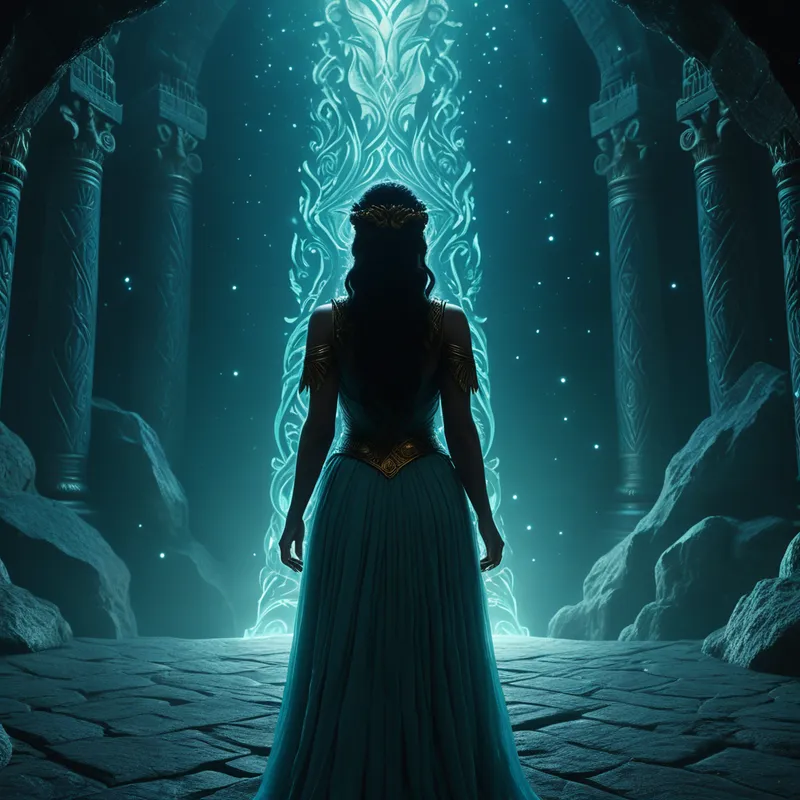
Gilgamesh at the World's End
The epic tale of King Gilgamesh's perilous journey to the ends of the earth in his desperate search for eternal life and ultimate meaning.
The Tale of Gilgamesh at the World's End
The tale begins in the aftermath of a profound rupture. Gilgamesh, the mighty king of Uruk, has witnessed the death of his beloved friend, Enkidu. This is no ordinary grief; it is a cataclysm that shatters the king’s world. Enkidu, fashioned from clay by the gods to be his mirror and balance, was the wild heart to Gilgamesh’s civilized might. In his death, Gilgamesh does not merely lose a companion; he is forced to stare into the abyss of his own inevitable fate. The terror of mortality, previously an abstract concept for the semi-divine king, becomes a visceral, rotting truth. He wanders the wilderness, clothed in lion skins, his royal splendor exchanged for the rags of despair, haunted by the question: “Must I die too? Shall I not be like him and also lie down, never to rise again?”
This terror crystallizes into a desperate quest. He recalls the legend of Utnapishtim, the Babylonian Noah, the sole mortal to have been granted eternal life by the gods after surviving the Great Flood. If any man holds the secret, it is he. But Utnapishtim dwells beyond the known world, at the Mashu mountains, the gateway to the sun’s path. Gilgamesh’s journey is a passage through the geography of the soul. He traverses the Garden of the Gods, encounters the fearsome Scorpion-beings who guard the mountain pass, and pleads his case with such raw anguish that they, moved by his suffering, allow him passage.
He descends into a tunnel of absolute darkness, a twelve-league night, running toward a pinprick of light—the sun itself. Emerging, he finds the world’s end: a shore beside the Waters of Death. Here resides Siduri, the wise alewife. Seeing his ragged, driven state, she initially bars her door, advising him to abandon his futile quest and embrace the simple joys of mortal life: a full belly, a clean garment, the love of a child. But Gilgamesh, consumed by his hubris and fear, cannot hear her. He threatens to break down her door, and she, relenting, directs him to Urshanabi, the ferryman of Utnapishtim.
The final crossing is an act of purification. Gilgamesh, in his rage and haste, shatters the sacred stone things that allow Urshanabi’s boat to safely traverse the lethal waters. Forced to fashion new poles from the forest, he must laboriously propel the boat himself, a symbolic shedding of his royal privilege through sheer, exhausting effort. He arrives at the far shore not as a king, but as a supplicant.
The encounter with Utnapishtim is the climax of his disillusionment. The immortal sage looks upon the haggard king and delivers a devastating lesson. He recounts the story of the Flood—a tale of divine caprice and rare grace, not a recipe for achievement. Eternal life was a singular gift from the gods, not a prize to be won. To test Gilgamesh’s worthiness, Utnapishtim challenges him to a simple contest: stay awake for six days and seven nights. Gilgamesh, claiming he is ready for any trial, immediately fails, succumbing to a sleep as deep as death. He is shown, in the most humiliating way, that he cannot even conquer sleep, the little brother of death.
As a final, parting gift of pity, Utnapishtim’s wife persuades her husband to reveal a secret of the gods: a thorny plant that grows at the bottom of the sea, a plant that can restore youth. Gilgamesh, his hope rekindled, ties stones to his feet, dives into the abyss, and retrieves it. For a fleeting moment, he holds rejuvenation in his hands. But on the journey home, while bathing in a cool pool, a serpent is drawn by the plant’s scent. It steals the prize, sloughs its skin, and vanishes. Gilgamesh sits on the shore and weeps. All his suffering, his monumental journey to the world’s end, has yielded nothing but the sight of a snake gaining what he sought. He returns to Uruk empty-handed, but not empty. He has been hollowed out, and in that hollow space, a new understanding begins to form.
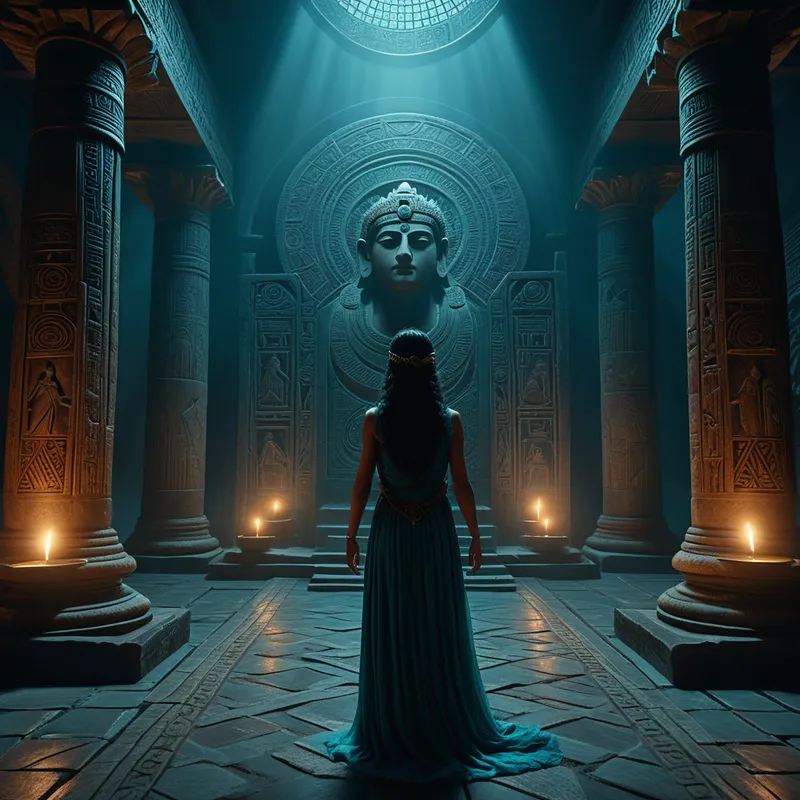
Cultural Origins & Context
The Epic of Gilgamesh is the world’s oldest surviving great work of literature, with Babylonian versions standardized in the second millennium BCE. The hero’s journey to the world’s end, contained in the latter tablets of the epic, is not a geographical adventure but a cosmological and theological one. Babylonian cosmology imagined the earth as a flat disk surrounded by the apsû (the sweet, subterranean waters) and the tâmtu (the salty, encircling ocean). Beyond this lay the Waters of Death and the distant realm of the apkallu (sages) like Utnapishtim. Gilgamesh’s voyage is a traversal from the center of human civilization (Uruk) to the very liminal edges of the created order.
This quest reflects profound cultural anxieties. Mesopotamian religion offered a bleak view of the afterlife—a dusty, shadowy underworld (Irkalla) where all souls, regardless of virtue, dwelt in diminished states. There was no paradise, only a grim equality in oblivion. For a king like Gilgamesh, whose deeds were meant to etch his name into eternity, this was an intolerable prospect. His quest is the ultimate expression of the human struggle against a divinely ordained fate, a rebellion against the very structure of a universe where gods hold immortality and humanity holds only labor and death.
Symbolic Architecture
The myth’s power lies in its layered symbolism, each stage representing an internal confrontation.
- The Death of Enkidu: This is the catalyst, the eruption of the conscious knowledge of death. Enkidu represents Gilgamesh’s connection to nature, instinct, and the unvarnished reality of the mortal condition. His death forces the king’s intellectual understanding of mortality into the realm of felt, personal terror.
- The Scorpion-beings and the Tunnel of Night: The guardians of the threshold represent the innate perils of seeking forbidden knowledge. The dark tunnel is the hero’s descent into the unconscious, a necessary period of confusion and terror (the "dark night of the soul") that must be endured to reach a new state of awareness.
- Siduri’s Advice: Often overlooked, her counsel is the voice of life-affirming wisdom. She represents the carpe diem philosophy, the suggestion that meaning is found not in transcending mortality, but in fully inhabiting it. Gilgamesh’s rejection of her wisdom underscores his obsession; he is not yet ready to accept limits.
The Waters of Death are the ultimate boundary. They do not merely kill the body; they represent the dissolution of the ego’s project. To cross them, Gilgamesh must first destroy his own "stone things"—the rigid, defensive structures of his identity—and labor with humble, perishable wood. The ferryman, Urshanabi, is the psychopomp guiding him through this ego-death.
- The Sleep Test: This is the masterstroke of psychological humiliation. Gilgamesh, who sought to conquer eternal death, cannot conquer a week of wakefulness. The test proves that his very body, his mortal nature, is the obstacle. His quest is revealed as a battle against his own essence.
- The Plant and the Serpent: The plant, "The Old Man Becomes a Young Man," is a symbol of cyclical renewal, not linear immortality. The serpent, an ancient chthonic symbol of transformation (via shedding skin) and hidden wisdom, is its rightful claimant. The serpent does not merely "steal" immortality; it demonstrates it, showing Gilgamesh the natural, cyclical form of renewal that he, in his linear, kingly desire for permanence, failed to comprehend.
The Dreamer's Resonance
For the modern dreamer or psyche, Gilgamesh’s quest is not about literal immortality. It is the archetypal drama of confronting personal limitation and existential dread. The "world’s end" is the point in our inner landscape where our fantasies of control, specialness, or eternal significance crash against the unyielding wall of reality—be it aging, failure, loss, or the simple fact of our finitude.
We all have our "Journey to the Mashu Mountains." It is the midlife crisis, the pursuit of a perfect achievement to stave off meaninglessness, the frantic accumulation of wealth or accolades as a bulwark against death. Siduri’s voice is the quiet, often-ignored part of us that whispers: "What if the answer is not out there, but in embracing the fragile, beautiful present?" Gilgamesh’s failure is, paradoxically, the beginning of wisdom. His tears on the shore are the baptism of a humbled ego. He returns to Uruk and, in the epic’s closing lines, marvels at the mighty walls he built. He does not possess eternal life, but he possesses a work, a legacy within the bounds of time. He exchanges the quest for being with the act of doing, finding a fragment of eternity not in his flesh, but in his creation.

Alchemical Translation
In the alchemical process, Gilgamesh begins as the prima materia—the arrogant, restless king, identified with his divine portion and blind to his mortal half. The death of Enkidu is the nigredo, the blackening, the crushing dissolution of his former identity. His frantic journey through wilderness and darkness is the mortificatio, a death of the old self.
The encounter with Utnapishtim is the albedo, the whitening. It is not an acquisition, but a revelation. The sage holds up a mirror of truth, showing Gilgamesh the futility of his project. The humiliating sleep test is the purifying fire that burns away the dross of his illusion. He is reduced to his essential, mortal state.
The retrieval and loss of the plant is the final, poignant stage. It represents a fleeting, false citrinitas (yellowing), a glimpse of the prize that is not yet fully integrated. The serpent’s theft is the necessary rubedo (reddening), but not in the way Gilgamesh hoped. The transformation is not his own rejuvenation, but the transformation of his understanding. The serpent, a symbol of the unus mundus (the unified world), takes the plant back into the cyclical order of nature, teaching Gilgamesh that life, death, and renewal are a single, interconnected process. He returns to Uruk having undergone the opus contra naturam—the work against his own nature—only to learn that wisdom lies in accepting nature’s law. His final state is not gold as eternal life, but gold as integrated wisdom: the union of his divine aspirations with his mortal acceptance.
Associated Symbols
Explore related symbols from the CaleaDream lexicon:
- Mortality — The central, terrifying truth Gilgamesh flees, which becomes the very teacher that leads him to a deeper form of wisdom.
- Quest — The desperate, linear journey outward in search of an answer that can only be found through an inward surrender.
- Underworld — Represented by the tunnel of darkness and the Waters of Death, it is the psychological descent into the realm of shadow, fear, and ultimate truths.
- Serpent — The agent of transformation whose theft of the plant demonstrates the cyclical, renewing nature of life that Gilgamesh’s linear quest for permanence could not grasp.
- Water — Appearing as the life-giving pool, the terrifying Waters of Death, and the abyssal sea, it symbolizes the unconscious, the unknown, and the fluid boundary between life and dissolution.
- Journey — The archetypal passage from ignorance through suffering to a hard-won awareness, mapping the evolution of the soul.
- Hero — Gilgamesh embodies the heroic archetype not in his triumph, but in his profound failure and the wisdom forged in its aftermath.
- Shadow — Enkidu’s death forces Gilgamesh to confront his own shadow—his mortality, vulnerability, and ultimate powerlessness before divine decree.
- Death — The great antagonist and secret mentor, whose presence gives shape, urgency, and ultimately meaning to the acts of life.
- Rebirth — Not achieved physically by Gilgamesh, but experienced psychologically as the death of his immortal ambition and the birth of his acceptance.