Baptism Myth Meaning & Symbolism
A ritual of descent into the primal waters and emergence reborn, symbolizing the death of the old self and the birth of a new, sanctified life.
The Tale of Baptism
In the time when the world was parched with longing, when the dust of old ways clung to the soul, there came a voice crying in the wilderness. It was the voice of John, clad in rough skins, his eyes like flint struck against the dark. He stood where the land met the water, at the ford of the Jordan, a river that remembered the parting of its waters for prophets and the crossing of a people into promise.
“Repent!” his voice thundered, not with anger, but with the gravity of a coming storm. “For the kingdom of heaven is at hand.” And the people came—a river of humanity flowing to meet the river of earth. They came burdened, their spirits heavy with the silt of transgressions, the weariness of years lived in a dry land. They confessed into the open air, their words carried away by the wind that swept the reeds.
Then, one came who needed no confession. A man from Nazareth, with the quiet bearing of a carpenter and the unsettling depth of still waters. He approached John, and the prophet’s certainty faltered. “I need to be baptized by you,” John protested, sensing the inversion of the world’s order. But the man from Nazareth spoke with a calm that settled the very air: “Let it be so now; it is proper for us to fulfill all righteousness.”
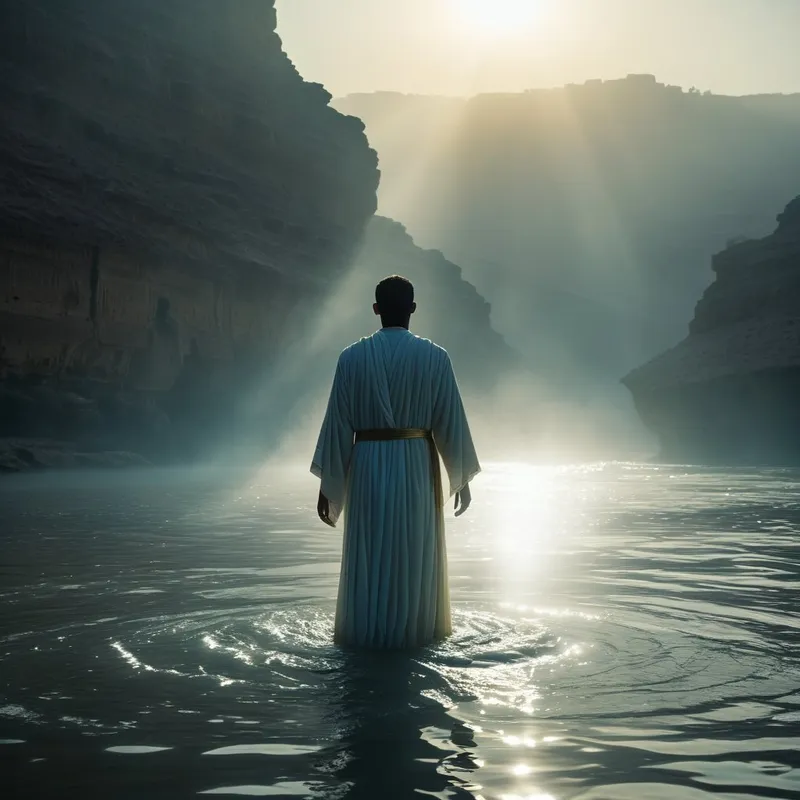
So John yielded. He guided the man into the cool, green embrace of the Jordan. The water swirled around his waist, then his chest. The crowd held its breath. This was no ordinary sinner seeking cleansing. This was something else—a sacred descent, a voluntary immersion into the very substance of human frailty and history. John placed his hands upon him, and for a moment, the world seemed to pause on the hinge of a breath.
He was submerged. The light from above fractured into a thousand dancing shards, then was swallowed by the river’s depth. In that silent, green womb, time ceased. It was a moment of symbolic death, a burial of what was. Then, breaking the surface, water streaming from his hair and beard, he arose. The air itself was different—charged, expectant.
And as he emerged, the heavens were torn open. Not a gentle parting, but a rending, as if the veil between the earthly and the eternal was ripped from top to bottom. A form, like a dove, descended—not a bird of flesh, but a manifestation of spirit, gentle yet immense, alighting upon him. And then, a Voice, not from the mountain or the whirlwind, but from the very core of the opened sky, speaking words of pure, unmediated belonging: “This is my Son, whom I love; with him I am well pleased.”
The water dripped from him, each drop a tiny prism catching the new light of a world begun again.

Cultural Origins & Context
The ritual act of baptism did not originate with Jesus or John. It grew from deep roots in Jewish purification rites (mikveh), where immersion in “living water” (flowing water from a spring or river) restored ritual cleanliness. It also echoed the proselyte baptism by which Gentiles were initiated into Judaism. John the Baptizer harnessed this powerful, existing symbol but radicalized its meaning. His was a “baptism of repentance for the forgiveness of sins,” a one-time, public act of moral turning (metanoia) in preparation for a coming divine judgment.
The early Christian community, following the narrative of Jesus’ own baptism, transformed the symbol once more. It became the definitive rite of initiation, the doorway into the ekklesia. As told in the Acts of the Apostles and the epistles of Paul, baptism was no longer just about repentance; it was participatory mysticism. To be “baptized into Christ Jesus” was to be baptized into his death, buried with him, so as to be raised to walk in newness of life (Romans 6:3-4). It functioned as the societal seal of a new identity, marking the transition from the old world into the new community of the saved, often performed in the name of the Father, Son, and Holy Spirit.
Symbolic Architecture
At its core, baptism is an archetypal drama of death and rebirth, enacted through the primordial element of water. Water is the matrix of life, the chaotic deep from which form emerges, and the dissolving agent that returns form to flux. Baptism harnesses this dual power.
The descent into the waters is a willing surrender to the unconscious, a dissolution of the ego’s rigid boundaries so that a more authentic Self may emerge.
The figure of John represents the necessary precursor to transformation: the critical conscience, the voice of self-awareness that calls one to account. The act of confession is the psychic honesty that must precede immersion. Jesus’ participation embodies the paradox that the one who is ostensibly “clean” must fully enter the human condition to sanctify it. His emergence and the divine affirmation model the ultimate goal: not just cleansing, but re-identification. The old, isolated self (“son of Adam”) is symbolically drowned; the new, connected self (“beloved Son”) is born, recognized by and in relationship with the transcendent.
The dove and the voice are crucial symbols of spirit and word. The dove signifies the gentle, life-giving, and unifying presence of the divine that rests upon the individual. The Voice speaks the words every psyche yearns to hear: an unconditional declaration of belovedness and worth. This completes the alchemy: from dissolution (water) comes new form, infused with spirit (dove) and validated by meaning (voice).
The Dreamer's Resonance
When the motif of baptism appears in modern dreams, it rarely manifests as a church ceremony. Instead, the dreamer may find themselves submerged in an ocean, a pool, or even a sudden flood in their own home. They may be struggling to surface or floating peacefully in the depths. These are somatic dreams of psychic process.
A dream of struggling against immersion often points to a conscious resistance to a necessary psychological death—the clinging to an outworn identity, a career, a relationship, or a self-concept that must be released. The water represents the overwhelming pressure of the unconscious demanding integration. Conversely, a dream of peaceful submersion or effortless floating suggests a surrender to this process, a trust in the depths to hold and transform.
Emerging from the water, gasping for air, can symbolize the raw, vulnerable, and often disorienting first breaths of a new phase of life. The dream may highlight the feeling of being “newborn”—exposed, sensitive, but cleansed of an old burden. To dream of being witnessed during this emergence, or hearing a voice of affirmation, speaks to the deep need for our transformations to be seen and validated, either by our own inner authority or by a supportive other.

Alchemical Translation
For the individual on the path of individuation, the myth of baptism is a master blueprint for psychic transmutation. The “wilderness” is that arid period of life where old meanings have crumbled, a necessary prelude to change. “Repentance” is translated as the courageous, inward turn—a ruthless self-honesty about one’s shadow, one’s contributions to one’s suffering.
The alchemical vessel is the human psyche itself, and the water is the solvent of the unconscious into which the lead of the old personality must be dropped.
The descent is the active, terrifying choice to let go, to allow the structures of the persona to soften and dissolve in the waters of feeling, memory, and instinct. This is not a passive drowning but a ritualized death. In that suspended, in-between state—the nigredo of alchemy—all seems lost. But it is here, in the full acceptance of non-being, that the seeds of new being are incubated.
Emergence is the albedo, the whitening. It is the birth of a consciousness that has faced its own depths and been reformed. The “dove” is the reconciling symbol that arises from the unconscious, a new attitude of peace and connection between conscious and unconscious realms. The “Voice” is the achievement of inner authority—the Self speaking to the ego, bestowing a sense of authentic identity and purpose that is not borrowed from external roles or expectations. One rises from the waters not merely washed, but fundamentally renamed.
Associated Symbols
Explore related symbols from the CaleaDream lexicon: