Enkidu Myth Meaning & Symbolism
A wild man, created by the gods, is tamed by a priestess, befriends a king, and confronts mortality, embodying the soul's journey from nature to consciousness.
The Tale of Enkidu
Hear now the tale of the first friend, a story whispered by the wind in the high reed-beds. In the great city of Uruk, the king Gilgamesh ruled with a heavy hand. His strength was unmatched, his will like forged bronze, but his vigor knew no bounds, and he claimed the right of first night with every bride, leaving the people of Uruk to groan under his boundless energy. Their cries rose like smoke to the ears of the gods.
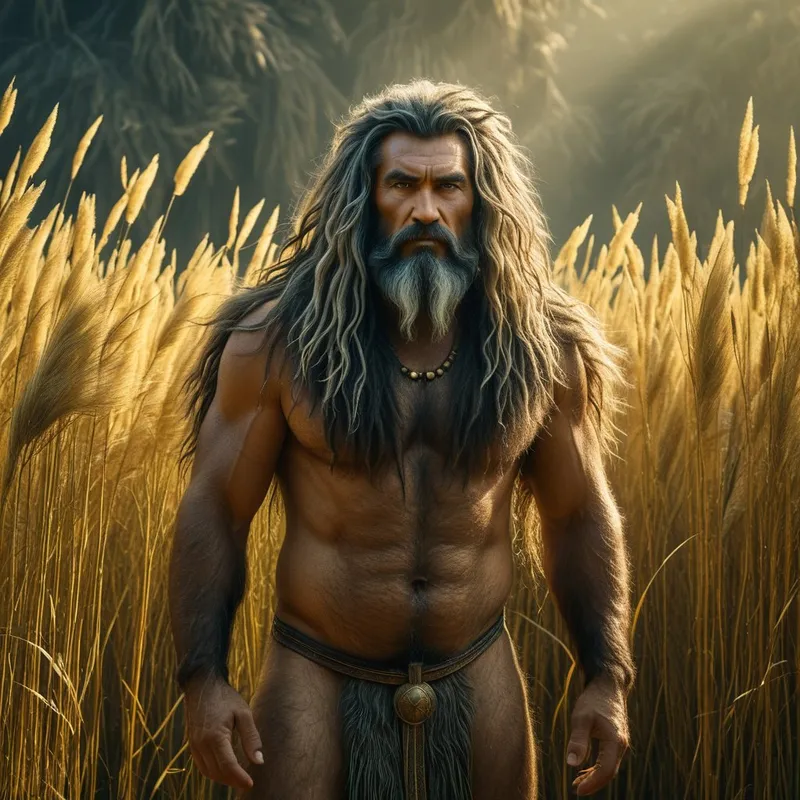
The gods heard. And Aruru, the mother of all, took clay from the silent, primordial steppe. She pinched and shaped it not in the image of a god or a king, but in the essence of the wild itself. She created Enkidu. His hair grew long and thick as a harvested field. His body was clothed in shaggy fur. He knew no people, no city. His heart belonged to the gazelles, with whom he grazed on tender grasses, and to the beasts of the water-hole, whom he protected from the snares of trappers. He was strength in its raw, untamed form, a storm on two legs.
A trapper, his pits destroyed by this wild guardian, brought word to Uruk. He spoke of a creature more powerful than any man. Gilgamesh, hearing this, devised a plan. He sent to the steppe the priestess Shamhat, whose wisdom was of the temple and the body. For six days and seven nights, she lay with Enkidu, teaching him the ways of a woman. This was no mere seduction; it was an initiation. When he rose, the gazelles fled from him. His body was the same, but his mind was opened. He had gained knowing, and with it, a profound loneliness. Shamhat clothed him, fed him bread and ale—the food of civilization—and spoke of Gilgamesh and his mighty city.
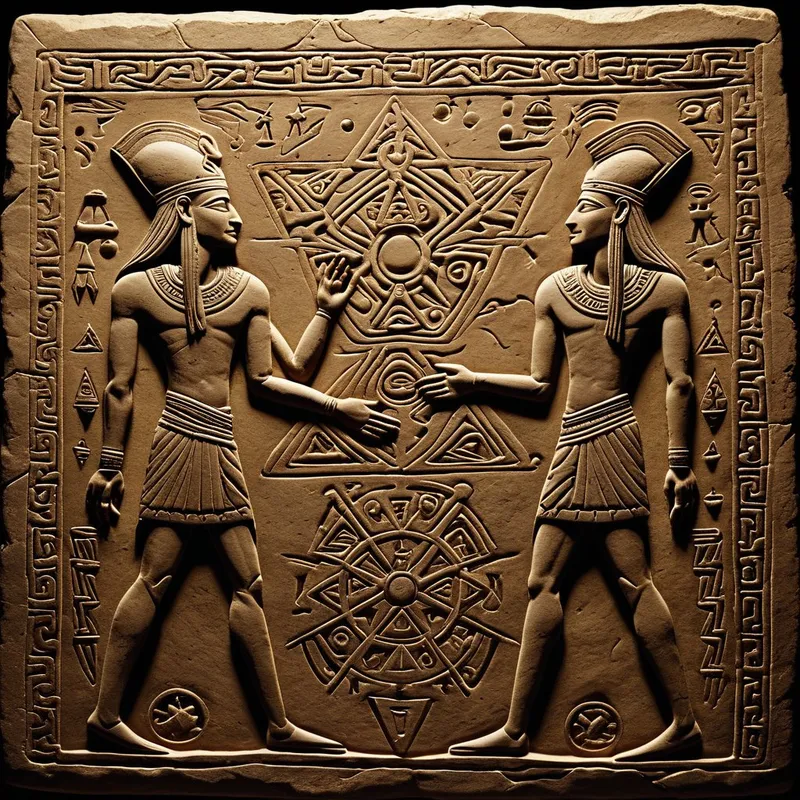
Enkidu’s heart, now kindled with a new fire, yearned for a match. He journeyed to Uruk. As he entered the city gates, he found Gilgamesh about to exercise his kingly right. Enkidu blocked the doorway to the bridal chamber. The two titans clashed in the street, a quake of muscle and will, shaking the very foundations of the houses. Doors splintered, walls trembled. But in the shattering of their struggle, something else broke open: recognition. They saw in each other the other half of a sundered whole. The fight ended not with a victor, but with a clasped hand. Gilgamesh, the civilized king, found his wild heart. Enkidu, the wild man, found his purpose. They became brothers, sworn companions.
To cement this bond, they sought a quest worthy of their combined might. They journeyed to the distant Cedar Forest, to slay its ferocious guardian, Humbaba. With the aid of the sun god Shamash, they succeeded, felling the sacred cedars and Humbaba with them. But the act was an affront. The balance was disturbed.
Their triumph turned to ash. The goddess Ishtar, enamored of Gilgamesh, offered herself to him. He spurned her, recounting the fates of her past lovers. In her wrath, she summoned the Bull of Heaven to ravage Uruk. Again, the brothers stood together. They slew the divine bull, tearing out its heart. But the gods convened in council. A price must be paid for the killing of Humbaba and the Bull of Heaven. The lot fell not on the king, but on his wild-born brother. Enkidu was stricken with a wasting sickness.
For twelve days, Enkidu languished, cursing the trapper, the priestess, and the gate that brought him to manhood. But as death’s shadow grew long, his anger cooled into a terrible, lucid sorrow. He dreamed of the House of Dust. On the thirteenth day, the friend, the wild heart of the king, breathed his last. Gilgamesh’s wail echoed through Uruk, a sound of pure rending. He clung to the body, refusing burial until a maggot fell from the nostril. He then fashioned a statue of his friend and poured out treasures before it. But the true quest—the desperate, mad flight from the reality of death—had only just begun for the one left behind.

Cultural Origins & Context
This story forms the core of the world’s oldest surviving epic narrative, the Epic of Gilgamesh, whose fragments were inscribed in cuneiform on clay tablets in Sumerian and later Akkadian. It was not mere entertainment for the courts of city-states like Uruk, Ur, and Nippur. It was a foundational text, recited by skilled scribes and perhaps accompanied by music, serving as a mirror for a civilization acutely aware of its own constructed nature.
Sumer was a world built literally from mud—mud bricks forming ziggurats, mud yielding crops through irrigation. The myth of Enkidu encapsulates the tension of that achievement. Here was a society that had created itself against the chaos of the wild marshes and steppes. Enkidu’s journey from animal-companion to city-dweller is the archetypal Sumerian story: the taming of nature, the gain of wisdom and power, and the devastating, inherent cost. The epic asked the questions that plagued an urbanizing, hierarchical world: What do we lose when we leave the wild? What is the true price of friendship and glory? And above all, how does a conscious being face the absolute certainty of death?
Symbolic Architecture
Enkidu is not merely a character; he is a living symbol of the untamed psyche, the instinctual self that exists before culture imprints its rules. He represents the totality of nature, both nurturing and fiercely protective. His creation is a divine counterbalance, an embodiment of the shadow cast by the oppressive, hyper-civilized light of Gilgamesh.
The taming by Shamhat is not a fall from grace, but a necessary wounding into consciousness. One cannot become human without losing the animal’s unconscious unity with the world.
Their battle is the classic confrontation between the ego (Gilgamesh) and the shadow (Enkidu). That it ends in stalemate and friendship is the myth’s profound psychological insight: wholeness is not achieved by conquering one’s inner wildness, but by integrating it. Gilgamesh gains heart, passion, and loyalty. Enkidu gains purpose, direction, and a name. Together, they represent the complete individual: conscious will married to instinctual strength.
The quest to the Cedar Forest symbolizes the heroic ego’s journey into the deep, uncharted territory of the unconscious (the forest) to confront the monstrous, guarding aspects of the psyche (Humbaba). Their victory is pyrrhic because to fully assimilate the unconscious is impossible; the attempt disrupts the natural order. Enkidu’s death is the inevitable consequence. The instinctual self, once awakened and integrated, cannot survive indefinitely in the realm of conscious striving. It must die so that the conscious self (Gilgamesh) can be forced to confront the ultimate limitation: mortality itself.
The Dreamer's Resonance
When the pattern of Enkidu stirs in modern dreams, it signals a profound somatic and psychological process of integration. To dream of a wild, powerful figure living among beasts may indicate a part of the dreamer’s innate vitality, intuition, or raw emotional power that has been exiled, living “outside the city walls” of conscious life.
Dreams of being tamed or seduced from a natural state, accompanied by feelings of both loss and awakening, mirror Shamhat’s initiation. The dreamer may be undergoing a necessary, yet painful, civilizing process—entering a new job, relationship, or phase of responsibility that requires channeling wild energy into form. Conversely, dreaming of a fierce, protective figure blocking a doorway (like Enkidu blocking Gilgamesh) can symbolize the healthy intervention of the instinctual self against the ego’s tyrannical or overreaching tendencies.
The most poignant resonance is the dream of a profound, soul-level friendship with this “other,” followed by their sickness and death. This often manifests during or after a period of significant personal growth, where an old way of being—a passionate but unrefined drive, a rebellious phase, a raw creative surge—has served its purpose and must now dissolve. The mourning in the dream is real; it is the psyche grieving the loss of a foundational state as it prepares the conscious self for the next, more solitary phase of the journey: the confrontation with existential limits.
Alchemical Translation
The alchemy of the Enkidu myth models the full arc of psychic transmutation, or individuation. The prima materia is the raw, undifferentiated Self, symbolized by Enkidu of the steppe. The first operation, calcinatio, is the burning encounter with Shamhat—the heat of experience, relationship, and culture that separates spirit from matter, awakening desire and consciousness from the inert clay of pure potential.
The friendship with Gilgamesh is the sacred coniunctio, the marriage of opposites. King and wild man, spirit and nature, conscious and unconscious. This united soul then performs the great work.
Their joint quest represents mortificatio and separatio—the killing of Humbaba and the Bull of Heaven. These are the difficult, often violent, processes of differentiating from internalized monsters (parental complexes, societal expectations, inflated ideals) and slaying divine inflation (the belief that one is above consequence). The inevitable putrefactio is Enkidu’s sickness and death: the rotting away of the now-outmoded form of the integrated instinct. This stage is dark, foul, and essential. Gilgamesh’s refusal to let go mirrors our own resistance to this decay.
Finally, Enkidu’s death forces the solutio—the dissolution of all previous certainties for Gilgamesh, flooding him with the waters of grief and mortality. This leads to the coagulatio: the solidification of a new, sobered consciousness. The statue Gilgamesh builds is not the living Enkidu, but a lasting, internalized memory—the lapis, or philosopher’s stone, of this alchemy. It is the enduring wisdom that our vitality is temporary, our bonds are precious, and our wholeness is forever purchased with the coin of loss. The modern individual undergoing this process moves from unconscious unity, through the fiery trials of relationship and ambition, into the dark night of losing what made them feel whole, emerging not with eternal life, but with the hard-won gold of mortal meaning.
Associated Symbols
Explore related symbols from the CaleaDream lexicon: