Dewa Ruci Myth Meaning & Symbolism
A Javanese knight dives into the cosmic ocean to confront a divine miniature of himself, discovering the universe within and the secret of ultimate knowledge.
The Tale of Dewa Ruci
Listen, and let the shadow-play of the world unfold. In the age when gods walked with men, there lived a knight of immense power and unyielding loyalty: Bima. His strength could shake mountains, his courage was a fortress, yet a profound thirst gnawed at his soul—a thirst for the ultimate truth, the sacred water of life known as Air Suci Perwitasari.
His quest was not across battlefields, but into the depths of his own being, guided by his enigmatic and demanding guru, Durna. Drona, bound by his own complexities, sent Bima on an impossible, perilous errand: to fetch the elixir from the heart of the Segara Kidul, the Southern Ocean, a realm of primordial chaos and terror.
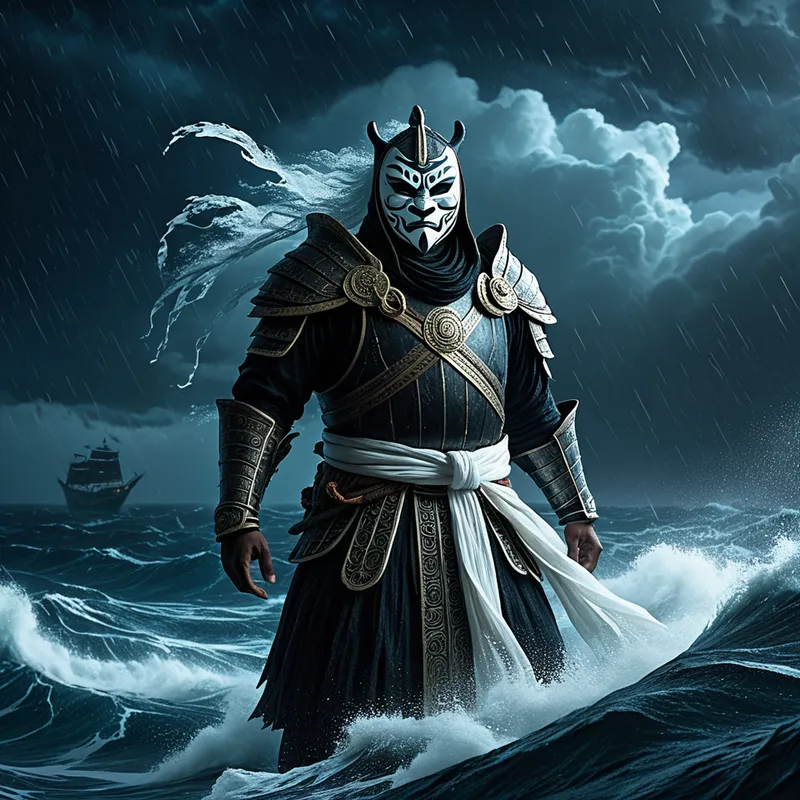
Bima did not hesitate. He sailed to the ocean’s edge, where the water was not blue but the color of midnight ink, and the waves rose like the coils of ancient serpents. The sky wept, the wind howled. With nothing but his legendary strength and his white sash, the Poleng, he plunged into the abyss.
Down he sank, through layers of crushing pressure and swirling darkness. Monstrous sea creatures, manifestations of doubt and fear, assailed him. A great Naga coiled around him, its scales like black iron, its breath a cold void. Bima fought, not with hatred, but with the pure force of his seeking. He vanquished each apparition, not as enemies, but as obstacles to be understood and passed.
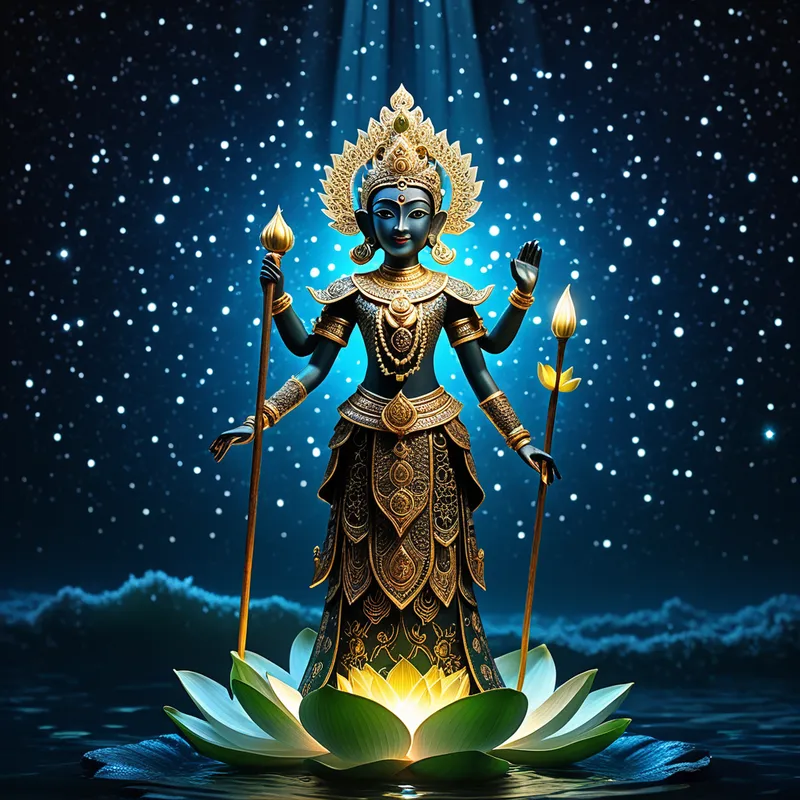
Deeper still, into a silence so absolute it hummed. The crushing weight of the ocean began to lighten. The darkness softened into a twilight glow. And there, in the heart of the abyss, he found not a cavern, but a vast, serene space. At its center, upon a radiant lotus, stood a being of impossible beauty and familiarity—a perfect, miniature Bima, glowing with a soft, inner light. This was Dewa Ruci.
The tiny deity spoke, and his voice was the sound of Bima’s own deepest thought. "Welcome, Bima. You have journeyed far to find me, yet I have always been here, within you." Dewa Ruci then performed a miracle of revelation. He invited Bima to enter his own miniature form. Bima, the giant, hesitated, then complied. And as he entered through the ear of Dewa Ruci, he did not find a cramped space, but an infinite universe. He saw the sun and moon orbiting, the stars swirling, the entire cosmos contained within this tiny vessel. He saw the microcosm and macrocosm as one. The sacred water he sought was not a liquid to drink, but the very essence of this realization—the knowledge that the source of all is within.
Filled with this sublime understanding, Bima emerged, transformed. He returned to the surface, not with a vial, but with a silence that held all answers. His quest was complete.
Cultural Origins & Context
The tale of Dewa Ruci is a cornerstone of Javanese spiritual literature, most famously rendered in the Serat Dewaruci, a text deeply influenced by the syncretic mystical traditions of Kejawen. It is a myth that belongs not to the temple, but to the pendopo (pavilion) and the heart. Historically, it was transmitted through the shadow puppet theatre, wayang kulit, where the dalang (puppeteer) was not merely an entertainer but a spiritual guide.
The story functioned as an esoteric teaching for those on the path of ngelmu kasampurnan (the science of perfection). It was a coded map, accessible to the warrior class (ksatria) like Bima, symbolizing that the ultimate battle is inward. Its societal function was profound: it democratized enlightenment, suggesting that the fierce, "rough" knight, through sincere devotion and courage, could achieve a wisdom surpassing that of the formal priest. It validated inner experience over external dogma, serving as a stabilizing, introspective counter-narrative within a hierarchical society.
Symbolic Architecture
The myth is a perfect allegory for the journey of self-realization. Bima represents the earnest human ego, strong and capable in the worldly realm, yet painfully aware of a deeper lack. His guru, Durna, symbolizes the limited, often contradictory, teachings of the external world and conventional religion, which can point the way but cannot complete the journey.
The ocean is not outside the seeker; the seeker is a vessel sailing upon the ocean of his own unconscious.
The Segara Kidul is the collective and personal unconscious—dark, chaotic, and filled with psychic monsters (complexes, fears, repressed memories). Bima’s descent is the courageous act of active imagination or deep meditation. The monstrous Naga is the guardian of the threshold, the primal fear of self-annihilation that must be faced.
The revelation of Dewa Ruci is the discovery of the Self, the divine nucleus of the psyche. That this Self appears as a miniature of the hero is the ultimate truth: the Divine is not an alien other, but the essence of one's own being, stripped of ego-inflation. The act of entering Dewa Ruci’s body symbolizes the ego’s submission to and alignment with the Self. The cosmos within represents the realization that the individual psyche (jagad cilik, the microcosm) mirrors the structure of the universe (jagad gedhe, the macrocosm).

The Dreamer's Resonance
When this myth stirs in the modern dreamer, it signals a profound somatic and psychological initiation. One may dream of diving into deep, dark water, exploring submerged caves, or finding a small, radiant room or object within a vast, oppressive space. There is often a sense of terrifying compression followed by unexpected expansion.
Somatically, this can correlate with the "dark night of the soul," a period of depression or existential anxiety where the familiar structures of identity feel hollow. The psyche is forcing a descent. The monsters encountered are the dreamer's own "shadow" material—bursts of irrational rage, overwhelming grief, or shame—rising up to be integrated, not slain. The climax, the encounter with the miniature divine self, might manifest as dreaming of a glowing child, a wise animal, or simply an overwhelming feeling of peace and cosmic belonging in a dream. This is the unconscious affirming the process of centering. The dreamer is not going mad; they are navigating the ocean to find their true center.
Alchemical Translation
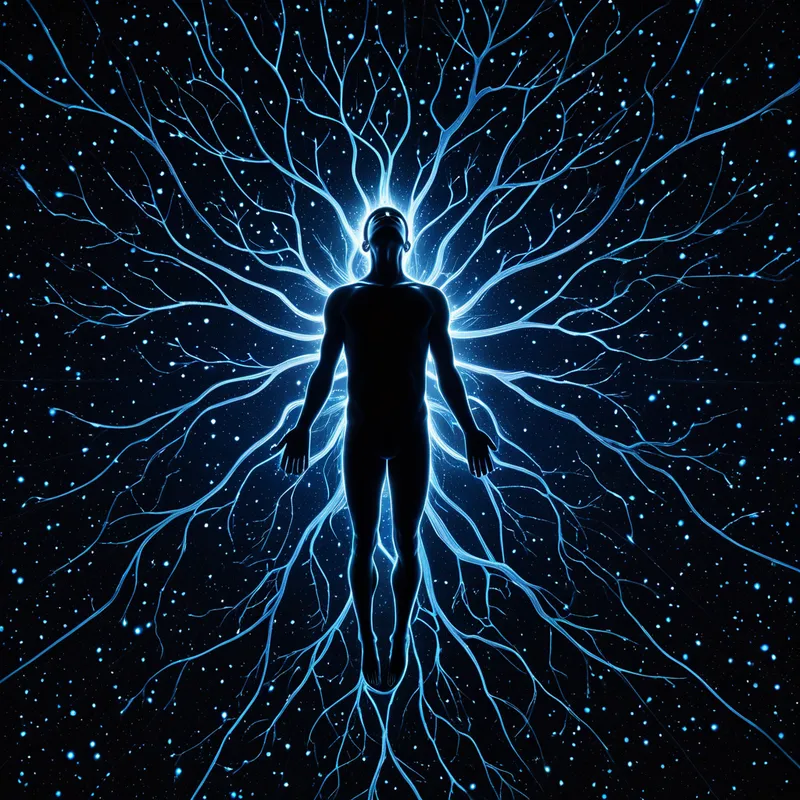
The process modeled by Dewa Ruci is the alchemical solve et coagula applied to the soul. First, the solve: Bima’s ego is dissolved in the waters of the unconscious. His worldly identity as a mighty warrior is stripped away in the deep. This is the necessary dissolution of old, rigid personality structures.
Enlightenment is not an acquisition, but a return. Not a becoming, but a remembering of the original, luminous blueprint within.
Then, the coagula: from this formless plunge, a new, more authentic center coagulates around the Dewa Ruci—the Self. This is individuation. The hero does not return with a new weapon, but with a new perception. The sacred water (Air Suci) is the transformed consciousness itself, the aqua permanens of the alchemists. For the modern individual, this translates to the often painful but liberating process of shedding the persona—the masks worn for society, family, and career—to confront the inner void. The triumph is not in conquering that void, but in discovering it is not empty; it is the womb of the true self. The journey inward becomes the only journey that ultimately matters, transforming existential thirst into a wellspring of inner authority and unshakeable peace.
Associated Symbols
Explore related symbols from the CaleaDream lexicon:
- Ocean — The vast, unconscious mind, both personal and collective, containing all latent potentials, memories, and primordial fears that must be navigated to find the Self.
- Cave — The inner sanctum of the psyche, the secluded, womb-like space within the depths where the ultimate revelation and meeting with the divine self occurs.
- Hero — Bima as the archetypal seeker whose strength is tested not against external foes, but against the inner demons and illusions of the deep unconscious.
- Mirror — Dewa Ruci himself acts as a living mirror, reflecting back to Bima not his external form, but his essential, divine nature and true identity.
- Journey — The entire narrative structure, representing the perilous, necessary descent into the unknown parts of oneself that is required for genuine transformation.
- Light — The inner illumination emanating from Dewa Ruci, symbolizing the enlightenment, wisdom, and conscious awareness found at the core of being.
- Water — The fluid medium of the unconscious and the transformative substance sought, representing the flow of life, emotion, and the dissolving power of truth.
- God — The miniature Dewa Ruci as the immanent divine, the God within, contrasting with distant, transcendent deities and personalizing the experience of the sacred.
- Key — The realization granted by Dewa Ruci, which unlocks the understanding that the macrocosm is contained within the microcosm, opening the door to ultimate knowledge.
- Rebirth — Bima's emergence from the ocean and from Dewa Ruci's form, signifying a psychological rebirth into a new state of consciousness, integrated and whole.
- Shadow — The monstrous Naga and other sea creatures, representing the repressed, feared, and unintegrated aspects of the self that must be confronted during the descent.