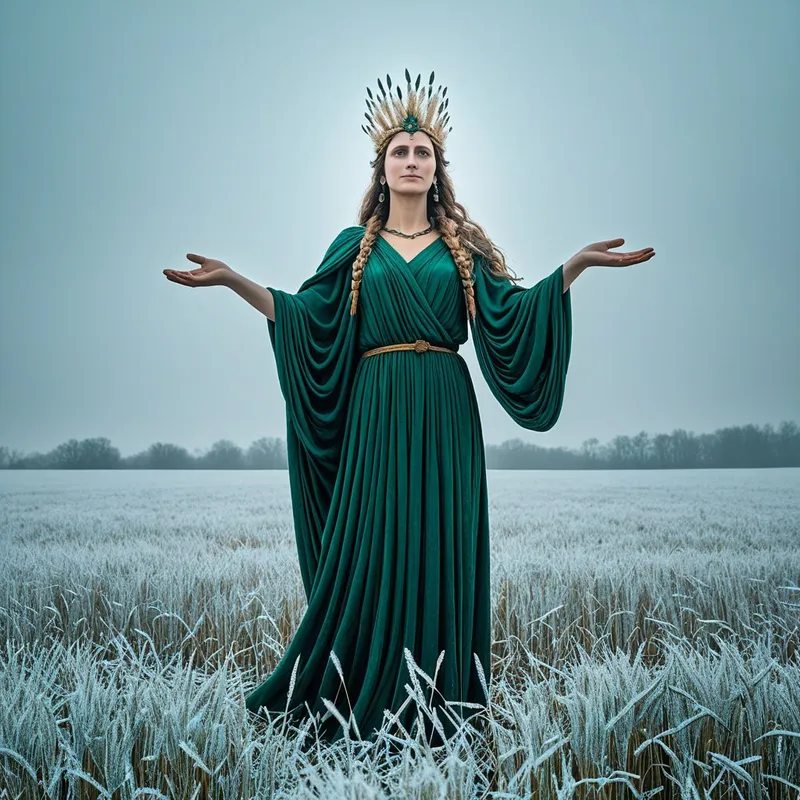
Demeter's Winter Myth Meaning & Symbolism
A mother's grief for her abducted daughter halts all life, creating winter, until a compromise with the underworld restores a cyclical world of loss and return.
The Tale of Demeter's Winter
Hear now the story of the world’s first winter, born not of tilted axis or distant sun, but of a mother’s shattered heart.
In the time when the world was young and green, Demeter walked the earth. Where her feet touched, life erupted. Her laughter was the rustle of ripe barley; her breath, the warm wind that swelled the grape. Her joy was her daughter, Persephone, a girl whose beauty was the first blossom of the year, whose voice was the song of clear streams. They wandered together in the Nysian plain, weaving garlands of hyacinth and crocus under an endless summer sky.
But beneath that world, in sunless depths, a longing stirred. Plouton, lord of the silent realms, saw Persephone and was pierced by a desire as vast and final as his kingdom. With the silent consent of her father, Zeus, he devised a theft. As Persephone reached for a radiant, hundred-blossomed narcissus—a flower sprung from the earth at his command—the ground split with a sound like thunder. From the chasm, a chariot of black obsidian drawn by immortal steeds erupted. A strong, dark arm seized the maiden. Her cry was swallowed by the closing earth, and only a torn garland and a single dropped sandal remained on the trampled grass.
Demeter heard the echo of that cry in the withering of every flower. A coldness entered her, a frost that began in her soul and spread outward. She cast off her divinity, wrapping herself in the guise of an old mortal woman, and wandered the world in a daze of grief. For nine days and nights, she neither ate nor drank, searching, her torchlight flickering against a world grown suddenly gray. The earth, feeling her despair, began to sicken. Leaves browned without falling. Fruits shriveled on the branch. The very soil hardened, refusing the plow.
In her wanderings, she came to Eleusis, where she served as a nurse to a mortal prince. In a moment of mad, grieving attempt to grant the child immortality, she was discovered. Revealing her true, terrible glory, she demanded a temple be built. There, she sat. And in her sitting, the great withholding began. She withdrew her blessing, her charis, from the world. The green veins of the earth closed. Snow, a thing unknown, began to fall. Famine stalked the lands. Mortals died, and their prayers to Olympus fell on deaf ears, for even the gods found their sacrifices dwindling.
The cosmos was dying. Zeus, seeing the ruin, sent messenger after messenger. But Demeter’s grief was a law unto itself. She would not relent until she saw her daughter. Finally, compelled, Zeus commanded Hermes to descend to the underworld and bid Plouton release his bride.
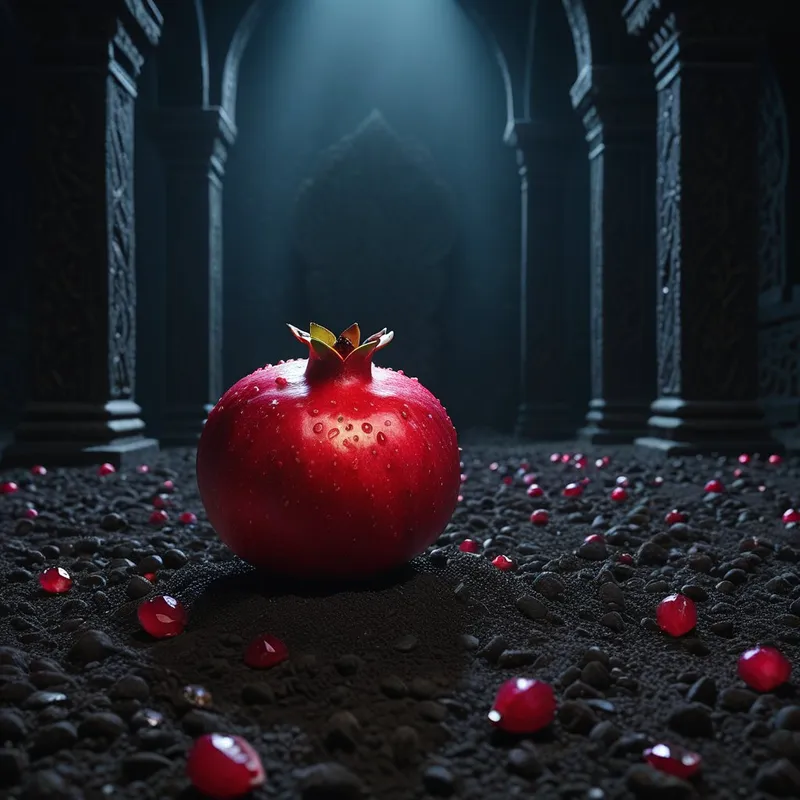
In the gloom of his hall, Plouton agreed. But as he set Persephone in the chariot for her return, he offered her a parting gift—a few seeds of the dark, sweet pomegranate. Hungry from her long fast, and perhaps touched by a new, complex feeling for her dark lord, she ate them. It was a fateful act. Those who consume the food of the dead are bound to return.
When Demeter saw her daughter erupt from the cleft in the earth at Eleusis, the world inhaled. Color rushed back into the stones. A sound like a million seeds cracking filled the air. They embraced, and for a moment, it was the first dawn.
But the law of the seed had been invoked. Because Persephone had eaten of the underworld’s fruit, she must return to it for a portion of each year. A compromise was struck: for each seed consumed, a month in the depths. Thus, when Persephone descends to her throne beside Plouton, Demeter mourns, and winter lays its hand upon the world. When she ascends, her mother’s joy brings forth the spring. The first grief became the rhythm of all life.
Cultural Origins & Context
This myth, central to what we call the Eleusinian Mysteries, was not merely a story told to children. It was the sacred, secret heart of a state-sponsored religious cult that endured for nearly two millennia, from the Mycenaean era well into the Roman period. The primary source is the Homeric Hymn to Demeter, a poetic narrative likely composed in the 7th century BCE.
The myth was performed, enacted, and experienced. At Eleusis, initiates (mystai) underwent elaborate rites that re-enacted Demeter’s search and Persephone’s return. The details were a closely guarded secret (arrheton), violation of which was punishable by death. This secrecy suggests the experience was deeply personal and transformative, not intellectual. The function was societal—providing hope for life after death—and profoundly psychological, offering a template for navigating life’s most devastating losses. It was a myth that explained the observable world (the seasons) while providing a container for the most un-speakable human experiences: abduction (trauma), grief, and the bittersweet cycle of attachment and separation.
Symbolic Architecture
At its core, this is a myth of the psyche’s necessary descent and the ecology of the soul. Demeter represents the conscious, nurturing, life-affirming principle—the ego that seeks to maintain growth, order, and connection. Persephone is the innocent, nascent self, the potentiality of the psyche (the anima in a man, the core identity in a woman) that must be taken into the unconscious.
The abduction is not a tragedy, but a necessity. No wholeness is possible without a confrontation with the underworld.
Plouton is not a villain, but the lord of the invisible, the ruler of all that is repressed, forgotten, and potent within us—the shadow and the deep masculine principle (the animus). His realm is the unconscious itself. The pomegranate seeds are the symbols of conscious choice within the unconscious realm; they represent Persephone’s agency in her own fate. By eating them, she accepts a portion of the darkness, internalizing her experience. She is no longer solely her mother’s daughter; she is also Queen of the Depths. The resulting cycle—descent and return—models the fundamental rhythm of psychological life: engagement with the inner world (introversion, depression, incubation) followed by return to the outer world (extraversion, creativity, action).

The Dreamer's Resonance
When this myth stirs in the modern dreamer, it often manifests as a profound sense of arrest. One may dream of a house suddenly cold, a garden that will not grow, or a vital relationship that feels frozen or distant. The somatic experience is one of numbness, heaviness, or a chilling hollow in the chest—the felt sense of Demeter’s withholding.
Dreams of being trapped in a basement, descending an endless elevator, or finding a beautiful, overgrown path that suddenly drops away speak to Persephone’s moment. These are not nightmares of persecution, but of initiation. The psyche is signaling that a part of the self—an innocence, a creativity, a joy—has been “abducted” by unconscious forces (a trauma, a depression, a life transition) and must be reckoned with. The dreamer is in the “winter” of the process, where all outward growth stops so that a crucial, invisible negotiation in the underworld of the self can take place.

Alchemical Translation
The alchemical journey mirrored in this myth is the nigredo, the blackening, followed by the albedo. Demeter’s winter is the nigredo: the utter dissolution of the old identity (“the grieving mother”), the putrefaction of the known world. Everything fertile turns black, cold, and inert. This is a necessary death. The ego’s plans are annihilated.
Persephone’s sojourn in the underworld is the soul’s work in that blackness. It is not passive imprisonment, but a period of royal claiming. She sits on the throne beside her animus/shadow (Plouton), integrating the powerful, chthonic aspects of her being.
The return is not to the old summer, but to a new, cyclical reality. The transformed self brings life, but carries the knowledge of darkness within it.
The compromise—the cyclical return—is the ultimate alchemical truth. The goal of individuation is not a permanent state of sunny consciousness, but the capacity to move fluidly between the upper and lower worlds, between action and reflection, joy and grief, without losing the self in either. The modern individual undergoing this process moves from a linear life (endless summer, or endless winter) to a spiral one. They learn that periods of contraction, grief, and introversion are not failures, but the fertile, dark soil from which the next phase of growth will inevitably, and only, spring. One becomes both Demeter, the nurturer of life in the world, and Persephone, the sovereign who knows the secrets of the depths.
Associated Symbols
Explore related symbols from the CaleaDream lexicon: