
Crocus Myth Meaning & Symbolism
A mortal youth beloved by a nymph is accidentally slain, his blood staining the earth to birth the first crimson saffron crocus, a symbol of eternal love.
The Tale of Crocus
Hear now a tale not of thunderous gods, but of a whisper—a sigh that forever changed the color of the earth. In the high, lonely meadows where the wind sings secrets to the pines, there lived a youth named Crocus. He was not a hero of renown, but his beauty was of the kind that makes the very air seem purer, a mortal echo of the divine. His laughter was the sound of clear water over stones, and his presence turned the simple act of running through the grass into a kind of prayer.
His companion in these wild places was the lovely nymph Smilax. She was of the mountain, her spirit as untamed as the creeping vine that shares her name. Together, they were a perfect harmony—the human and the nature spirit, woven into the landscape of their play. Their world was the discus throw on the sun-warmed slope, the chase through the twilight groves, a friendship so deep it brushed the edges of a love not yet named.
But the Fates, who spin their threads with indifferent hands, had woven a different pattern. One afternoon, under the watchful eye of Apollo, the god of the sun himself, they played at their favorite game. Crocus took his stance, the polished wooden disc cool in his palm. He laughed, a challenge to Smilax, and with the grace of a young god, he let it fly. The disc cut a perfect, singing arc through the crystalline air.
And then—a hitch in the world’s breath. A misstep. A divine distraction. Perhaps Apollo turned his gaze, or perhaps it was the cruel whim of chance. The discus, meant to soar, did not fall gently to the grass. It struck. It found the temple of the laughing youth. A sound, not of impact, but of a song cut short.
Crocus fell. Not with a hero’s cry, but with the soft finality of a petal detaching. His life, bright and brief, seeped into the soil where he lay. Smilax’s scream was not heard by mortal ears; it was the sound of the mountain itself cracking. The gods, in their distant pity—or perhaps in their recognition of a beauty too perfect for this world—acted. They would not restore what was broken. Instead, they translated.
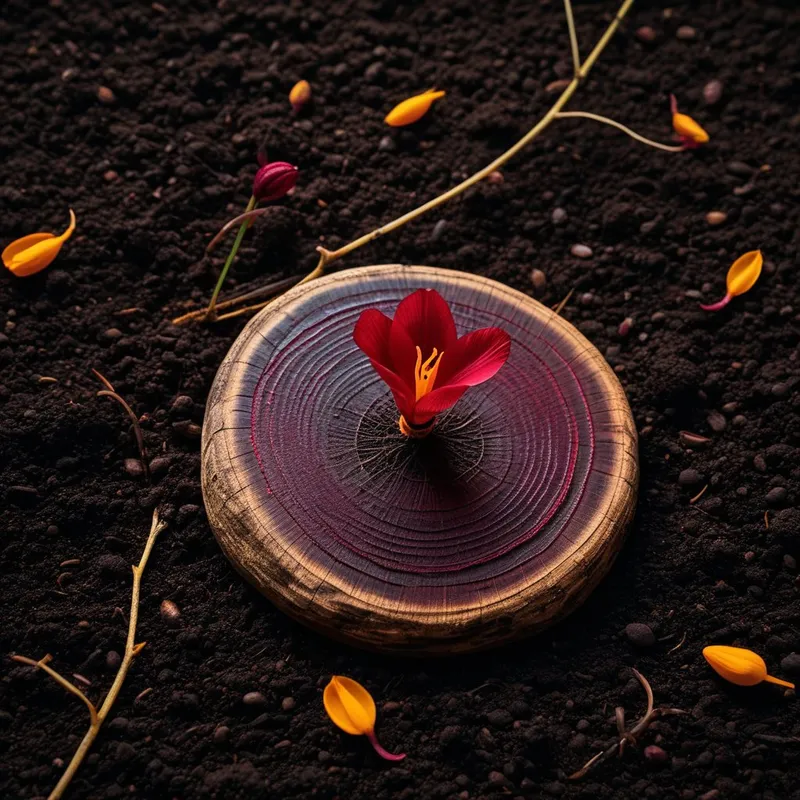
Where his blood soaked the dark earth, the ground did not merely stain. It quickened. From that sacred wound, life pushed forth—not the life that was lost, but a new one, fragile and fierce. Slender green spears pierced the soil, and from them bloomed a flower of the most profound and aching violet. At its heart, three filaments burned with a color never before seen: a luminous, fiery crimson, the very hue of his spilled vitality. The first saffron crocus. And where Smilax stood, frozen in her grief, her own form began to change, twisting and hardening into the tough, clinging smilax plant, forever reaching, forever entwining with the memory of her lost friend.
Cultural Origins & Context
The myth of Crocus is a delicate thread in the vast tapestry of Greek mythology. It belongs not to the epic cycles of Homer but to the realm of aetiological tales—stories that explain the origin of things in the natural world. It is a pastoral myth, born from the intimate observation of the Greek landscape. The sudden, brilliant appearance of the crocus flower in late winter or early spring, its vivid stigmas a shocking contrast to the dormant earth, demanded a story worthy of its beauty.
Such tales were the currency of local tradition, passed down by shepherds, farmers, and poets like Theocritus. They served a profound societal function: they humanized the landscape, filling it with memory and meaning. Every blooming crocus became a monument, a reminder that the land itself was sanctified by stories of love and loss. It connected the people to their environment not just practically, but mythically, teaching that beauty often springs from tragedy, and that the divine is present in the most fleeting of natural wonders.
Symbolic Architecture
At its heart, the myth of Crocus is a profound allegory of transformation through rupture. Crocus, the beautiful mortal, represents the unblemished, potential-filled ego—the conscious self in its state of innocent play. His accidental death is not a punishment, but a necessary numinous intervention, a shattering of that conscious wholeness by a force beyond its control (the discus, guided by fate or divine oversight).
The most precious pigments are not found on the surface, but are released only when the form is broken.
The blood is the key symbol. It is the vital essence, the anima, the very substance of the soul. Its spillage is not an end, but a descent—a fertilization of the chthonic depths (the soil). The flower that arises is the new, integrated symbol. The violet petals speak of spirituality and melancholy, while the crimson stigmas are the concentrated essence of his sacrificed life, now become something of immense value—saffron, used for dye, medicine, and sacrament. Crocus achieves a form of immortality, but it is a bittersweet one: eternal beauty at the cost of eternal fragility. Smilax’s parallel transformation into a clinging vine symbolizes the fate of unresolved grief—a fixation that binds one to the past, forever grasping at what is gone.

The Dreamer's Resonance
When this myth stirs in the modern unconscious, it often manifests in dreams of sudden, beautiful, yet painful endings. One might dream of a cherished object shattering to reveal a glowing core, of a youthful version of oneself dying peacefully in a field, or of bleeding not blood, but liquid light or flowers.
Somatically, this can correlate with the feeling of a "heartbreaking" opening—a poignant ache in the chest that feels simultaneously like loss and potential. Psychologically, the dreamer is likely at a point of involuntary transformation. A long-held identity, a cherished relationship, or a phase of life is being abruptly concluded, not by conscious choice, but by the "discus" of fate: an unexpected job loss, the end of a relationship, a health diagnosis, or simply the passage of time. The psyche is processing this rupture, not as a pure catastrophe, but as the painful, necessary precondition for a new kind of blooming. The dream is the soul’s assurance that the essence of what was lost is not gone; it is being composted into the soil of the self, preparing to rise in a new, perhaps more refined, form.

Alchemical Translation
The Crocus myth is a perfect map for the individuation process, specifically the stage of nigredo—the blackening, the descent, and the dissolution. The conscious personality (Crocus) must be "accidentally" struck down by contents from the unconscious (the thrown discus, perhaps from the hand of Apollo as solar archetype). This is the crisis that feels like annihilation.
The ego does not choose its death; it is chosen for it. The work of the soul begins in the aftermath of the fall.
The alchemical operation here is mortificatio—the killing of the old form. But in the vessel of the psyche, this death is not literal. It is the death of an attitude, a dependency, a naive self-image. The "blood" that flows is the released psychic energy, the libido that was once invested in that old form. This energy, this vital essence, must be willingly surrendered to the dark, fertile ground of the unconscious (the earth). There, in the silence of incubation, it undergoes its transmutation.
The "saffron" that results—the crimson stigmas—is the rubedo or the Philosopher's Stone on a small scale. It represents the distilled, precious essence of the experience: a new depth of feeling, a poignant wisdom, a creative gift that could only be born from that specific sacrifice. For the modern individual, the myth teaches that our most painful ruptures are not meaningless. They are the often-brutal mechanics by which the soul insists on moving from innocent play (Crocus and Smilax in the meadow) to a state of conscious, embodied value. We are asked to become the flower that remembers the youth, and the spice that flavors the world from the memory of its own bleeding.
Associated Symbols
Explore related symbols from the CaleaDream lexicon: