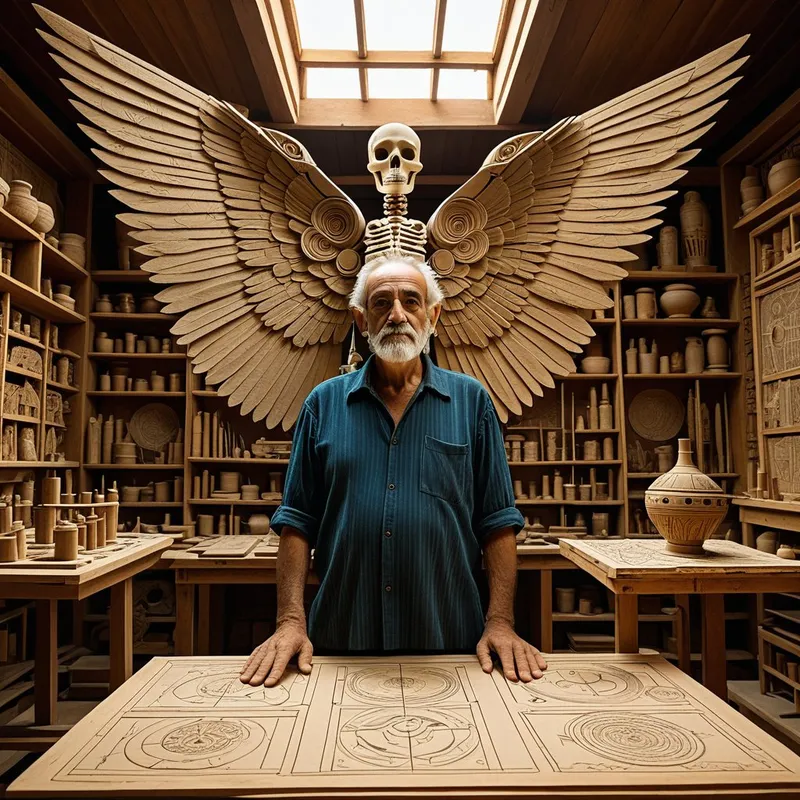
Daedalus's Workshop Myth Meaning & Symbolism
The myth of the master artisan Daedalus, his labyrinth, his waxen wings, and the tragic flight that embodies the creative spirit's glory and peril.
The Tale of Daedalus's Workshop
Hear now the tale not of a god, but of a man whose craft brushed the divine. In the sun-baked stone of Crete, there stood a workshop that hummed with a music all its own. It was the song of saw on wood, of chisel on stone, of a mind that saw the soul hidden within inert matter. This was the domain of Daedalus.
He had fled to this island, his reputation a cloak both splendid and heavy. King Minos, mighty son of Poseidon, saw in Daedalus not a refugee, but a tool. And a tool must be put to work. The queen, Pasiphaë, had been cursed with a monstrous desire, and from that union was born a creature both bull and man—the Minotaur. Its roars shook the palace foundations; its hunger was insatiable.
Minos turned his cold eyes to Daedalus. "Contain it," he commanded. "Build a prison from which this shame can never emerge." And so Daedalus bent his genius to a terrible purpose. He did not build walls, but a concept given stone form: the Labyrinth. A winding, coiling, ever-turning path where every corridor lied, where the entrance vanished behind you, and the center was a trap. It was his masterpiece of confusion, a perfect machine for loss. The Minotaur was placed within, and Athenian youths soon followed, tribute to Minos's wrath.
But Daedalus, architect of the prison, soon found himself a prisoner. For Minos, fearing the secrets of the Labyrinth would escape, sealed its creator and his young son, Icarus, in a tower overlooking the wine-dark sea. The workshop was gone. Now there was only the empty sky and the imprisoning waves.
Daedalus’s eyes, which once saw the potential in wood and bronze, now studied the gulls crying on the wind. "Minos may control the land and sea," he mused to Icarus, "but he does not control the air." And so, in that high cell, a new workshop was born. He gathered feathers fallen from the cliffs, pleaded for wax from the bees, stole threads from their own garments. With infinite patience, he crafted two pairs of wings, binding feather to feather with wax, creating a sublime, fragile technology of escape.
On the fateful morning, he fastened the wings to his son’s shoulders. His instructions were a father’s prayer: "Follow my path. Fly the middle course. If you sink too low, the sea’s damp will clog your wings. If you soar too high, the sun’s fire will melt their binding."
The leap from the tower was an act of faith. And for a glorious, breathless time, it worked. They flew, two strange new birds, leaving the labyrinthine world below. But Icarus, drunk on the ecstasy of flight, on the warmth of the Helios-sun, forgot the middle way. He climbed, chasing sublimity, until the wax softened, wept, and failed. One feather, then a dozen, then a storm of white plumes spun away. His cry was not of a man, but of a falling star, extinguished in the cold embrace of the sea that now bears his name. Daedalus, the creator, landed alone on distant shores, his greatest creation, his son, lost to the sky.
Cultural Origins & Context
This myth comes to us primarily from the Roman poet Ovid in his Metamorphoses, though the figure of Daedalus is far older, appearing in fragments of earlier Greek literature and art. He is a pre-Homeric archetype, a bridge between the age of heroes and the age of human ingenuity. Unlike tales of gods, the Daedalus cycle is profoundly humanist. It was a story told not just to explain, but to warn and awe.
In a culture that venerated technē (craft, art, skill) but deeply feared hubris (excessive pride), Daedalus was the ultimate embodiment of that tension. He was the patron of artisans, architects, and inventors—a culture hero who demonstrated that human intellect could rival the gods' whims. His stories were likely shared in workshops, symposia, and theatrical plays, serving as a potent narrative about the ethical use of knowledge. The myth functioned as a societal check on innovation: brilliance is divine, but it carries a divine responsibility. The fate of Icarus was a chilling reminder that the products of genius, like children, can escape their creator's control with tragic consequences.
Symbolic Architecture
The workshop is not merely a room; it is the ego of the creator, the ordered mind where raw materials of the unconscious (wood, stone, desire, fear) are shaped into conscious form. The Labyrinth is its shadow output.
The Labyrinth is the ultimate symbol of a brilliant mind turned inward upon its own darkness, constructing elegant, logical prisons for its own monsters.
Daedalus represents the creative intellect itself—soaring, problem-solving, yet perpetually in exile, forever fleeing the consequences of its own inventions. The Minotaur is not just a monster; it is the unintegrated, bestial shadow, the primal desire or shame that the conscious mind (Daedalus, at the king's command) walls off in a maze of rationalization and complexity. But one cannot simply wall off the shadow; one must eventually face it or remain its eternal jailer.
The wings are the sublime, spiritual aspiration of the intellect to transcend its earthly confines—to move from the literal to the symbolic, from imprisonment to meaning. The wax is the fragile, human element that binds inspiration (feathers) into a workable form. It is emotion, relationship, the mortal body.
Icarus’s fall is not a punishment for ambition, but the inevitable result of an inspiration untethered from its human grounding. The sun is not an enemy, but the dazzling, archetypal symbol of the Self—wholeness, divinity, ultimate knowledge. To fly directly into it is to be dissolved, to mistake ego-achievement for true individuation.

The Dreamer's Resonance
To dream of Daedalus's workshop is to dream of a phase of intense, isolated psychic construction. You are in a space of your own making, surrounded by half-finished projects, blueprints for your life, and the tools of your trade. The dream may feel urgent, cluttered, yet powerfully focused. You are building something—a new identity, a career, an art, a solution to a complex emotional problem (your personal labyrinth).
Dreaming of the labyrinth signals a state of psychological confusion or entrapment. You feel lost in your own logic, going in circles within a problem of your own devising. The Minotaur at the center is the feared emotion or truth you are avoiding—a rage, a grief, a dependency—that you have successfully contained but now must feed with your energy (the Athenian tributes).
The dream of crafting or wearing the wings speaks to a desire for radical escape or transcendence. It is a dream of liberation, of finding an ingenious solution to an impossible bind. But if the wax melts in the dream, it signals a somatic warning: your brilliant plan, your new spiritual identity, is not yet integrated. The body, the heart, the human connections (the wax) cannot yet support the flight. The dream is the psyche's way of stress-testing the invention before the conscious ego attempts the leap.
Alchemical Translation
The myth of Daedalus is a perfect model for the alchemical process of individuation. It begins with the nigredo, the blackening: Daedalus in exile, then imprisoned. This is a state of despair, limitation, and confrontation with the shadow (the Minotaur, his own complicity). The workshop-in-the-tower is the albedo, the whitening: a distillation of purpose in isolation. Here, the raw materials of a life (feathers of past experiences, wax of personal bonds) are purified and reassembled with new intent.
The crafting of the wings is the central act of psychic transmutation. It is the moment the ego, using all its skill, consciously builds a vehicle to engage the transpersonal—the sky, the realm of spirit, the larger Self.
The flight is the risky, essential rubedo—the reddening, the operation of the soul. It is the attempt to live the synthesized truth one has built.
Icarus’s path represents a failed coniunctio (sacred marriage). He seeks union with the sun (the Self) through inflation, through ego-identification with the divine ("I am flying so high!"). He is dissolved because he bypasses the human. Daedalus’s mournful, completed flight represents the successful, if wounded, integration. He carries the knowledge of both the labyrinth and the sky. He lands not as a triumphant god, but as a whole human—a creator who has felt the full cost of creation, who holds the blueprint and the funeral shroud in the same scarred hands. His workshop is now eternal, internal. To individuate is not to escape the labyrinth forever, but to learn you carry the tools to navigate it, and the wisdom not to build one for others.
Associated Symbols
Explore related symbols from the CaleaDream lexicon: