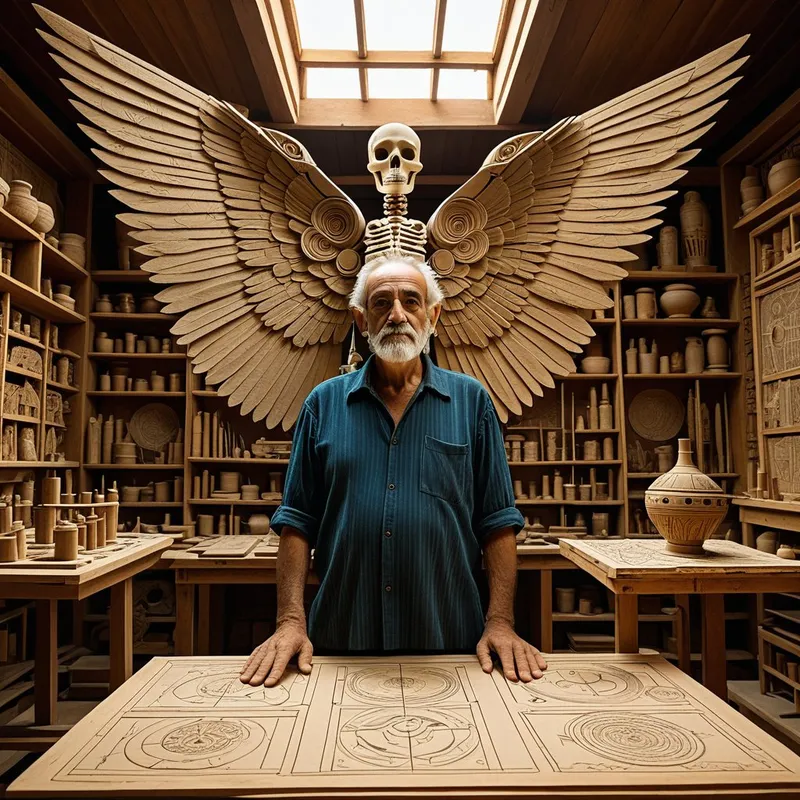
The Forge of the Psyche: Dreaming of Invention
The Somatic Echo
Before the mind conjures a blueprint, the body knows. It is a peculiar tension, a humming in the marrow. Not anxiety’s brittle rattle, but the deep, resonant frequency of potential held under pressure. You feel it in the solar plexus—a tight coil of unsolved equations, a magnetic pull toward a form not yet born. Your hands might ache with a phantom memory of tools they have never held, your breath might become shallow, as if you are working in a rarefied atmosphere. This is the somatic signature of invention: the visceral sense that the raw, unshaped matter of your experience—your grief, your forgotten joys, your unspoken truths—is demanding a new vessel. It is the ache of a structure waiting to be built from the inside out.
The Dreamer's Log (Case Vignette)
In the dream, I am in a silent workshop. My task is to repair a cracked porcelain mask, but I have no glue. Instead, I find myself weaving strands of my own hair with filaments of copper wire, soldering them with my breath. The mask becomes a new face, one that can both speak and receive signals from a silent frequency only I can hear.
Alchemical Interpretation: The dreamer is not mending a broken social self, but actively inventing a new interface between the soul’s silent language and the world’s noise.

The False Lead
This theme is not about literal creativity or the desire to build a better mousetrap. To mistake the dream-invention for a call to patent an idea is to confuse the blueprint with the territory. It is not a promise of external success, nor is it a simple metaphor for “problem-solving.” The terror or exhilaration here is not about fixing a broken part of your life, but about the profound, often destabilizing realization that the entire structure of your inner world—the way you process feeling, the narratives you call “self”—requires a fundamental redesign. It is the difference between rearranging furniture and discovering you must pour a new foundation while still living in the house.
Psychological Architecture
Invention, in the deep psyche, is an act of shadow integration so radical it constitutes a paradigm shift. You are not merely adding a new room to the house of the self; you are the architect, standing in the rubble of an old, cramped floorplan, holding the luminous schematics for a new dwelling. The shadow work here is immense: you must first become intimately acquainted with the limitations of your current psychic machinery. What contracts in fear? What circuit overloads with grief? What old program runs on a loop of resentment? This is the “disassembly” phase, often felt as disintegration or crisis.
Then comes the true invention: you take these disassembled parts—the orphaned grief, the exiled anger, the forgotten innocence—and you see them not as flaws, but as components. You begin the patient, often terrifying work of re-wiring. You connect your compassion to your boundaries, creating a new circuit of empowered kindness. You solder your vulnerability to your courage, creating a transducer that turns fear into authentic connection. This is Individuation in its most active, creative form: you are building the vessel that can contain the totality of who you are, a vessel that did not exist until you dared to imagine its form.
Mythic Resonance
We see this eternal process in the figure of Hephaestus, the Olympian smith. Cast out from Olympus for being imperfect, he did not simply languish. In the depths of the earth, in his volcanic forge, he turned his lameness, his pain, his isolation into the source of his power. From that place of exile, he invented wonders: the palaces of the gods, Achilles’ armor, Pandora herself. His myth tells us that the inventive faculty is often born in the place of our deepest wound; the forge is lit in the underworld of our experience. The new creation—the invented self—is always a fusion of divine spark and earthly suffering, hammered into form on the anvil of necessity.
Symbolic Nodes
- Unfamiliar Tools or Machinery: Represent new psychological functions or capabilities coming online.
- Blueprints, Schematics, or Equations: The emerging, conscious plan for the new self-structure.
- Forgotten or Broken Objects Being Repurposed: Past traumas or outdated self-concepts being integrated as raw material.
- Fusion of Organic and Metallic/Technological Elements: The marriage of instinct (body) with conscious design (mind).
- A Workshop or Laboratory, Often Isolated: The sacred, interior space where this profound self-creation occurs.
- An Incomplete or Glitching Creation: The nascent, fragile state of the new psychic structure.
Archetypal Resonance
The core energy of the invention dream is the pure, driving force of The Creator Archetype. This is not the artist making a piece about the self, but the architect building a new self from the self.
The Creator’s resonance here is absolute. Its somatic echo is that coiled potential in the gut, the itch in the hands—the imperative to give form to the formless. Its alchemical potential lies in its willingness to enter the chaos of raw, psychic material—the memories, the shadows, the contradictions—and to hold the vision of a cohesive whole. The Creator does not shy away from the mess of the process; it understands that the pressure, the heat, and the seemingly destructive act of dismantling are all essential to the act of making. In the invention dream, the psyche dons the Creator’s mantle, declaring that your life is not a fate to be endured, but the primary material for a masterpiece of being that only you can design and assemble.
The Alchemical Process
The alchemy of invention is Transmutation through Directed Pressure. The prima materia is the chaotic totality of your unlived life, your unmet potentials, and your unresolved pains. The furnace is the intense heat of conscious attention focused on this inner chaos. This is not passive suffering; it is the active, often agonizing, pressure of holding two contradictory truths: “I am broken by my experience” and “My experience is the very material of my wholeness.”
The catalyst is the vision. A fleeting image of a more integrated you. A feeling of sovereignty that arrives in a dream. This vision acts as the Philosopher’s Stone—it does not change the material’s essence, but it reorganizes it at a fundamental level. Under this heat and pressure, grief becomes empathy’s depth sensor. Rage becomes the energy for unwavering boundaries. Fragmentation becomes the blueprint for a more complex, resilient structure. The terror of dissolution is the necessary fire that burns away the old, rigid forms, leaving only the essential, malleable elements ready to be cast into a new mold of your own conscious design.

The Integration Protocol
Question 1: What old, internal "machine" or structure in my psyche feels most obsolete, glitching, or insufficient for the life I am now living?
Question 2: If my most challenging emotion (e.g., grief, anger, fear) were not a problem to be solved, but a raw component, what unique function or capability could it power in a newly invented self?
Question 3: Where in my body do I feel the most potent, creative tension—the "hum" of something wanting to be built? What does that sensation want to become?
Action 1 (Somatic Blueprinting): For five minutes, place your hands on the part of your body where you feel the inventive tension. Breathe into that space. Do not think of ideas. Instead, imagine your breath as a delicate probe, sensing the shape of the potential there. Is it a knot, a coil, a sphere, a lattice? Let the body reveal the abstract form of what is waiting to be created.
Action 2 (Salvage & Repurpose Journaling): Take an old journal entry, a painful memory, or a recurring negative thought. On a new page, perform a "technical salvage" operation. Write down three "component parts" you can extract from it (e.g., from a memory of betrayal: 1) a sensor for inauthenticity, 2) a high-tensile strength for self-trust, 3) a circuit for deep discernment). This practice alchemizes history into usable parts.
Action 3 (The Silent Workshop Ritual): Create a small, clear physical space—a corner of a desk, a shelf. Place upon it three unrelated objects: one natural (a stone, a leaf), one manufactured (a bolt, a circuit board), one personal (a worn ring, a key). For a week, simply observe them together each morning. On the seventh day, without planning, use any medium (clay, wire, drawing, words) to create a single new form that unites them. This ritual externalizes the psyche's innate drive to synthesize disparate elements into a novel whole.
Final Validation
The path of the inventor-dreamer is not for the faint of heart. It asks you to become comfortable in the liminal workshop where everything is taken apart, where the air smells of ozone and possibility, and where the only blueprint is the one you must draw with a hand that sometimes shakes. It is profoundly lonely, deeply disruptive, and utterly necessary. Remember: the dream does not come to show you what is broken. It comes because the architect within you has already seen the glorious, impossible design for what you could become, and it will not rest until you pick up the tools and begin, piece by luminous piece, to build it. The sovereignty you seek is not found, but forged.