Aeolian Harp Myth Meaning & Symbolism
The story of the harp that plays not by human hand, but by the breath of the wind, revealing the hidden music of the world and the soul.
The Tale of the Aeolian Harp
Listen, and you will hear it. Not in the crowded agora, nor in the torch-lit halls of kings. You must go to the high places, where the earth meets the sky and the sea whispers to the cliffs. Go when the sun bleeds into the wine-dark sea and the world holds its breath. There, you will find the true musician.
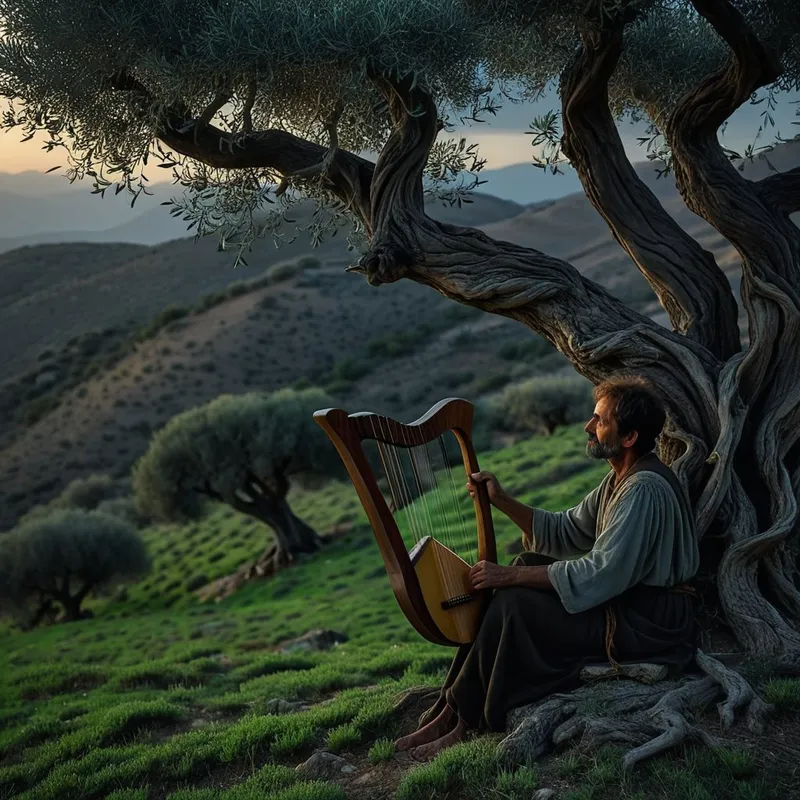
It begins not with a hero, but with a shepherd. A man whose name the stories have forgotten, for he was every man who ever felt a longing too vast for words. His days were measured by the steps of his flock, his nights by the cold clarity of the stars. He carried a simple lyre, a companion for his solitude, and with calloused fingers he would pluck melodies of the earth—songs of the grass, the rock, the patient sheep.
But his heart heard another music. It was in the sigh that rushed through the pine forests, the low moan that prowled the mountain passes, the playful whisper that scattered the autumn leaves. It was the voice of Zephyrus, of Boreas, of all the untamed children of Ouranos. He would hold his lyre aloft, offering it to the empty air, but his mortal hands could not coax this wild song forth. The wind’s symphony remained just beyond the edge of hearing, a maddening, beautiful ghost.
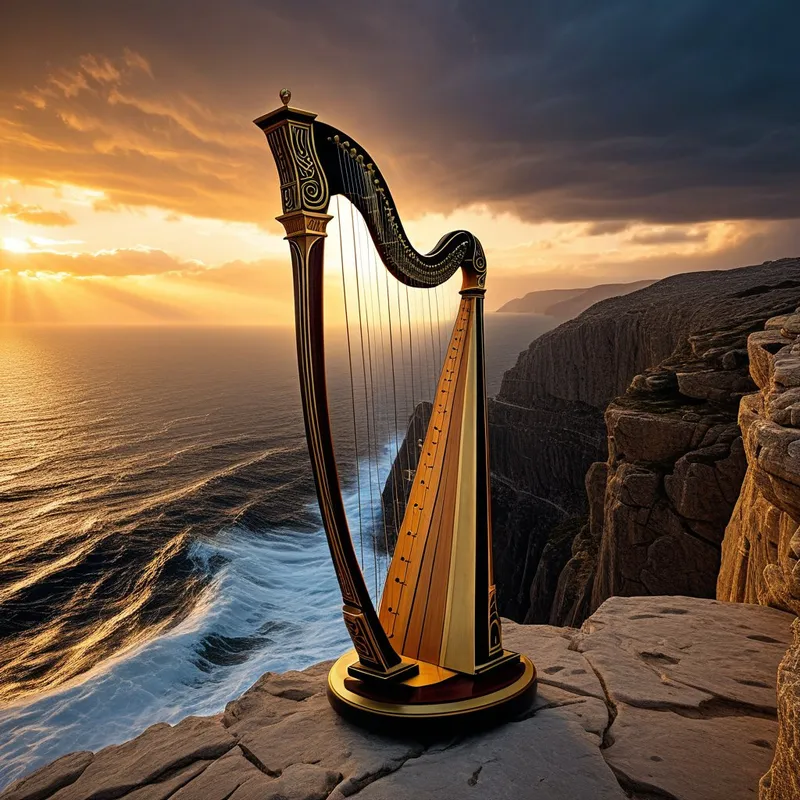
One evening, as a storm gathered its purple robes on the horizon, a despair deeper than the ocean trench took him. The gulf between the music in his soul and the silence in his hands was too great. In an act not of creation, but of surrender, he did not play his lyre. Instead, he took the cords of gut and sinew, the frame of weathered wood, and he placed it—no, he entrusted it—to the elements. He wedged it firmly in the cleft of an ancient, lightning-scarred oak that stood as a sentinel on the cliff’s edge.
He stepped back. He closed his eyes. He ceased.
Then, Zephyrus arrived. Not as a hurricane, but as a curious lover. His breath, which moments before had been a silent force, found the strings. A single note hummed into being, pure and questioning. Then Boreas answered from a different quarter, his colder breath stirring a cluster of strings into a dissonant, thrilling chord. The winds began to converse, to argue, to dance. They swept across the harp not as a musician would, with intention, but as a force of nature—erratic, passionate, whole.
And the harp sang. It sang a song no human composer could ever write. It was the sound of distance itself, of clouds forming, of waves caressing shores a world away. It was the lament of the lost and the joy of the free. The shepherd fell to his knees, not in prayer, but in witness. He had not made the music; he had merely become the hollow through which the world’s breath could become song. The instrument, now an Aeolian Harp, played on into the gathering night, its voice the only truth under the indifferent stars.
Cultural Origins & Context
The myth of the Aeolian Harp is less a formal narrative from the epic cycles and more a pervasive poetic idea, a fragment of folk understanding that seeped into the Hellenic consciousness. It belongs to the realm of aetiology, explaining the origin of a haunting natural phenomenon: the inexplicable music heard in lonely places. This story was likely passed down not by rhapsodes in courts, but by farmers, sailors, and shepherds—those who lived in intimate dialogue with the wind.
Its societal function was dual. On a practical level, it personified and made sense of the capricious, powerful, and essential force of the wind. By giving it a musical intent, the natural world became less alien and more communicative. On a deeper level, it served as a metaphysical model. In a culture that revered the arts as divine gifts (enthousiasmos), the myth illustrated that true inspiration does not originate from the self. It is a force that passes through the individual. The harpist is not the source of the wind, but the vessel that gives it form. This idea underpinned the Greek concept of the poet or seer as a mouthpiece for the gods, a concept later echoed in Plato’s notion of the poet being possessed by the Muses.
Symbolic Architecture
At its core, the Aeolian Harp is a perfect symbol of the relationship between the human soul and the animating spirit of the universe, the Anima Mundi. The rigid, structured frame of the harp represents the individual ego, the body, and the confines of conscious personality. The strings are the latent capacities, the nerves, the sensitivities of the psyche.
The most profound music is not played by the hand of the will, but is breathed into the surrendered soul by the unseen.
The wind is the uncontrollable, transcendent element—the collective unconscious, divine inspiration, fate, or the raw force of life itself (psyche also means "breath"). The myth’s pivotal moment is not an act of mastery, but of relinquishment. The shepherd’s despair leads him to stop trying to capture the wind and instead to offer himself as its instrument. The resulting music is a co-creation between structure and chaos, between the finite and the infinite. It symbolizes the beauty that emerges when the ego aligns with, rather than opposes, the larger patterns of existence.
The Dreamer's Resonance
To dream of an Aeolian Harp, or of being one, signals a profound somatic and psychological process of receptivity. The dreamer is likely in a state where conscious striving has led to exhaustion or sterility—a "creative block" or a feeling of existential dryness. The psyche is presenting an image of the solution: becoming an instrument.
Somatically, this may manifest as a dream of being hollowed out, of wind rushing through the chest cavity, or of vibrating in resonance with a deep, external hum. Psychologically, it indicates a necessary dissolution of the ego’s rigid control. The dream is an invitation to stop "playing yourself" and to allow the larger currents of the unconscious—intuitions, synchronicities, forgotten memories, archetypal energies—to move through you. The anxiety in such a dream often centers on the fear of being passive or empty. The healing lies in understanding that this emptiness is not a void, but a sacred space prepared for a guest.

Alchemical Translation
The myth models the alchemical stage of solutio, or dissolution, which is essential for psychic transmutation and individuation. The conscious personality (the shepherd with his intended music) must be dissolved so that a new, more authentic configuration (the harp played by the wind) can coalesce.
The modern individual’s parallel struggle is the tyranny of the "willful self," the part that believes it must manufacture its own identity, purpose, and creativity through sheer effort. The alchemical process begins with the "despair on the cliff"—a dark night of the soul where one’s own resources are proven inadequate. The act of "placing the harp in the tree" is the active surrender: engaging in practices that bypass the ego, such as active imagination, mindful receptivity, or committing to a creative medium without demanding a specific outcome.
Individuation is not about building a louder, more complex melody of the self. It is about tuning the instrument of the soul so clearly that the wind of the cosmos cannot help but make it sing.
The resulting "music" is the individuated life: not a life of one’s own design, but one that feels authentically, strangely, and beautifully given. It is the expression of the Self (the total, archetypal psyche) rather than just the ego. The individual becomes a unique vessel through which the transpersonal, the archetypal, and the inspired can enter the world. One does not become the wind, but one becomes indispensable to its song.
Associated Symbols
Explore related symbols from the CaleaDream lexicon: