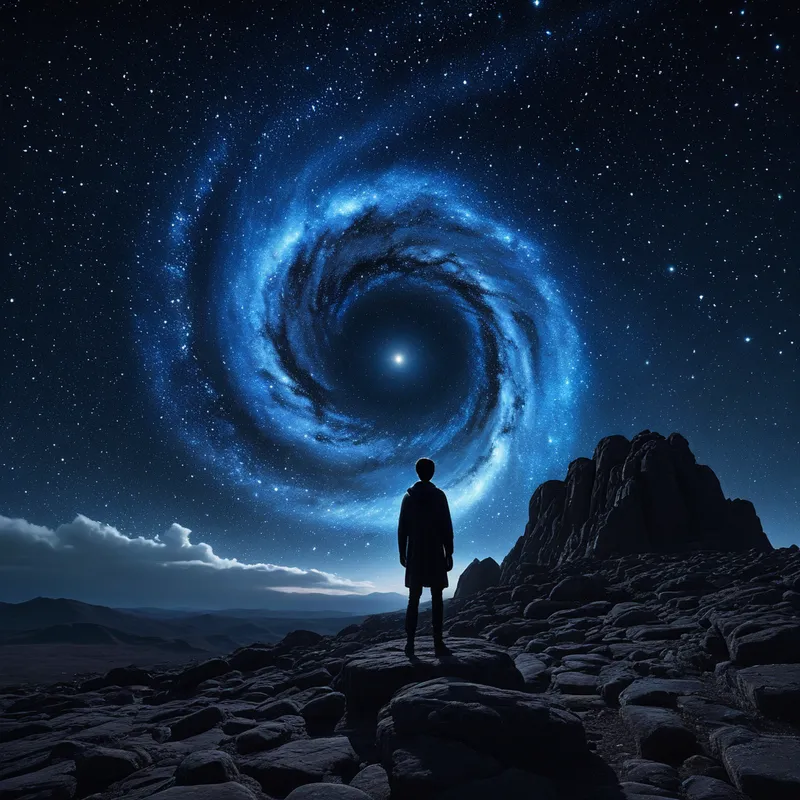
Ouranos Myth Meaning & Symbolism
The primordial sky god, Ouranos, is castrated and overthrown by his son, an act of cosmic rebellion that births a new order from chaos.
The Tale of Ouranos
In the beginning, there was only Chaos. From its depths arose the first beings, the foundations of all that is. First came Gaia, the broad-breasted earth, solid and fertile. And then, without sweet union, she brought forth Ouranos, the starry sky, to be her equal and to cover her completely.
Ouranos was vast, a dome of darkest indigo studded with glimmering, unblinking eyes. He descended upon Gaia, and in their embrace, the world was made. From their union sprang the first children: the twelve mighty Titans, deep-voiced and powerful as earthquakes. Then came the three wild, one-eyed Cyclopes, and finally the three monstrous Hecatoncheires, each with a hundred arms and fifty heads.
But Ouranos looked upon his offspring, and he felt not love, but a cold, cosmic dread. The Cyclopes with their singular, blazing eyes saw too deeply. The Hecatoncheires, with their countless grasping hands, threatened the very fabric of his ordered sky. He could not bear their potential, their raw, untamed power. So, as each was born from Gaia’s deep clefts and hidden places, Ouranos did not let them rise into the light. He pushed them back. He forced them down, deep into the dark, suffocating womb of the earth itself, into the pit of Tartarus. Gaia groaned under the weight, her body strained and aching with the imprisoned fury of her own children.
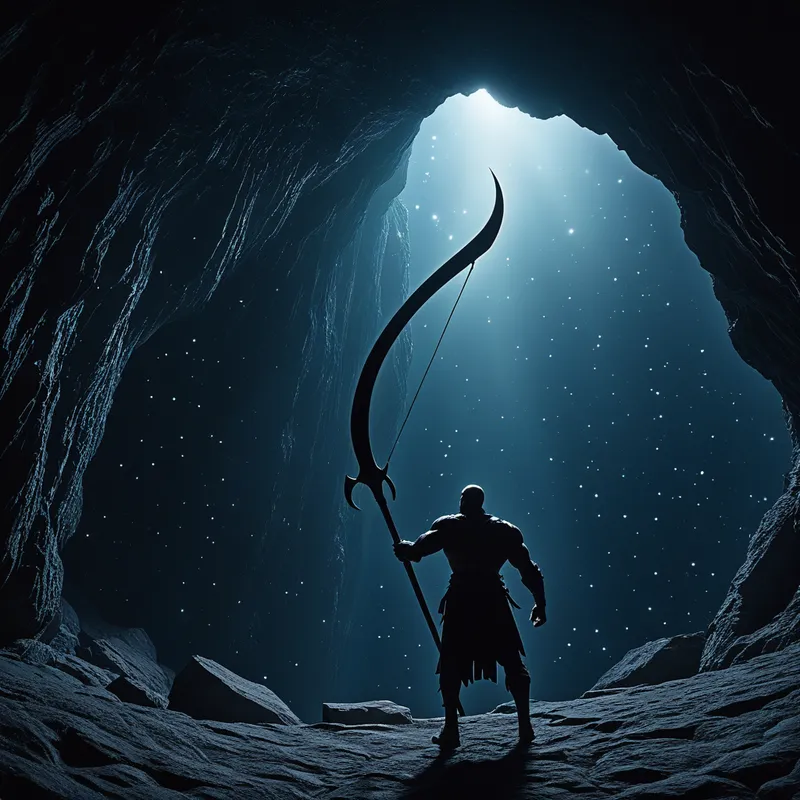
Her love for Ouranos curdled into a pain as vast as her form. In the deep dark, she forged a plan of grim necessity. From her hardest flint, she fashioned a great, jagged sickle, its edge sharp enough to shear the fabric of night. Then she went to her children, the Titans, still free but cowed by their father’s might.
“Who among you,” she asked, her voice the rumble of continents shifting, “will wield this tool and free your siblings? Who will check your father’s cruel embrace?”
A silence fell, heavy with fear. To raise a hand against the sky itself was unthinkable. Then, from the shadows, Kronos stepped forward. His eyes held a cold, cunning light. “I will do it, Mother. I am not afraid.”
The time came. Ouranos, as was his custom, descended in the deep night to envelop Gaia. It was an act of both creation and suffocation. As he lay upon her, Kronos emerged from his hiding place. With a motion born of pent-up rage and ambition, he swung the adamantine sickle. The blade met not flesh and blood, but the essence of celestial dominion. A terrible, silent severing echoed through the cosmos.
Ouranos recoiled with a roar that shook the stars loose from their moorings. He retreated, wounded and forever separate, to become the distant, eternal sky. From the drops of his essence that fell upon the fertile earth, new life sprang: the vengeful Erinyes, the mighty Gigantes, and the graceful Meliae. The rule of the primordial sky was ended. The age of the Titans had begun, born from an act of intimate betrayal that set the heavens and earth forever apart.
Cultural Origins & Context
This foundational narrative comes to us from the poetic tradition of ancient Greece, most systematically recorded in Hesiod’s Theogony (c. 700 BCE). This was not scripture in a religious sense, but a cosmogonic map—a story explaining how the world, and the hierarchy of divine powers that govern it, came to be. Bards like Hesiod performed these tales, weaving a shared understanding of cosmic order for their audiences.
The myth functioned as a prehistory to the familiar Olympian gods, establishing a pattern of violent succession: power is seized by a younger generation from an older, more oppressive one. It explained why the sky is separate from the earth, and it provided an origin story for various spirits and races that populated the Greek worldview. Crucially, it positioned chaos and tyranny as the original state, with order and justice being hard-won through painful, necessary rebellion.
Symbolic Architecture
The myth of Ouranos is a profound allegory of the psyche’s own foundational drama. Ouranos represents the original, undifferentiated state of consciousness—a totality that is both creative and stifling. He is the uroboric father, the circle that contains everything but allows for no differentiation, no growth.
The sky that smothers is not a protector but a prison. True creation requires separation, a space for the child to breathe.
Gaia is the embodied, material reality and the deep, instinctual unconscious. She is the matrix of all potential. Her children, especially the monstrous Hecatoncheires and Cyclopes, symbolize the raw, chaotic, and immensely powerful psychic contents—the instincts, talents, and primal energies that the ruling consciousness (Ouranos) finds too threatening to acknowledge. To repress them is to bury them in the dungeon of the personal shadow.
Kronos, the rebel son, embodies the necessary but flawed principle of differentiation. His act is not one of noble heroism, but of cunning and ambition. It is the psyche’s first, violent act of self-definition: cutting away the overwhelming, enveloping influence of the primordial parent to claim a space for the emerging ego. The castration is symbolic of severing an unhealthy, enmeshed connection, allowing for distinction and the birth of individual will.
The Dreamer's Resonance
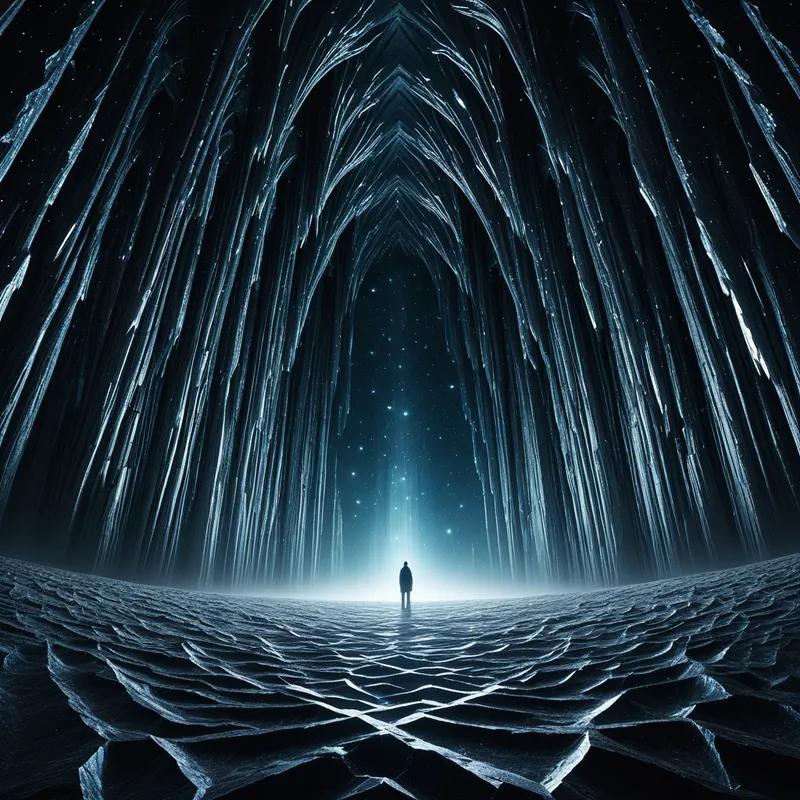
When this mythic pattern stirs in the modern dreamer, it often manifests as somatic pressure and claustrophobic imagery. One may dream of a ceiling that is impossibly low and getting lower, of a domed sky pressing down, or of being trapped in a small, dark space by a powerful, indifferent presence. These are the dreams of the repressed Hecatoncheires—the hundred-handed potentials within us that are being stifled.
The psychological process is one of confronting a tyrannical inner authority or a suffocating life structure. This could be an internalized critical parent, a rigid belief system, or a life path that feels imposed rather than chosen. The dreamer is experiencing the "groaning of Gaia"—the deep, instinctual self protesting its imprisonment. The rising emotion is not just fear, but a gathering, righteous rage that seeks a "sickle": a precise, decisive tool or insight to cut the binding tie.
Alchemical Translation
The alchemical journey modeled here is the prima separatio—the first and most crucial separation. For individuation to begin, the psyche must differentiate itself from the unconscious matrix. Ouranos’s embrace is the state of being unconsciously identified with one’s origins, family patterns, or collective norms. It feels like totality, but it is a totality that prevents growth.
The castration of Ouranos is not an act of destruction, but of sacred severance. It creates the space where consciousness can stand and look upon the vastness of its own origins.
The modern individual undergoes this transmutation when they consciously choose to separate from a dominating influence, internal or external. It is a painful, often guilt-laden process (symbolized by the vengeful Erinyes born from the act). One "kills" the internalized tyrant not to become a tyrant in turn (as Kronos would), but to free the imprisoned potentials—the creative Cyclopes and the capable Hecatoncheires—within one’s own soul. The liberated sky becomes the space of conscious perspective, no longer smothering but vast and inspiring. The earth becomes the grounded realm of potential from which one can now consciously build, having established the necessary and sacred distance between the self and the source. This is the painful, essential birth of psychological sovereignty.
Associated Symbols
Explore related symbols from the CaleaDream lexicon: