
Adam in Eden Myth Meaning & Symbolism
The story of humanity's primordial awakening, a fall from unconscious unity into the painful, necessary world of self-awareness and moral choice.
The Tale of Adam in Eden
In the beginning, before memory, there was a breath in the dark. From the formless void, a voice spoke, and light shattered the deep. And from the good earth, watered by a mist that rose from the ground, Yahweh shaped a man. He breathed into his nostrils the breath of life, and the man became a living being.
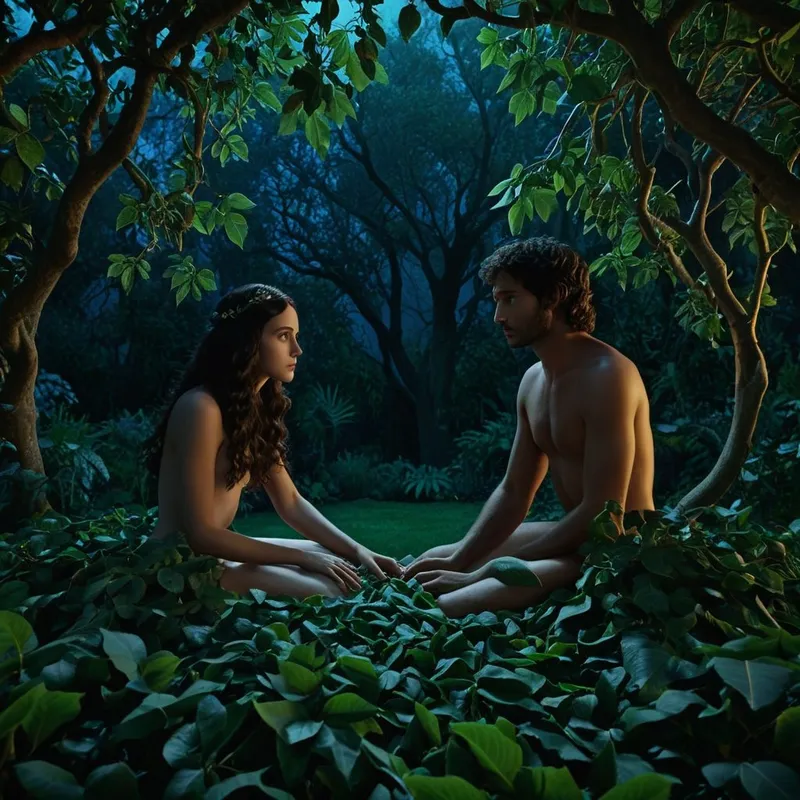
He was placed in a garden—Eden—a sanctuary eastward, where every tree that was pleasant to the sight and good for food sprang from the ground. A river flowed from it to water the garden, parting into four heads to water the whole earth. The man, Adam, was given a sacred task: to tend and keep this paradise. And Yahweh spoke a solitary prohibition: “You may surely eat of every tree of the garden, but of the tree of the knowledge of good and evil you shall not eat, for in the day that you eat of it you shall surely die.”
Yet Adam was alone. So, from his very side, as he slept a deep sleep, Yahweh fashioned a companion. Bone of his bones, flesh of his flesh. She was Eve, the mother of all living. They were both naked, the man and his woman, and they felt no shame. They dwelt in a state of pure being, walking in the garden in the cool of the day, known by their maker.
But in the garden was also a creature, more crafty than any other beast of the field. The serpent came to the woman and whispered a question that hung in the air like forbidden fruit: “Did God actually say, ‘You shall not eat of any tree in the garden’?” The woman corrected the serpent, repeating the command. But the serpent hissed the great seduction: “You will not surely die. For God knows that when you eat of it your eyes will be opened, and you will be like God, knowing good and evil.”
The woman looked at the tree. She saw that it was good for food, a delight to the eyes, and was to be desired to make one wise. She took of its fruit and ate. She gave some to her man, who was with her, and he ate. In that moment, their eyes were opened. The first knowledge they gained was of their own nakedness. They felt exposed, vulnerable, separate. They sewed fig leaves together and made loincloths.
Then they heard the sound of Yahweh walking in the garden. A terror, new and cold, seized them. They hid themselves among the trees. The voice called out, “Where are you?” Adam answered, “I heard the sound of you in the garden, and I was afraid, because I was naked, and I hid.” The questions unfolded the deed. The man blamed the woman. The woman blamed the serpent.
And so, curses were spoken—not mere punishments, but the hard truths of a fractured world now born. The ground was cursed because of Adam; in toil he would eat of it all the days of his life. In pain Eve would bring forth children. And to the serpent, enmity was decreed.
Finally, Yahweh said, “Behold, the man has become like one of us, knowing good and evil. Now, lest he reach out his hand and take also of the tree of life and eat, and live forever…” Therefore, Yahweh sent him out from the garden of Eden to work the ground from which he was taken. He drove out the man, and at the east of the garden of Eden he placed the cherubim and a flaming sword that turned every way to guard the way to the tree of life.
And the gates closed behind them. The first exile had begun.
Cultural Origins & Context
This foundational narrative is found in the opening chapters of Genesis. It is part of the Torah, the core of Israelite law and identity. Its origins are complex, woven from ancient Near Eastern oral traditions, likely refined during the Babylonian Exile (6th century BCE) as a people sought to define their origins and relationship with their god against a backdrop of displacement and foreign mythologies.
It was not a story told for mere historical record, but a theological and etiological compass. It answered profound communal questions: Why do we labor? Why do women suffer in childbirth? Why is there enmity in nature? Why are we here, outside paradise? It established a covenant framework—humanity in relationship with a sovereign, personal deity, a relationship defined by law, transgression, consequence, and yet, lingering grace (the provision of clothing, the prevention of eternal life in a fallen state). It served as the prelude to the entire biblical drama of redemption, setting the stage for the problem that the rest of the scripture seeks to address.
Symbolic Architecture
The myth of Adam in Eden is not a historical report but a symbolic map of the birth of human consciousness. Every element is a psychic reality.
The Garden represents the original, unconscious unity of the psyche—a state of undifferentiated wholeness with the Self (symbolized by Yahweh) and the world. It is the womb of being, where instinct reigns and there is no separation between subject and object.
The Fall is not a moral catastrophe, but the necessary trauma of becoming conscious. One cannot know the self without first losing it.
Adam is the nascent ego, formed from the earth (the unconscious, the body) and animated by the divine breath (spirit). Eve, drawn from his side, symbolizes the relatedness of the ego—the soul, or the anima, that which connects the ego to the deeper layers of the psyche. The serpent is the catalyst of transformation, the trickster archetype that forces development. It is instinct itself, rising from the dust, demanding recognition and integration.
The Tree of the Knowledge of Good and Evil is the symbol of reflective consciousness, of duality. To eat its fruit is to acquire the capacity for moral judgment, self-reflection, and with it, shame, guilt, and the awareness of death—the price of self-knowledge. The Tree of Life represents the temptation to remain in that unconscious unity forever, a state of psychic stagnation.
The Flaming Sword is the painful, necessary boundary that protects the psyche from regression. It ensures the journey forward, into the difficult world of time, history, and individual responsibility.
The Dreamer's Resonance
When this myth stirs in modern dreams, it signals a profound threshold in the dreamer’s psychological life. Dreaming of a pristine, enclosed garden may point to a feeling of being in a protective but limiting state of innocence or naivety—perhaps in a relationship, career, or one’s self-view. A dream of eating a forbidden fruit often coincides with the acquisition of painful but crucial knowledge that shatters a previous worldview, leading to a “fall” from grace (a job loss, the end of a relationship, a personal failure seen in a new light).
Dreams of being naked and ashamed directly mirror Adam and Eve’s first experience of self-consciousness. This somatic feeling of exposure indicates the ego feeling vulnerable, seen for what it truly is, stripped of its persona. A dream of a wise or threatening serpent can represent the emergence of instinctual wisdom or transformative energy from the depths of the unconscious, challenging the dreamer’s conscious attitudes. Finally, to dream of being expelled from a beautiful place, or standing before a guarded gate, often manifests during life transitions—graduations, divorces, moves—where one must leave a familiar “Eden” for an unknown future.

Alchemical Translation
The alchemical process mirrored in this myth is the Nigredo, the blackening, the first necessary stage of Individuation. The goal is not to return to the Garden, but to integrate its loss into a conscious, mature selfhood.
The exile from Eden is the commencement of the heroic journey of the soul. Paradise is not behind us, but ahead—forged in the crucible of conscious experience.
The initial state (Unus Mundus) is the unconscious unity of Eden. The Separatio is catalyzed by the serpent—the stirring of curiosity, desire, and the shadow. Eating the fruit is the Solutio, the dissolution of the old, naive self. The shame and hiding represent the Nigredo—the despair, confusion, and “dark night of the soul” that follows the awakening to one’s own complexity and fault.
The work of the myth, and of the individual, begins with the exile. The toil of Adam tilling the cursed ground is the lifelong work of consciousness: to cultivate the difficult, resistant material of one’s own nature (the “cursed ground” of personal history, trauma, and shadow). The pain of Eve is the creative labor of bringing something new—insights, relationships, works—into being from the depths of the psyche.
The cherubim and flaming sword are not merely guards, but symbols of the transformed attitude required. They represent the fierce protection of one’s hard-won consciousness against the regressive pull to blame, to seek simplistic innocence, or to flee from moral complexity. The true “Promised Land” is not a return to a childlike garden, but the achievement of a conscious, responsible relationship with the divine, the self, and the world—a paradise earned, not given. In this light, the Fall is the Felix Culpa, the “fortunate fault,” that made the journey of the soul not only possible, but necessary.
Associated Symbols
Explore related symbols from the CaleaDream lexicon: