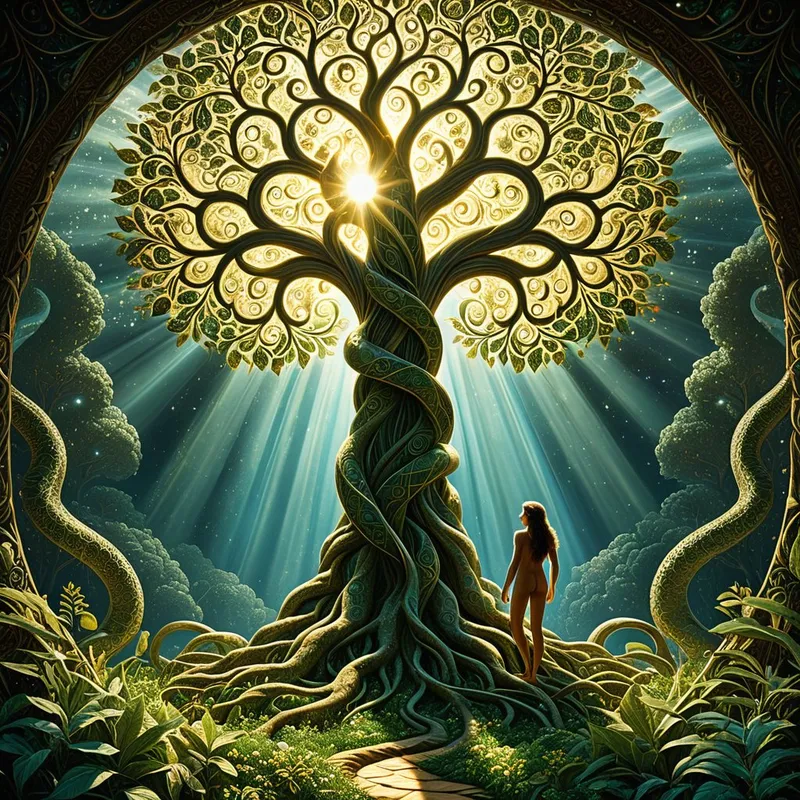
Garden of Eden Myth Meaning & Symbolism
A foundational myth of humanity's awakening from unconscious unity into the painful, necessary dawn of self-awareness and moral consciousness.
The Tale of Garden of Eden
In the beginning, before time had a name, there was a mist rising from the earth. And from that mist, the divine breath moved. It sculpted dust into form, and the form was a man, Adam, asleep upon the virgin soil. He awoke not to an empty world, but to a garden. Not a garden as we know it, but the Garden—a place where every color was deeper, every scent a symphony, every fruit a promise of eternal sustenance. Rivers of honey and milk were but metaphors for the sheer, overflowing abundance that pulsed from the very ground. Here, Adam walked in a state of profound unity, naming the creatures not to claim them, but to know them, as a child knows its own breath.
Yet, in the midst of this perfection, a loneliness bloomed—a quiet, echoing chamber in the heart. And so, a deep sleep fell upon the man, a sleep not of death, but of creation. From the substance of his own side, from the clay near his beating heart, a new being was drawn forth: Eve. Bone of his bone, flesh of his flesh. They stood together, naked, and felt no shame, for their eyes saw only wholeness, their souls knowing no separation from each other or from the lush world around them.
But the garden held a center, and at the center stood two trees. The Tree of Life, thrumming with the essence of eternity. And the Tree of the Knowledge of Good and Evil. Of this second tree, a single command had been given, clear as crystal: "You shall not eat of it, for in the day that you eat of it, you shall surely die." It was the one note of discord in the harmony, the single locked door in an endless palace of open halls.
Then came the voice, smooth as oil, clever as shadow. It did not come from the sky, but from the earth, from a creature more subtle than any other. The serpent coiled upon the root of the forbidden tree, and its question hung in the perfumed air like a new kind of fruit. "Did God actually say...?" It spoke not of tyranny, but of potential, of a hidden greatness being withheld. "You will not surely die. For God knows that when you eat of it, your eyes will be opened, and you will be like God, knowing good and evil."
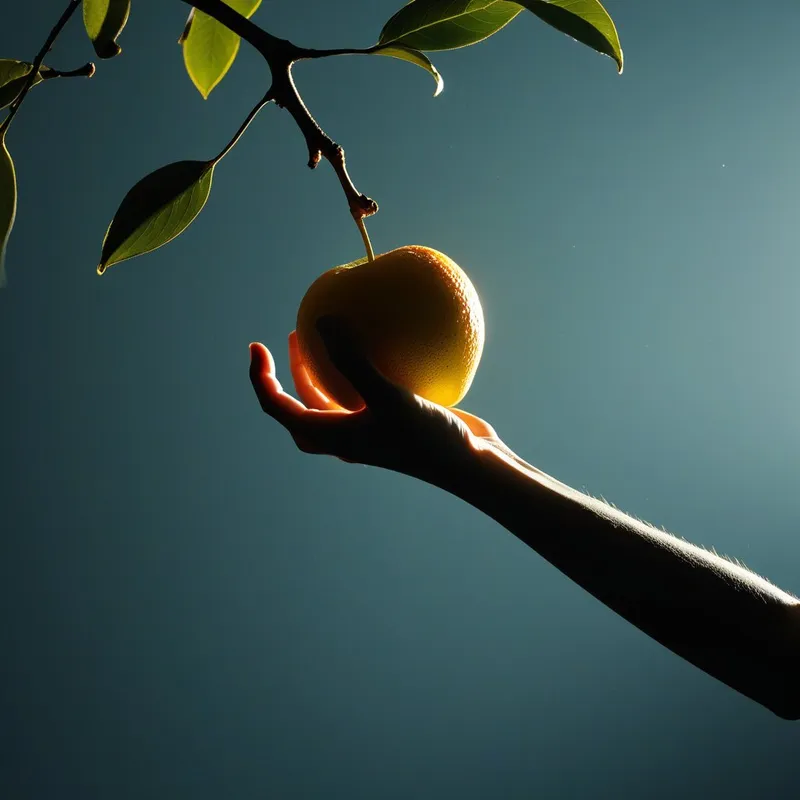
The woman looked at the tree. She saw that its fruit was good for food, a delight to the eyes, and desirable to make one wise. The desire was not base greed; it was a yearning for the fullness of knowing, a pull toward a horizon of consciousness she could not yet see. She took. She ate. And she gave to her man, who was with her, and he ate.
In that moment, the world fractured. The symphony of the garden fell silent. Their eyes were opened, and they knew they were naked. The knowledge was not intellectual; it was a visceral, shocking awareness of separation—self from other, self from world, self from God. They heard the sound of the divine presence walking in the garden in the cool of the day, and for the first time, they hid, sewing fig leaves into crude aprons, their hands fumbling with shame.
Called forth from their hiding, the truth tumbled out in a cascade of blame—the man to the woman, the woman to the serpent. And the voice that had spoken creation now spoke consequence. To the serpent, a curse of enmity. To the woman, pain in creation and a turning toward her husband. To the man, a life of toil, wrestling with a cursed ground that would yield thorns and thistles. "For you are dust," the voice intoned, "and to dust you shall return."
But before the exile, an act of mercy, woven into the judgment. The divine hand made for them garments of skins, covering their nakedness not with leaves, but with the hide of another life given. Then, they were sent out, east of Eden, and a flaming sword was placed, turning every way, to guard the way to the Tree of Life. The gates closed behind them. They stepped into the world of history, of sweat, of birth, of death—the world we have always known.
Cultural Origins & Context
This foundational narrative is found in the Book of Genesis, the first book of the Hebrew Torah and the Christian Old Testament. Its origins are layered, drawing from ancient Near Eastern oral traditions, likely refined during the Babylonian Exile (6th century BCE) as a people sought to define their identity and relationship with the divine against a backdrop of displacement and foreign mythologies. Unlike the enuma elish of Babylon or the epic cycles of Canaan, the Genesis account is starkly monotheistic and profoundly psychological. It was not merely an etiological story explaining why snakes crawl or why childbirth is painful; it served as the ontological bedrock for understanding the human condition—why we labor, why we yearn, why we feel separated from a state of grace, and why we wear the heavy mantle of moral choice. It was told not to glorify kings or gods of war, but to answer the deepest questions of a covenantal people about the nature of sin, responsibility, and the fraught gift of free will.
Symbolic Architecture
The Garden is not a historical place, but a psychic state: the unconscious unity of infancy, the pre-conscious paradise where the self and the world are one. It represents the uroboric state of wholeness before the dawn of ego.
The Tree of Knowledge is the archetype of consciousness itself. To eat its fruit is not to commit a crime of appetite, but to undergo the irreversible trauma of awakening.
The serpent is perhaps the most complex symbol. It is not a cartoon devil, but the embodiment of the catalyzing principle, the trickster archetype that disrupts stasis to force evolution. It represents the necessary, if painful, instinct toward differentiation, the voice of questioning that ends innocence but begins the journey of the soul. The "Fall" is thus a felix culpa—a "fortunate fall"—for without it, humanity would remain in eternal, unconscious infancy, never knowing itself, never creating, never loving with the full awareness of loss.
The garments of skins signify the birth of the persona—the protective, social skin we must wear to navigate the world after the loss of primal innocence. The flaming sword guarding Eden is the barrier of memory and time; we can never regress to unconsciousness once consciousness has been achieved. The exile is into the realm of time, history, and the arduous work of becoming.

The Dreamer's Resonance
When this myth stirs in modern dreams, it signals a profound threshold in the psyche. Dreaming of a lost, idyllic garden often arises during times of naive idealism being shattered—the end of a first love, disillusionment with a job or belief system, the painful acquisition of a difficult truth. It is the somatic memory of paradise lost.
Dreaming of the forbidden fruit manifests as a tantalizing, often dangerous-secret knowledge or opportunity that promises empowerment at the cost of current stability. The serpent in a dream is frequently the dreamer's own shadow, their repressed curiosity, cunning, or transformative energy, appearing to guide (or tempt) them toward a necessary but frightening expansion of awareness. The feeling upon waking is often one of profound ambivalence: grief mixed with a strange sense of inevitability. The psyche is processing its own exile from a simpler state and its forced march into a more complex, responsible, and conscious mode of being.

Alchemical Translation
The alchemical journey begins not in lead, but in a state of prima materia—undifferentiated, pure potential. This is Eden. The process of individuation, of becoming a conscious, integrated Self, requires the separatio. The serpent is the alchemical mercurius, the volatile spirit that dissolves the old unity. Eating the fruit is the nigredo, the blackening, the first painful stage where the naive "innocent" archetype is broken down by the influx of shadow material (knowledge of good and evil).
The exile from the garden is the necessary mortificatio—the death of the child-self that lived in unconscious fusion with the parent-world. It is the beginning of the great work.
Our life in the "world east of Eden," with its toil and suffering, is the long, slow process of the albedo (whitening) and rubedo (reddening). We work the cursed ground of our own psyche, cultivating it through reflection, integrating our shadows (the knowledge we gained), and slowly, through conscious labor, building a new, earned wholeness that is not a regression to innocence, but a hard-won synthesis. The flaming sword ensures we cannot go back; we can only go forward, carrying the memory of the garden not as a lost home, but as the North Star of a wholeness we must now consciously create. The goal is not to return to the Garden, but to become, through the conscious embrace of our exile and labor, the gardeners of our own soul.
Associated Symbols
Explore related symbols from the CaleaDream lexicon: