The Alchemy of Hope: The Psyche's Blueprint for a Future Self
The Somatic Echo
Before it is a thought, hope is a physical sensation. It is not the giddy flutter of anticipation, but something quieter, deeper, and more structural. It begins as a subtle, almost imperceptible tension—a faint pull in the solar plexus, a gentle pressure behind the sternum, as if a seed is swelling against the confines of a long-frozen soil. The breath catches, not in fear, but on the threshold of a new rhythm. There is a warmth that spreads not from the outside in, but from some hidden, internal core, a low-grade fever of potential. The body knows it first: a loosening in the jaw you hadn't realized was clenched, a softening in the shoulders that have borne a familiar weight. This is the somatic echo of hope—the body’s intelligence registering a shift in the internal pressure system, a tectonic plate of the psyche beginning its slow, monumental grind. It is the feeling of a door you didn't know was there, whispering on its hinges.
The Dreamer's Log
The dreamer stands on a cracked, endless highway at night, under a single, buzzing streetlamp. The world beyond the cone of orange light is absolute blackness. They look down into a rain-filled pothole at their feet and see, perfectly reflected in the murky water, the brilliant, full disk of a moon that is not in the sky above them.
Alchemical Interpretation: The psyche, stranded in the harsh, artificial light of conscious despair, discovers an intact, celestial truth reflected in the very depths of its perceived ruin.

The False Lead
Hope is not the denial of gravity. It is not a saccharine optimism that paints over cracks with bright colors, nor is it a passive waiting for external rescue—the lottery win, the sudden pardon, the deus ex machina. To mistake hope for these is to confuse the blueprint with the wishful doodle in the margin. The false hope is a ghost that promises an end to pressure; true hope is the recognition of pressure as the necessary condition for transformation. It is not the absence of despair, but its alchemical partner. Hope is what remains when naive optimism has been incinerated in the facts of your life, and from that ash, a new, more resilient structure insists on forming.
Psychological Architecture
The architecture of hope is built in the shadowlands, in the parts of the self we have exiled as too broken, too naive, or too painful to bear. In the language of Internal Family Systems, it is often the voice of an exiled Innocent part—not the childish part that demands comfort, but the essential, core self that remembers wholeness before fracture. This part does not speak in words, but in somatic echoes and symbolic images. The work is to sit in the council of your own psyche, to hear out the cynical Orphan who catalogues every betrayal, the weary Caregiver who insists on managing despair, and the Shadow Sage who judges all longing as foolish. Hope emerges not by silencing these voices, but by acknowledging their truth. It is the individuation process in microcosm: the conscious ego, humbled by circumstance, must descend to meet this exiled innocence, not to become childlike again, but to retrieve the foundational memory of possibility. This is the shadow work: to hold the absolute truth of your limitation in one hand, and the inexplicable, somatic pull of potential in the other, without letting either cancel the other out.
Mythic Resonance
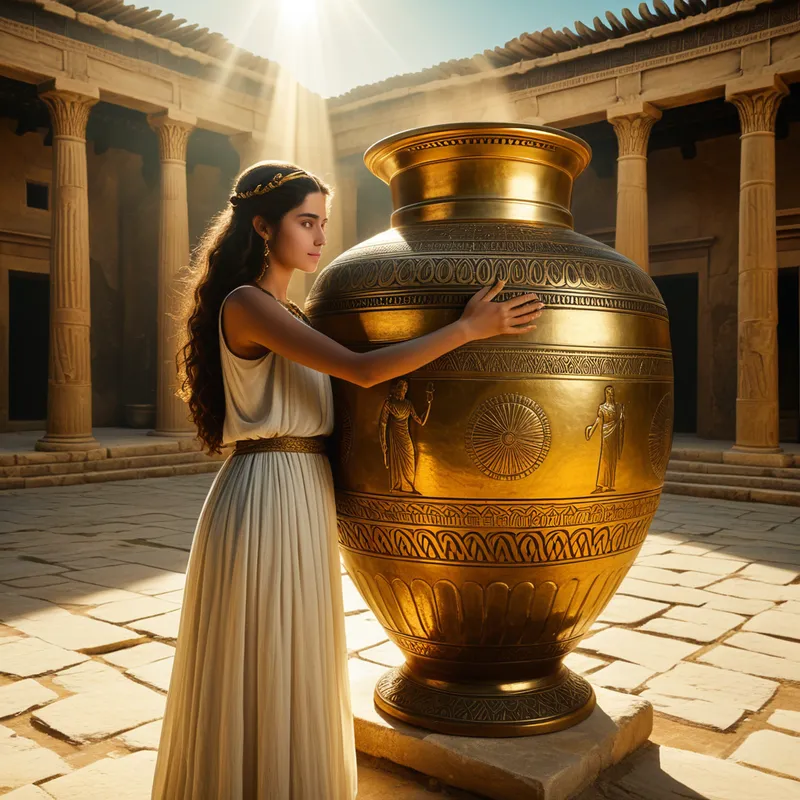
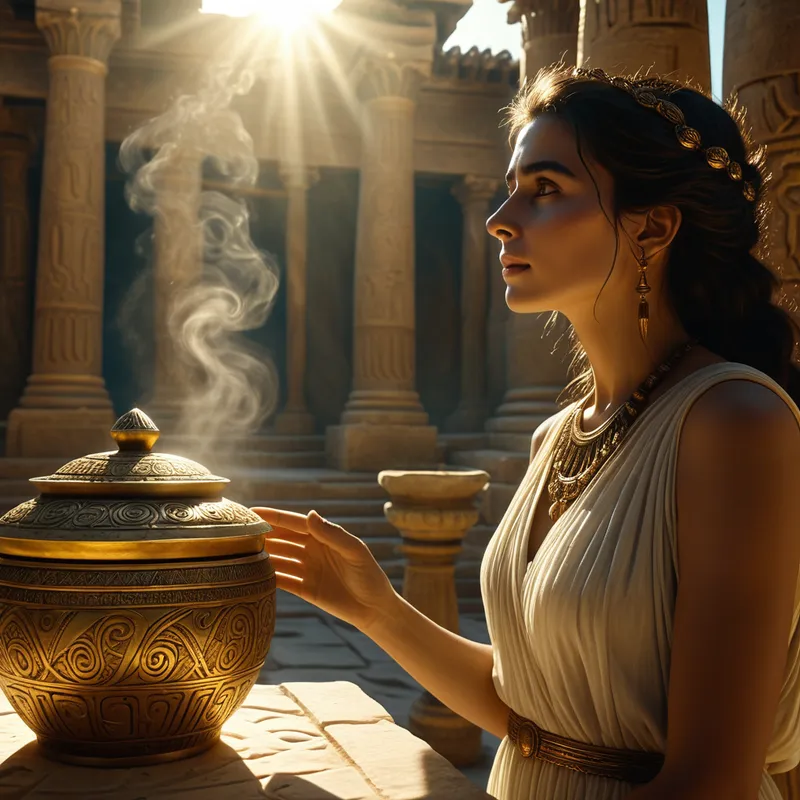
Consider Pandora. The myth is often flattened to a cautionary tale about curiosity. But look deeper. After all the plagues and sorrows have escaped the jar, one thing remains inside: Elpis—Hope. Is it a final curse, a cruel delusion left to torment humanity? Or is it the ultimate, necessary gift? In the alchemical view, Hope is what remains when every other illusion has been dispelled. It is the final, irreducible substance. Similarly, in the Norse myths, after the cataclysm of Ragnarök, the world tree Yggdrasil, though scorched and shaken, remains. From its surviving branches, a new world is born. Hope is not the prevention of the fire; it is the green shoot found in the charcoal, the latent pattern within the seed that survives the burning. It is the firmware that persists after the system crash, containing the code for reboot.
Symbolic Nodes
- A Single, Distant Light in profound darkness (a star, a lighthouse, a candle in a window).
- Intact Reflections in broken surfaces (a whole face in a shattered mirror, a clear sky in a muddy puddle).
- Seeds, Bulbs, or Eggs presented in barren or wintery landscapes.
- A Forgotten or Hidden Room discovered in a well-known house.
- A Bridge appearing over a previously uncrossable chasm.
- Receiving a Simple, Potent Gift (a key, a glass of water, an unmarked seed) from an unexpected source.
- The Sound of a Child Laughing from an unseen location.
Archetypal Resonance
The energy of hope resonates most powerfully with The Magician Archetype. Not the stage illusionist, but the deep, archetypal Magician who understands the fundamental principles of reality and works to transform vision into substance. Hope is the first, essential act of magic: the perception of a latent pattern within chaos, the unwavering vision of a future state that does not yet exist in the material world. Its somatic echo—that internal warmth and pull—is the Magician’s power gathering, the prima materia of the soul beginning to stir. The alchemical potential of hope lies in this archetype's core function: transmutation. The Magician does not deny the leaden weight of current despair; instead, it holds the visionary template of gold within that very weight, applying the heat of attention and the pressure of meaning until a fundamental change of state occurs.
The Alchemical Process
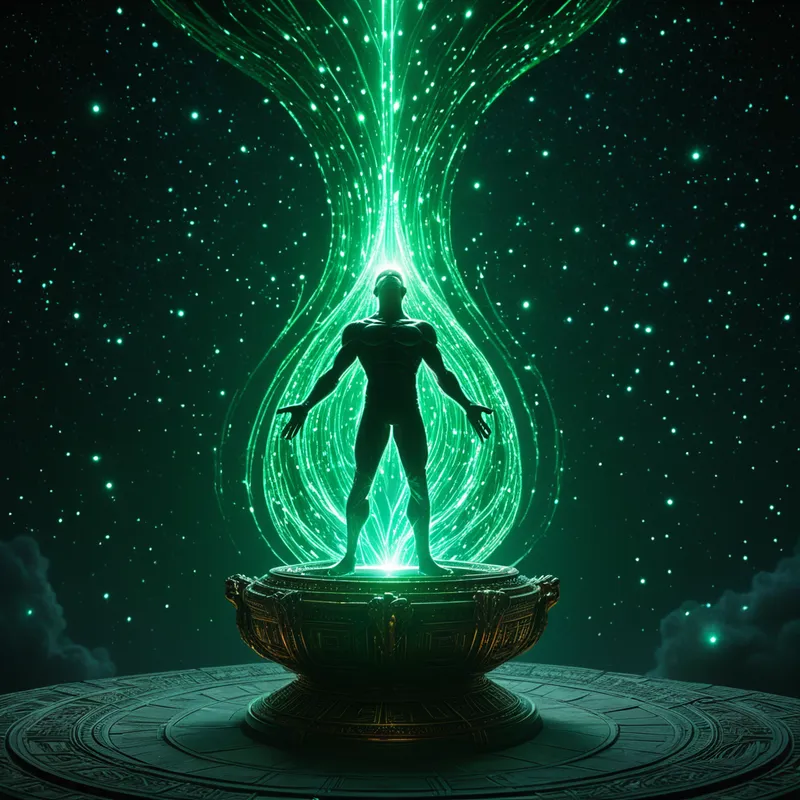
The alchemy of hope is the Transmutation of the Known into the Possible. The prima materia is the dense, leaden certainty of your present limitation—"This is all there is. I am only this. It will always be this way." The alchemical vessel is the human body-mind, capable of holding unbearable tension. The required heat is not comfort, but its opposite: the sustained, courageous act of staying present to the full reality of your pain, without resorting to the old narratives of finality. This is the nigredo, the blackening. The pressure is the simultaneous, defiant act of listening for the somatic echo, of giving attention to the symbolic node from the dream. This is the tension of opposites: absolute acceptance of what is, and a subtle fidelity to what might be. In this crucible, the lead of despair does not vanish; it is reconfigured. Its atomic structure changes. It becomes the foundational substrate for a new vision. The hope that emerges is not a feeling, but a faculty—a sovereign ability to perceive and participate in the patterns of becoming, rather than being enslaved by the patterns of the past.
The Integration Protocol
Question 1: Where in my body do I feel the "no"— the contraction, the numbness, or the heavy certainty about my situation? Can I describe its exact texture, temperature, and weight?
Question 2: What is the smallest, most concrete image or memory that carries a feeling of intactness or possibility for me, even if it seems irrelevant? (e.g., the way light falls through a certain window, the smell of rain on dry soil, a line from a forgotten poem).
Question 3: If the hopeful sensation in my body had a voice, what one sentence would it whisper about the next step? Not the grand plan, but the immediate, physical next step.
Action 1 (Somatic Anchoring): For one minute, place your hand over the area of your body where you feel the somatic echo of hope or its absence. Breathe into that space. Do not try to change the sensation; simply give it the dignity of your full, neutral attention. This grounds the process in the physical vessel.
Action 2 (Symbolic Reclamation): Create a simple, private altar or dedicated space. Place upon it a single object that corresponds to a "symbolic node" from your dreams or your answer to Question 2. This is not about belief, but about externalizing the internal image, giving the Magician within you a focal point for its work.
Action 3 (Unstructured Mapping): With a large piece of paper and drawing tools, make a map of your inner landscape. Let one area represent the "Known Country" of your current reality. Without planning, allow your hand to sketch the features of the "Uncharted Territory" that pulls at you. Use colors, shapes, and abstract lines—not words. This creative act bypasses the inner critic and allows the blueprint of hope to express itself visually.
Final Validation
To feel the ache of hope is often more terrifying than to settle into despair. Despair has a familiar architecture; it is a house you know, however cold. Hope asks you to step into the unknown, to trust a sensation over a fact, to become a builder on unsteady ground. This difficulty is not a sign you are doing it wrong; it is the measure of the transformation at hand. The very tension that feels like breaking is the pressure required for rebirth. You are not being led out of the dark by a blinding light, but learning to see by the faint, sovereign glow of the pattern you carry within. The hope was always there, not as a promise of rescue, but as the latent code for your own becoming. Your task is not to find it, but to finally, courageously, agree to translate it.