
Pandora's Jar Myth Meaning & Symbolism
The first woman, Pandora, opens a forbidden jar, releasing all evils into the world but trapping hope inside, a profound allegory for the human condition.
The Tale of Pandora's Jar
In the beginning, after the great war of the gods, the world was a place for men alone. They walked the earth, free from toil and sickness, living in a kind of golden dream. But they had angered the great Zeus. For Prometheus, champion of mortals, had dared to steal the sacred fire from Hephaestus's hearth and deliver it to the clay-formed humans below.
Zeus’s wrath was a cold, plotting thing. He would not strike with a thunderbolt, but with a creation. He summoned the smith-god Hephaestus. "Mix water and earth," he commanded, "and fashion a being with the likeness of the immortal goddesses, but make it mortal. Give it a voice and strength, and the face of a deathless beauty."
And so Hephaestus labored. From the clay of the earth, he shaped the first woman. Aphrodite breathed upon her, granting her grace and desire that could unravel the hearts of men. Athena clothed her in a shimmering silvery gown and taught her the arts of weaving. Hermes, the sly one, was given a final task by Zeus: "Place in her a dog-like mind and a deceitful nature. Make her curious beyond all reason."
They named her Pandora, for all the Olympians had given her a gift. She was brought before Epimetheus, whose name means "afterthought." Though his brother Prometheus had warned him to accept no gift from Zeus, Epimetheus was lost the moment he saw her. Pandora was not just a woman; she was a wonder, a walking, breathing mystery.
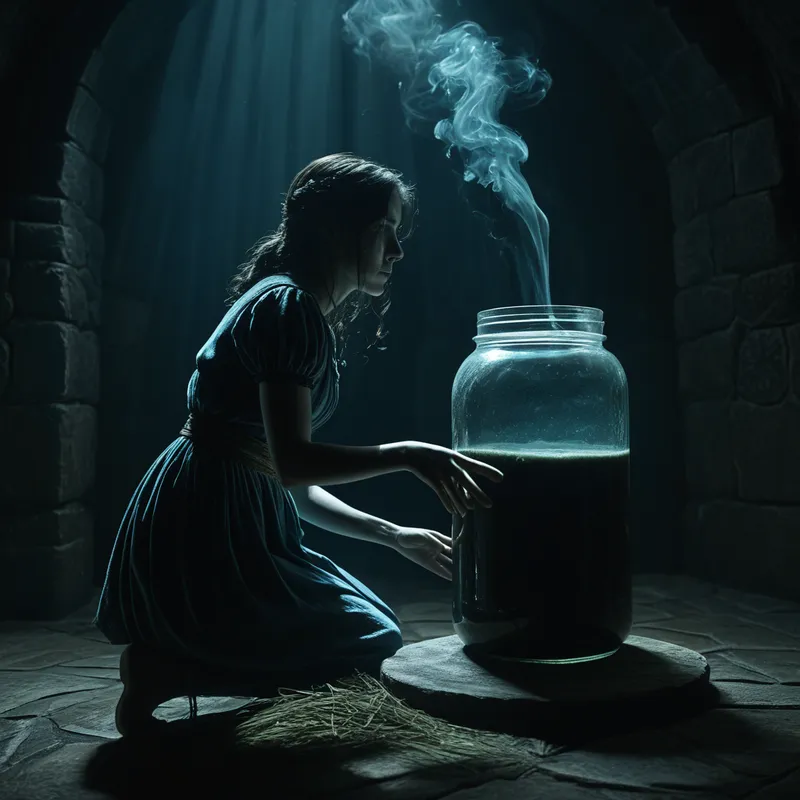
With her, she brought a dowry from the gods: a great pithos. It was not a small trinket, but a massive jar of clay, sealed tight with a heavy lid. "You must never open this," she was told, though the reason was a secret folded within a secret. The jar sat in their home, a silent, imposing presence. It did nothing. It said nothing. Yet its very silence was a whisper. What splendors or treasures might it hold? What divine gift was meant only for them?
Days passed. The jar occupied her thoughts. Its smooth surface seemed to call to her hands. The unknown within it hummed, a vibration felt only in her soul. The command not to open became a kind of torment, a itch in the center of her mind that could not be scratched. One day, the whisper became a shout. Driven by the insatiable curiosity planted within her, Pandora approached the jar. Her hands, almost of their own will, found the heavy lid. With a great effort, she pried it loose and lifted it just a crack.
It was not a treasure that burst forth.
It was a shrieking, formless torrent of darkness—a howling plague of all the spirits that would haunt humanity until the end of days. Ponos, and Lethe, and Limos. Sickness and old age, hatred and envy, and a thousand other miseries, long imprisoned, exploded into the world. They swarmed around her, filling the air with a bitter cold, then streamed out the door to find every corner of the earth.
Terrified, Pandora slammed the lid back down. But it was too late. The evils were free. As she stood trembling in the now-chilled and empty room, a faint, final sound came from within the jar. A soft, fluttering whisper. She lifted the lid once more, just a sliver. And there, trapped beneath the rim, was one last spirit, too gentle to have escaped with the violent rush. This was Elpis. It did not fly away, but remained, a fragile, glowing ember in the bottom of the vast, empty jar. The world was now a place of struggle and sorrow, but it was not, and would never be, entirely without hope.
Cultural Origins & Context
The myth of Pandora is primarily preserved in the epic poetry of Hesiod, in both his Theogony and Works and Days. For the ancient Greeks, this was not merely a story of origin but a foundational etiology—a myth explaining why the world is as it is. It served a crucial societal function, embedding a specific worldview. In the patriarchal structure of ancient Greece, the myth provided a divine rationale for the hardships of life and positioned woman as both a glorious gift and a catastrophic necessity, the vessel through which suffering entered a previously idyllic male existence.
Hesiod, a farmer-poet, used the myth didactically, warning of the dangers of curiosity, disobedience, and the allure of the unknown, especially as embodied by the "beautiful evil" of womankind. The jar itself, a pithos, was a common household object for storing grain, oil, or wine, grounding the cosmic drama in everyday life. The story was passed down orally and through texts as a core piece of cultural instruction, a reminder from a harsher age that the gods’ gifts often come with a hidden, and terrible, price.
Symbolic Architecture
Pandora is not a villain, but an instrument. She symbolizes the awakened human consciousness, endowed with divine gifts (beauty, craft, speech) but also with an intrinsic, often self-wounding, curiosity. She is the embodiment of Epimethean consciousness—acting first, understanding later. The jar represents the unconscious, the sealed repository of all that is unknown, repressed, or potential within the individual and the cosmos.
The jar does not contain evils, but potentialities. What is released depends entirely on the consciousness that opens it.
The "evils" are the necessary shadows of existence: differentiation, limitation, mortality, and consciousness of suffering. They are not external punishments, but the inherent conditions of a conscious, embodied life. Without them, there is no growth, no narrative, no soul.
The most profound symbol is Elpis, trapped within. This is not simple optimism. In its ancient context, Elpis is deeply ambiguous—it can be a sustaining expectation or a delusive fantasy. Its imprisonment suggests that hope is not a force that flits freely in the world, but something that must be consciously sought and contained within the very vessel of our troubles. Hope remains inside the jar, meaning true hope is found only by confronting, and not fleeing from, the reality of the suffering we have unleashed.

The Dreamer's Resonance
When this myth stirs in the modern psyche, it often manifests in dreams of forbidden rooms, sealed containers, or overwhelming curiosity with catastrophic results. The dreamer may find themselves opening a door they were warned against, lifting a lid, or breaking a seal. The somatic experience is one of intense anticipation followed by a flood of dread, awe, or chilling release.
Psychologically, this dream pattern signals a critical encounter with the personal or collective shadow. The "jar" is a life situation, a relationship, a memory, or a part of the self that has been kept tightly sealed. The act of opening is the ego's inevitable, often reluctant, engagement with this repressed content. The "evils" that pour out are the raw, unintegrated emotions, traumas, and complexes that have been bottled up. The dreamer is in the process of what James Hillman called "soul-making"—allowing the painful, difficult material of life to enter awareness, thereby ending its unconscious, autonomous rule over them. The terror of the dream is the birth pang of a broader consciousness.

Alchemical Translation
The alchemical journey modeled by Pandora's myth is the opus contra naturam—the work against one's own naïve nature. It begins with a state of psychic innocence (the pre-Pandoran world), which is inevitably shattered by the catalytic gift (the fire of consciousness, the beautiful complex). The sealed jar represents the prima materia, the unworked, chaotic totality of the self.
The first stage of individuation is not acquiring light, but consenting to the conscious containment of darkness.
Opening the jar is the necessary separatio and mortificatio. The ego, driven by its innate curiosity (the spirit of inquiry, the desire to know the self), unleashes the contents of the unconscious. This is a painful, disorienting dissolution of the old, simplistic identity. The evils—anger, grief, envy, despair—are the nigredo, the blackening, the essential dark night of the soul that precedes any transformation.
The work is not to recapture the evils and re-seal the jar, which is impossible, but to do what Pandora does next: to look back inside. This is the albedo, the whitening. To peer into the now-emptied vessel of one's suffering and discover what remains. Elpis, hope, is the lumen naturae, the light of nature found in the depths. It is the small, enduring sense of meaning, the capacity for anticipation, and the will to continue that is only forged in the crucible of hardship. The integrated individual does not live in a world without suffering, but carries a contained, inner hope—a knowing light within the very jar that once held their darkness. The vessel of the self, once a tomb of potential woes, becomes the crucible for a tempered, hopeful consciousness.
Associated Symbols
Explore related symbols from the CaleaDream lexicon:
- Barrel
- Potential
- Filthy Pot
- Glass Jar of Pickles
- Cascading Hydrocarbon Rain
- Snow Globe
- Ming Dynasty Vase
- Glass Display Case
- Glass Canister
- Silo
- Shattered Vases
- Shattered Dreams
- Cracked Glass
- Emptiness
- Urn of Memories
- Cracked Vase
- Hollowed Stone
- Cracked Clay Pot
- Underwater Acorns
- Seed Jar
- Pottery Shard
- Ceramic Shard
- Cracked Pottery
- Woven Pouch
- Ashen Sky
- Brittle Crack
- Pathogen
- Exposition
- Insufficient
- Junk
- Forgotten Wishes
- Button
- Jar
- Wouldn
- Bundle
- Shattered Vase
- Wooden Crate
- Shattering Glass
- Vase of Promises
- Glass Beaker
- Canvas Tote Bag
- Cedar Chest
- Bread Box
- Seed Storage
- Hollowed Gourd