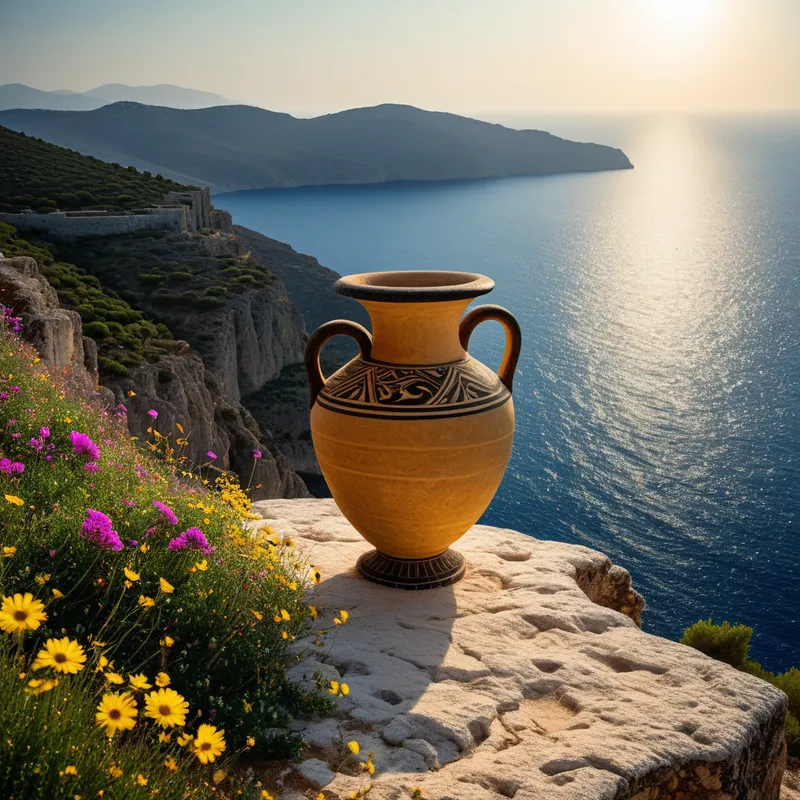
The Cracked Jar Myth Meaning & Symbolism
A tale of a flawed vessel carrying the world's blessings, revealing how our imperfections create the conditions for life's beauty to flourish.
The Tale of The Cracked Jar
Listen, and let the hearth-fire cast its shadows. This is not a story of gleaming heroes or thunderous gods, but of a quiet, forgotten moment when the world’s breath caught in its throat.
In the age of shaping, when the clay of humanity was still damp from the hands of Prometheus, the immortals convened. They wished to bestow upon this new, fragile race a final blessing—a dowry for their life upon the green earth. From the vaults of Olympus, they gathered their gifts: strength, swiftness, cunning, and beauty. They gathered the seeds of all arts and crafts, the spark of music, and the deep, knowing silence of the mountains. Each was a shimmering essence, a liquid light too potent for mortal hands to hold.
So, they commissioned a vessel. Not from the forges of Hephaestus, whose work was flawless and unyielding, but from the humble, yielding earth itself. They fashioned a great jar of simple clay, wide-bellied and sturdy, with a lid to seal the heavens’ bounty within. One by one, the gods poured their gifts into the jar. It glowed from within, a contained dawn, heavy with the promise of a perfected world.
The task of carrying this treasure down to the waiting mortals fell to a being whose name the bards let slip into silence. Some say it was a curious nymph, others a trusted but forgetful spirit. This bearer took the jar and began the long descent from the high, thin air of the gods to the dense, fragrant world below.
But the path was treacherous, a slope of loose scree and thorn. The bearer, perhaps in awe of the burden, perhaps distracted by the first songs of birds below, stumbled. The jar, for all its sacred contents, was still clay. It struck a hidden rock with a sound like a heart breaking. Not a shattering, but a sigh—a fine, hairline fracture spiraled up from its base.
The bearer froze, dread a cold stone in the belly. Peering in terror at the crack, expecting the luminous gifts to come pouring out, to be lost forever in the dust. But nothing flowed. The seal held. The crack was fine, a mere flaw in the otherwise perfect container. Shamefaced, the journey continued, the bearer’s hands now trembling with care.
The jar was delivered to the village square of the first men and women. With great ceremony, the lid was removed. And as the divine effulgence began to pour forth… it happened. From that tiny, almost invisible fissure, the last of the gifts—the one that had settled at the very bottom of the jar—began to leak. It was not strength, nor wisdom, nor skill. It was a lighter, more elusive essence. It was Hope.
While the other gifts filled the world, granting dominion and craft, Hope seeped slowly, quietly, into the very cracks of the earth, into the waiting hollows of the human heart. The vessel was flawed, the delivery imperfect. And from that singular, accidental brokenness, the one gift that would make all the others endurable was set free into the world, not by design, but by a fortunate fault.
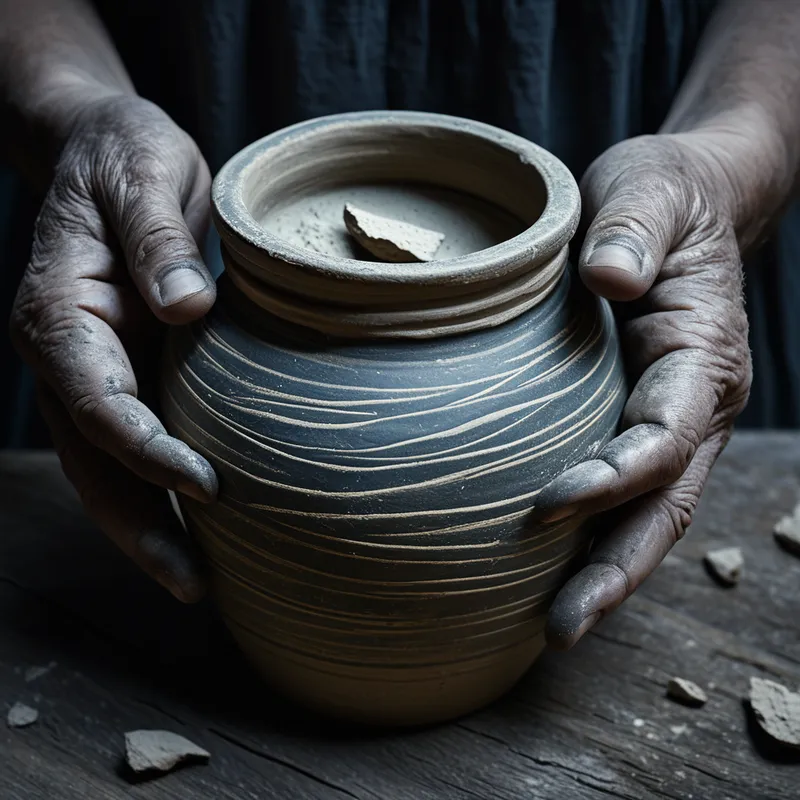
Cultural Origins & Context
This poignant story reaches us not through the grand epics of Homer, but from the later, more philosophical compendium of Pseudo-Apollodorus, and most famously from the fable-collecting hand of Aesop. Its transmission is that of the parable and the moral tale, told not in royal courts but in workshops and around modest hearths. It functions as a ainos, an instructive story for daily living.
In the pragmatic, often harsh world of ancient Greece, where fate (Moira) was inflexible and the gods capricious, this myth served a vital societal function. It was a narrative salve for a culture deeply acquainted with tragedy, plague, war, and personal misfortune. It did not explain cosmic origins like the tales of Chaos or Gaia, but rather addressed the human condition after the gifts of civilization had been received. It asked: "Why, with all our arts and strengths, do we still suffer? And what allows us to continue?" The myth provided an answer that was both humbling and empowering: our very imperfection is the conduit for our most essential strength.
Symbolic Architecture
The myth’s power lies in its stark, elegant symbolism. The jar itself is the vessel of the human psyche, designed to carry the magnificent, often overwhelming potentials bestowed by nature, lineage, and the collective (the "gods"). We are each given a container for our talents, our intelligence, our inherent capacities—the "perfect gifts."
The crack is the inevitable wound. It is the flaw in our inheritance, the childhood trauma, the innate vulnerability, the anxiety, the "not-enoughness" that we spend lifetimes trying to hide, repair, or disown. In a culture and a psyche obsessed with wholeness and perfection, the crack is seen as a catastrophic failure, a leak that will drain us of our vital essence.
The crack is not where we lose ourselves; it is where the world enters us, and where we, in turn, escape our own imprisonment.
But the myth performs a breathtaking reversal. The crack is not a defect that loses the contents; it is the specific aperture that releases the particular content necessary for a fully human life. Hope (Elpis in Greek) is not a naive optimism. In its ancient context, it is the capacity to endure an uncertain future, to plant a crop when storm clouds gather, to love despite knowing loss, to continue the journey without a guarantee of the destination. It is the psychological function that makes all other functions bearable. The myth insists that this crucial quality could only be released through brokenness. Perfection would have kept it sealed away forever.

The Dreamer's Resonance
When this myth stirs in the modern unconscious, it often manifests in dreams of fragile or leaking containers: a cracked phone screen bleeding light, a cup that won’t hold water, a house with a slowly spreading damp stain on the ceiling, or one’s own body as a vessel with a slow leak of energy or light.
These are not dreams of catastrophe, but of subtle, persistent permeability. The dreamer is somatically processing a profound psychological realization: the protective shell of the persona—the "perfect jar" we present to the world—is compromised. This can feel like a crisis of identity, a fear of depletion ("I’m leaking my life force!"). The psyche, through the dream, is beginning to differentiate between the contents of the self (one’s gifts, talents, knowledge) and the structure of the self (the ego-container). It is discovering that the contents are not lost through the crack; rather, something is being exchanged with the outer world. The dream invites the dreamer to stop futilely trying to seal the crack and instead to inquire: "What, precisely, is flowing out? And what is flowing in?"

Alchemical Translation
In the alchemical process of individuation—the journey toward psychological wholeness—this myth models the critical stage of nigredo transforming into albedo. It is the moment when the leaden recognition of one’s flaw, one’s shadow, one’s fundamental "cracked" nature, ceases to be a source of shame and becomes recognized as the vas spiritus, the very crucible of transformation.
The modern individual is tasked with carrying their own jar—their bundle of genetic gifts, cultural conditioning, and personal potential. We are taught to hide the cracks, to present a seamless, "curated" self. The alchemical work this myth proposes is the opposite: to consciously take the jar on the treacherous descent from the ideal (the "mount of the gods") into the reality of embodied, earthly life. We must willingly risk the stumble. We must consent to the fracture.
Individuation is not the repair of the vessel to its original, flawless state. It is the sacred work of learning what unique essence—what personal form of hope, creativity, or compassion—can only emerge through your specific fracture line.
The "hope" that leaks out is the transcendent function, the new, previously non-existent attitude that arises from the conscious confrontation with one’s imperfection. It is the artist’s style born from limitation, the healer’s empathy forged in personal pain, the thinker’s insight crystallized from doubt. Your crack is not an error in your making; it is the signature of your necessity. The myth of the cracked jar ultimately tells us that the soul is not a fortress to be kept sealed, but a vessel made porous by life, designed for a sacred exchange. Our wholeness, therefore, is not a state of perfect integrity, but a dynamic ecology where loss and gift are two names for the same, blessed flow.
Associated Symbols
Explore related symbols from the CaleaDream lexicon: