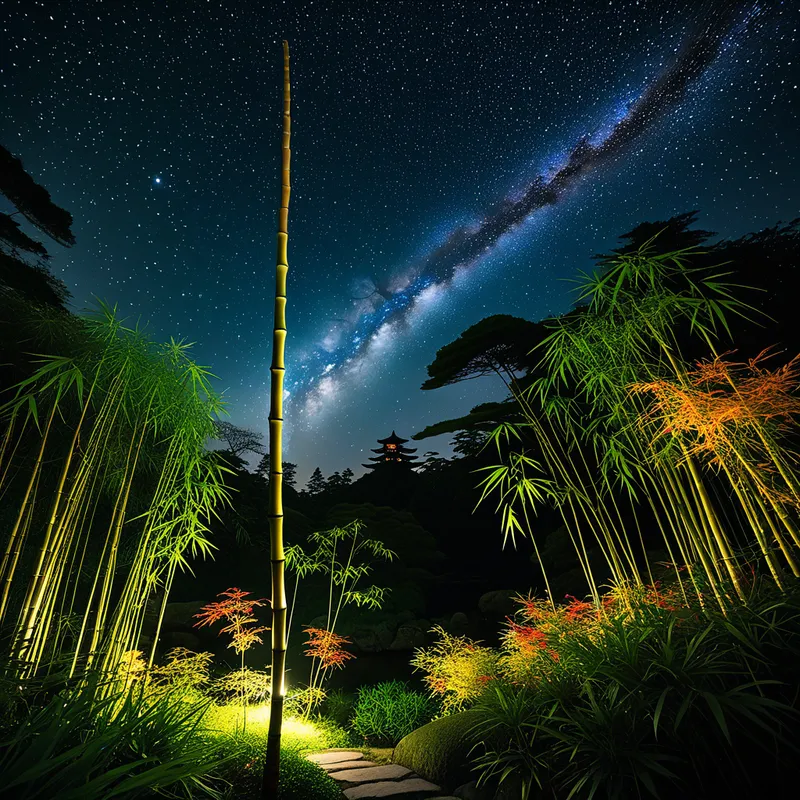
Tanabata Bamboo Myth Meaning & Symbolism
A celestial weaver and a cowherd, separated by the Milky Way, are granted one annual meeting, embodying the ache and hope of star-crossed love.
The Tale of Tanabata Bamboo
Listen, and hear the whisper of the stars. In the high, silent vault of the heavens, where the Ama-no-gawa flows with the cold light of a billion suns, there lived a weaver of unparalleled skill. Her name was Orihime, daughter of the Tentei. Her loom was the cosmos itself, and from it she wove the robes of the gods—tapestries of dawn and dusk, of cloud and constellation. Yet, for all the beauty she created, her own world was one of solitary perfection, a gilded cage of duty and isolation.
Across the starry river, amidst celestial meadows, labored Hikoboshi. His charge was the heavenly oxen, driving them across the fields of night. His life was one of simple, earthy toil, his eyes more often on the dust of the star-paths than on the splendor above. But fate, or perhaps a weary father’s compassion, conspired to cross their paths. When Tentei brought them together, the universe held its breath. In one glance, the weaver and the cowherd saw not their stations, but their souls. Love, swift and brilliant as a shooting star, ignited between them.
Their union was a celestial harmony. But such all-consuming love knows no balance. Orihime’s sacred loom fell silent, its shuttle still. Hikoboshi’s oxen wandered, neglected, across the heavens. The robes of the gods grew threadbare; the order of the sky began to fray. Tentei’s initial joy turned to wrath. The bond that filled their hearts had emptied the world of its function. And so, the king pronounced a terrible decree. With a sweep of his hand, he carved the Ama-no-gawa deeper and wider, a raging torrent of star-light, an impassable barrier between the two lovers. There they stood, on opposite shores, their cries lost in the silent roar of the galaxy.
Yet, even divine wrath can be moved by the depth of true despair. The sound of their endless weeping touched the king’s heart. He granted a mercy, austere and agonizing: one night each year, on the seventh day of the seventh month, they may cross the river and meet. But only if the skies are clear. On that night, a bridge forms—not of stone or wood, but of the gathered wings of ten thousand kasasagi, who take pity on the pair. And so, each year, the people of the earth look up. They see Vega and Altair burning bright, drawing closer across the dark. And when the magpies come, for one fleeting night, the weaver and the cowherd are reunited, their joy a silent testament echoing down through the centuries to any heart that has ever yearned.

Cultural Origins & Context
The tale of Tanabata, meaning "Evening of the Seventh," is a profound example of cultural syncretism in Japan. Its roots stretch back to the Chinese Qixi Festival, a story of the Weaver Girl and the Cowherd, which entered Japan via the Korean peninsula during the Nara Period (710-794 AD). It was initially observed as an elite court ceremony, Kikkōden, where noblewomen prayed for improved skills in weaving and other arts.
Over centuries, the myth woven into the fabric of Japanese folk tradition, merging with local harvest festivals and Shintō purification customs. By the Edo period (1603-1868), it had blossomed into a popular public celebration. The practice of writing wishes on strips of paper (tanzaku) and hanging them on bamboo branches (sasa) became widespread. This bamboo, often set afloat on rivers or burned after the festival, acted as a conduit—a worldly stalk reaching into the celestial realm, carrying human hopes to the attentive stars above. The myth served a societal function beyond romance; it was a communal ritual of aspiration, a moment to articulate personal dreams for skill, love, or health, and to participate, however symbolically, in a cosmic drama of longing and fulfillment.
Symbolic Architecture
At its heart, the Tanabata myth is not merely a love story, but a profound map of the human soul's structure. The Ama-no-gawa is the ultimate symbol of separation—the chasm between self and other, between desire and duty, between the earthly and the spiritual. It represents any fundamental divide that defines our existence.
The river in the sky is the space between who we are and who we love, between our daily toil and our celestial calling.
Orihime embodies the archetype of the anima, the creative, aesthetic, and spiritual principle. She is order, artistry, and the higher longing of the soul. Hikoboshi represents the animus, the active, worldly, and labor-oriented principle. He is instinct, physicality, and grounded endeavor. Their initial separation is the natural state of these inner forces—often disconnected within an individual. Their passionate union symbolizes the ego’s thrilling, yet destabilizing, discovery of its inner counterpart. The subsequent crisis—the neglect of their duties—mirrors the psychological turmoil when one aspect of the psyche consumes all others, throwing the inner kingdom into chaos.
The annual reunion is the myth’s core alchemy. It does not promise a permanent merger, which proved destructive, but a sacred, cyclical meeting. This models the conscious integration of opposites: the creative self and the practical self, the spiritual and the material, meeting in a temporary but renewing synthesis. The bamboo, with its segmented yet unified growth reaching from earth to sky, is the perfect symbol for this process—the resilient structure that allows our wishes (the tanzaku) to be held aloft, visible to both our earthly and celestial natures.
The Dreamer's Resonance
When this myth stirs in the modern unconscious, it often manifests in dreams of profound separation and yearning. You may dream of a loved one visible across a wide, uncrossable river, or of trying to shout a message that cannot be heard over a roaring void. The somatic sensation is one of aching tension in the chest—a literal heartache. The bridge of magpies might appear as a fragile, makeshift structure, or one that dissolves as you step onto it.
Such dreams signal an active confrontation with a fundamental divide in the dreamer’s life. This could be a literal separation from a partner, family, or homeland. More often, it is intrapsychic: a gap between one’s professional life (Hikoboshi’s toil) and creative spirit (Orihime’s loom), or between a current reality and a longed-for future. The dream is not a solution, but an honest depiction of the terrain. The emotional intensity is the psyche’s way of highlighting this rift, demanding attention. It asks: What are the two shores within you? What starry river keeps them apart? The act of writing a tanzaku in the waking world—of articulating a wish—is the first step in building your own psychic bridge.
Alchemical Translation
The individuation process, the journey toward psychic wholeness, is perfectly modeled in the Tanabata drama. We begin in a state of unconscious specialization: identified solely as the Weaver (our spiritual/creative role) or the Cowherd (our practical/social role). The first alchemical stage is Coniunctio—the thrilling, often disruptive, encounter with our inner opposite. This "falling in love" with a disowned part of ourselves is necessary but chaotic; it dismantles the old, rigid order of the psyche.
The wrath of Tentei represents the necessary, painful consequence of this imbalance. It is the reality principle reasserting itself, creating the crisis that forces differentiation. The eternal separation across the Milky Way is the enduring condition of duality within wholeness. The opposites cannot, and should not, permanently fuse, lest the entire system collapse.
The goal is not to live on the bridge, but to learn the sacred ritual of crossing it.
The final, mature alchemy is the establishment of the sacred cycle. One must learn to be the Weaver diligently at her loom for most of the year, and the Cowherd faithfully tending his herd. But one must also honor the appointed time—the conscious, ritualized moment—to let the magpies gather. This is the act of introspection, creative play, deep relationship, or spiritual practice where the inner lovers are allowed to meet. The bamboo is the enduring symbol of the conscious ego-structure that makes this possible: grounded, resilient, and designed to hold our most cherished wishes up to the light. In this ritual, we do not erase the river, but we learn to navigate its tides, transforming perpetual longing into a rhythm of sacred reunion. We become, like the stars themselves, fixed in our nature yet moving in a dance of eternal return.
Associated Symbols
Explore related symbols from the CaleaDream lexicon: